When children first learn to add, their fingers are often the first counting tools they reach for. Holding up two fingers on one hand and three on the other lets them see both parts of five. I created these finger addition worksheets for kindergarten to help children connect what they can show on their hands with the numbers they write on the page.
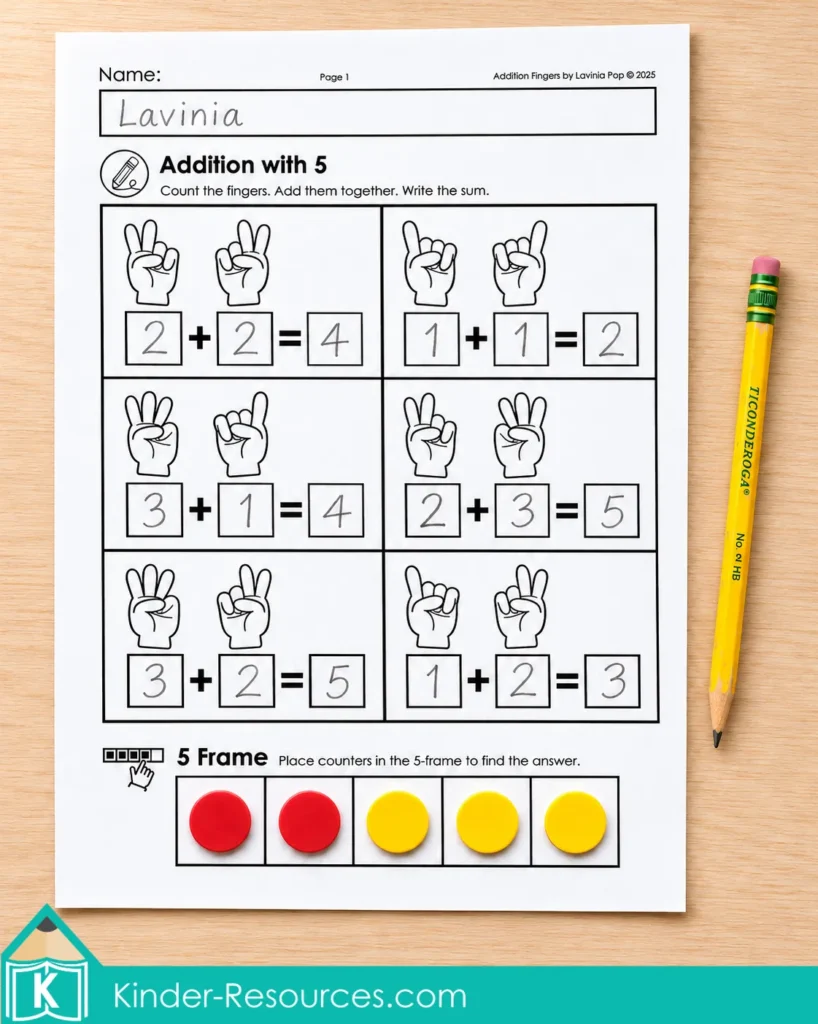
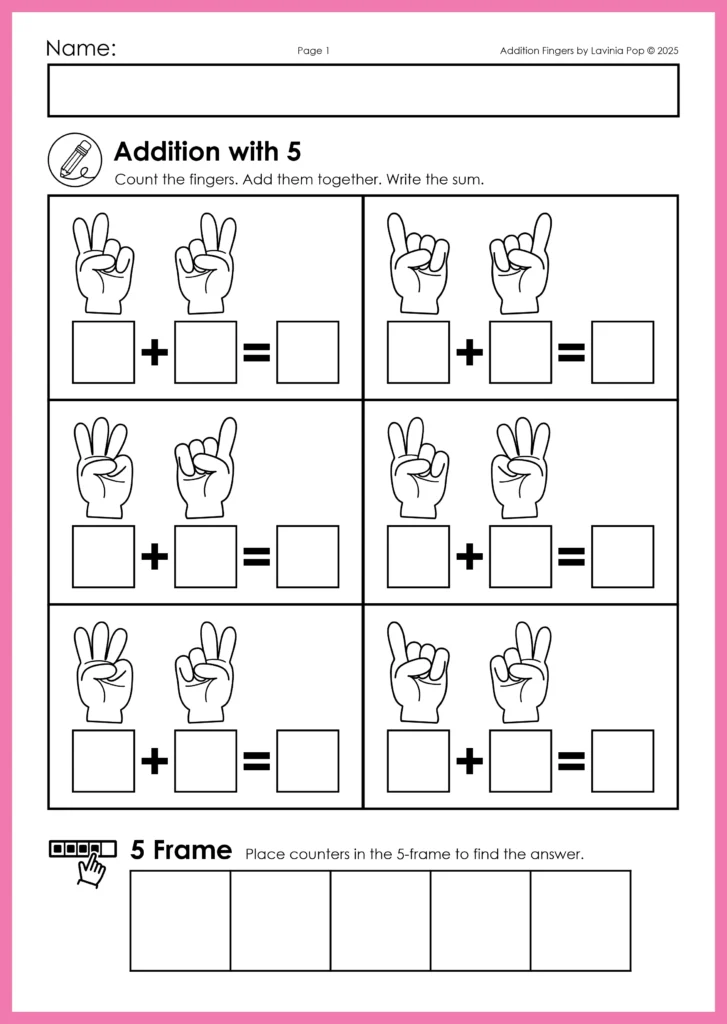
The worksheets begin with addition within 5 and build up to addition within 10. Children count the fingers in each picture, write a number sentence, and use the five frame or ten frame at the bottom of the page to check their thinking. There are also missing addend pages for exploring a different question. “I have four, but I need five. How many more do I need?” All you need to get started is a pencil and a few counters in two colors.
Start with five fingers
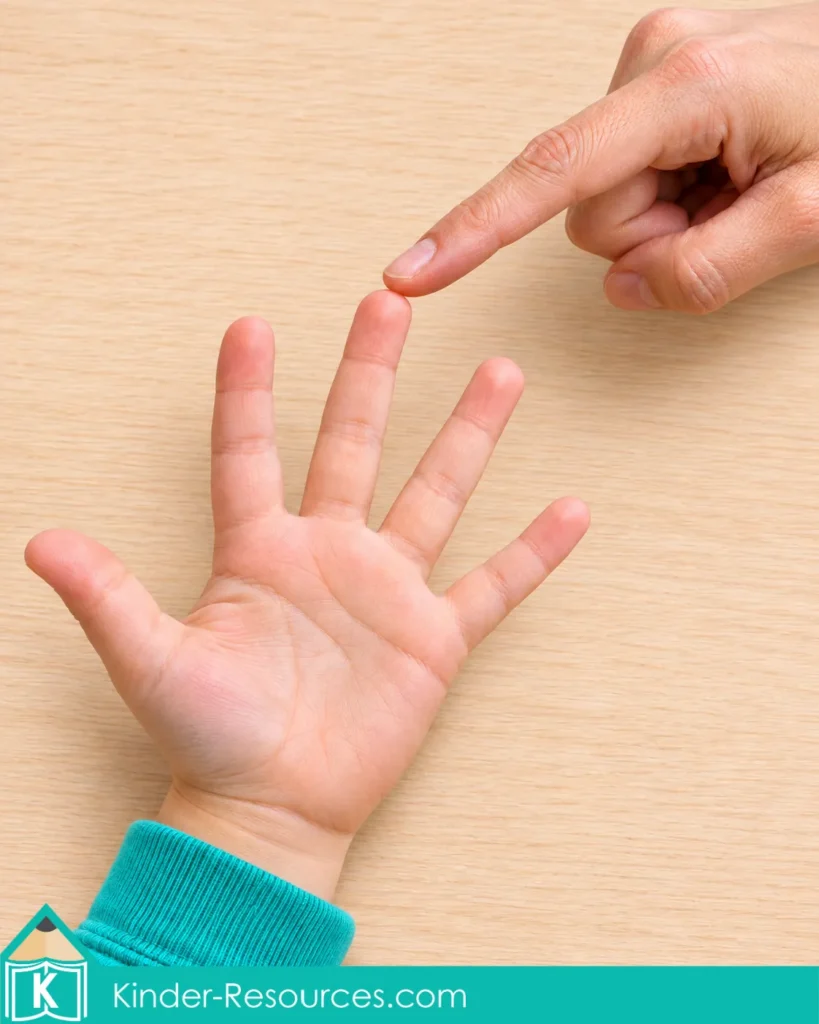
Before picking up a pencil, invite your child to hold up one open hand. Point to each finger as you count to five together. Then ask, “Can you show me five using both hands?”
Give your child a moment to try. They might hold up two fingers on one hand and three on the other. Can they find another way? Four fingers on one hand and one on the other still make five!
Next, look for the problem on the worksheet that shows two fingers and three fingers. Invite your child to copy the pictures with their own hands. Then place two red counters and three yellow counters on the five frame. Your child can point to each group as they read the number sentence aloud and write 2 + 3 = 5.
Finger Counting Worksheets for Missing Addends Within 5
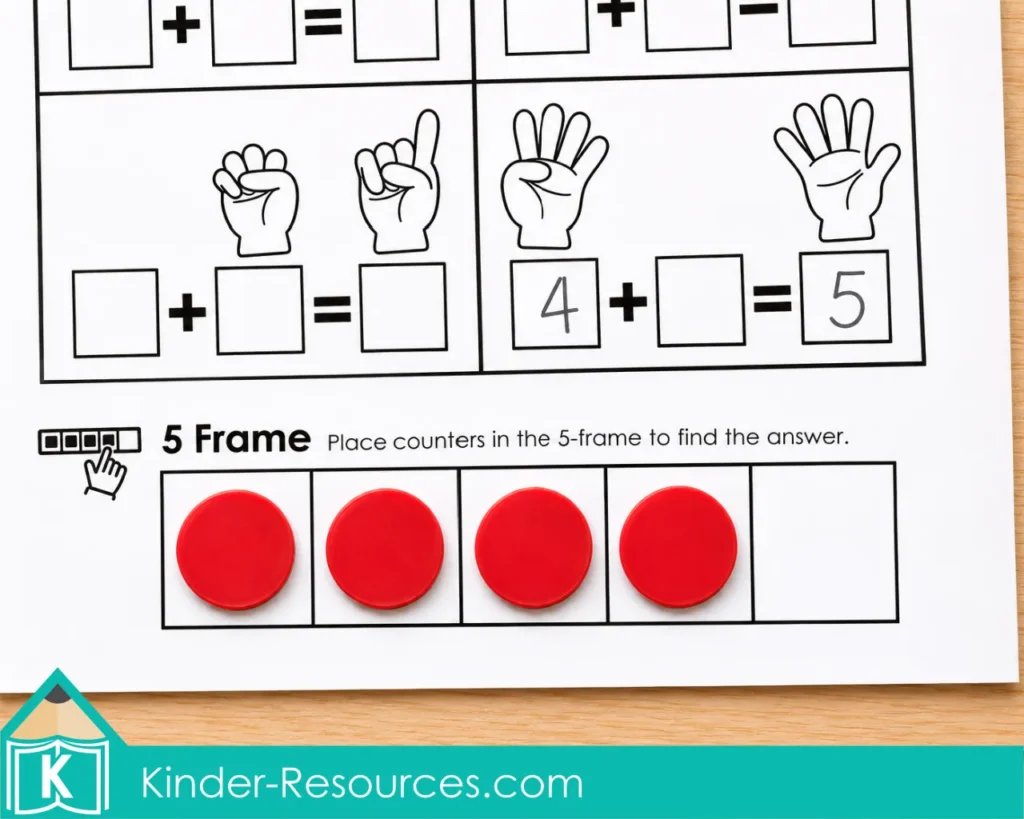
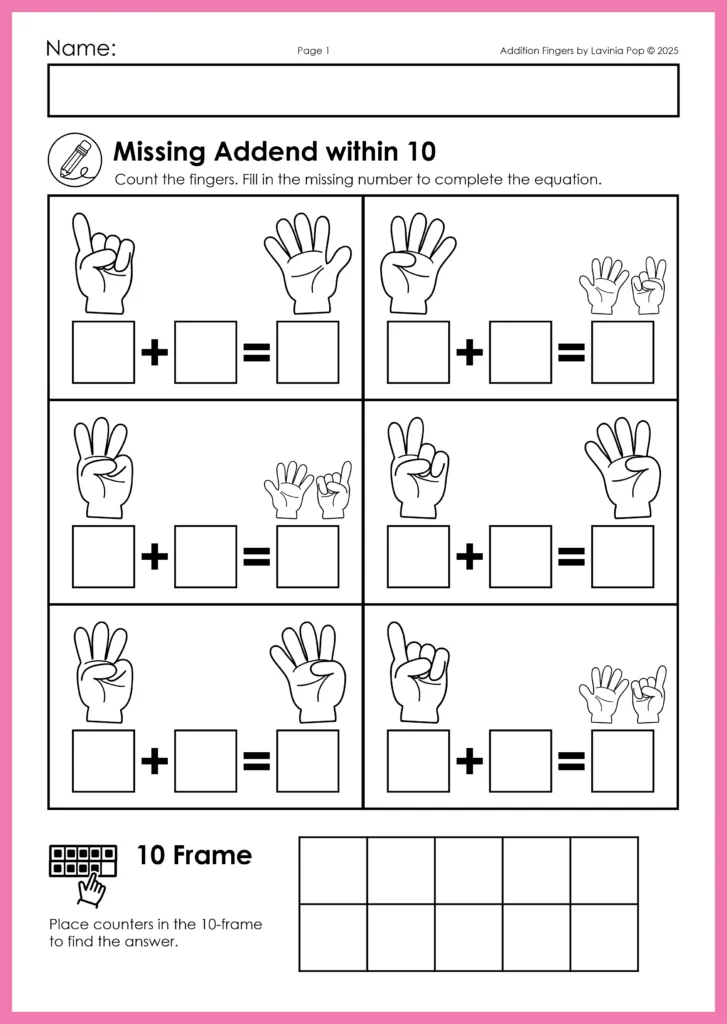
Once your child has practiced adding two groups, try a missing addend page. Look for the problem that shows four fingers at the beginning and five fingers at the end. Help your child write 4 and 5 in the matching boxes, leaving the middle box empty.
Place four red counters on the five frame, starting on the left. Ask, “How many more do you need to make five?” Before giving the answer, let your child look at the frame and point to the empty space.
Now invite them to fill that space with one yellow counter. Ask, “Which number belongs in the empty box?” Your child can write 1 and read the completed number sentence aloud. “Four plus one equals five!”
Counting On With Kindergarten Addition Worksheets
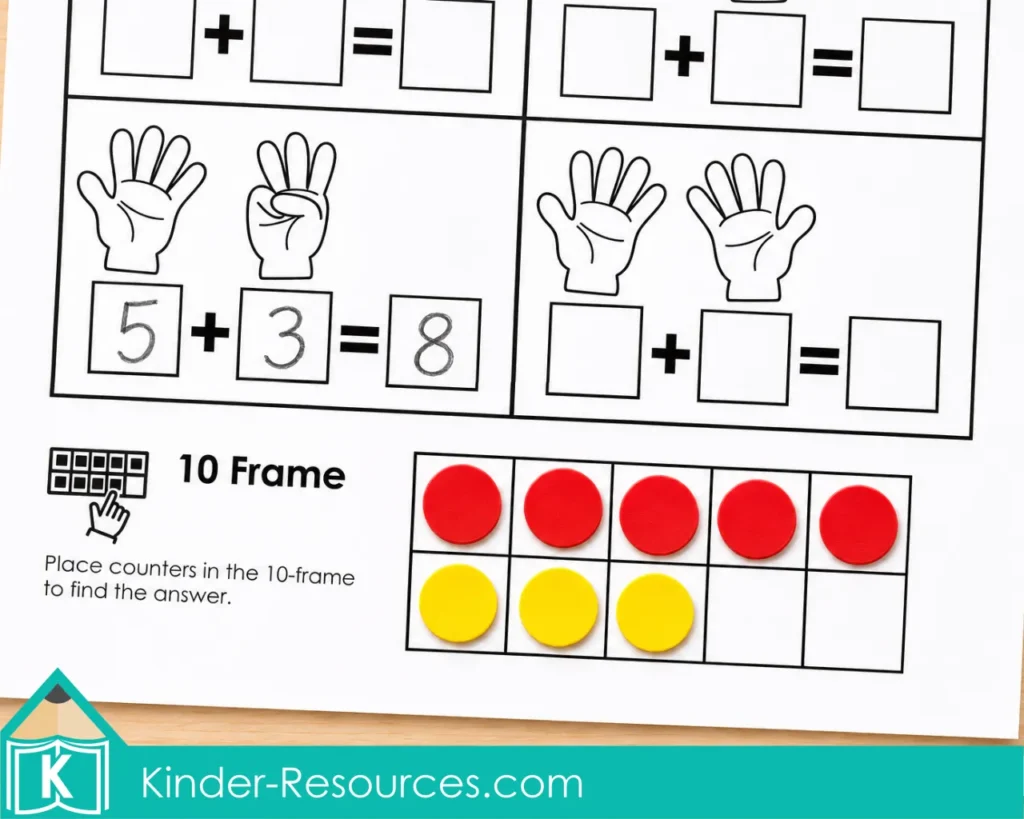
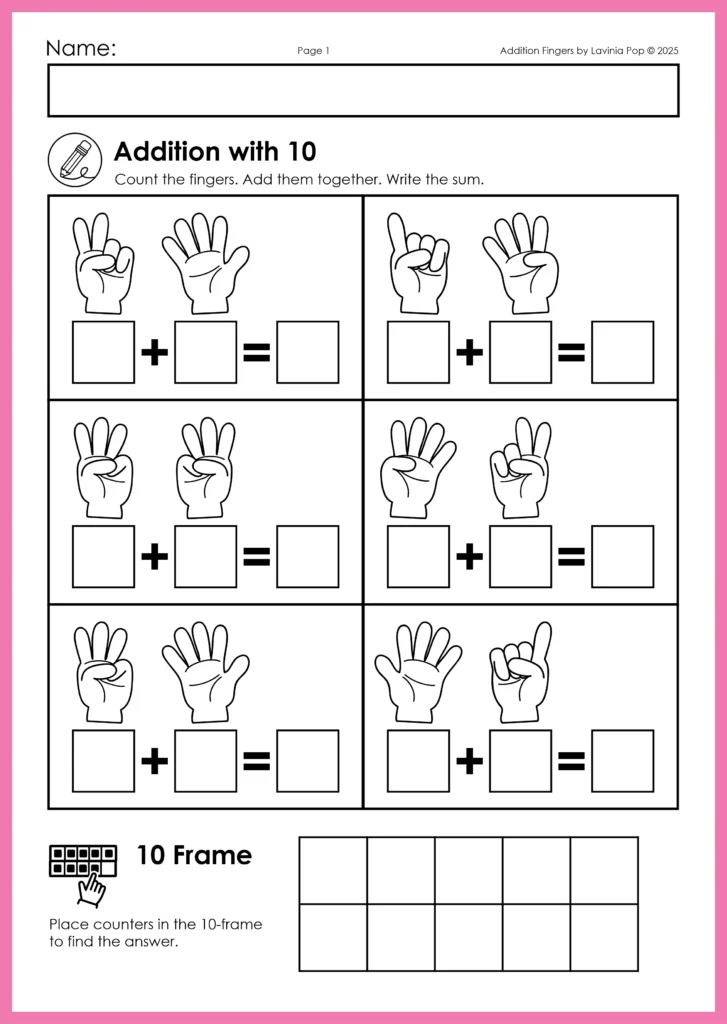
When your child is ready to add beyond five, look for the problem that shows one open hand and three raised fingers. Fill the top row of the ten frame with five red counters. Then place three yellow counters along the bottom row, starting on the left.
If your child recognizes the full row as five, try counting on. Point to the red row and say “five.” Then touch each yellow counter as you say “six, seven, eight.” Your child can write 5 + 3 = 8 beneath the finger pictures.
Find a missing addend within 10
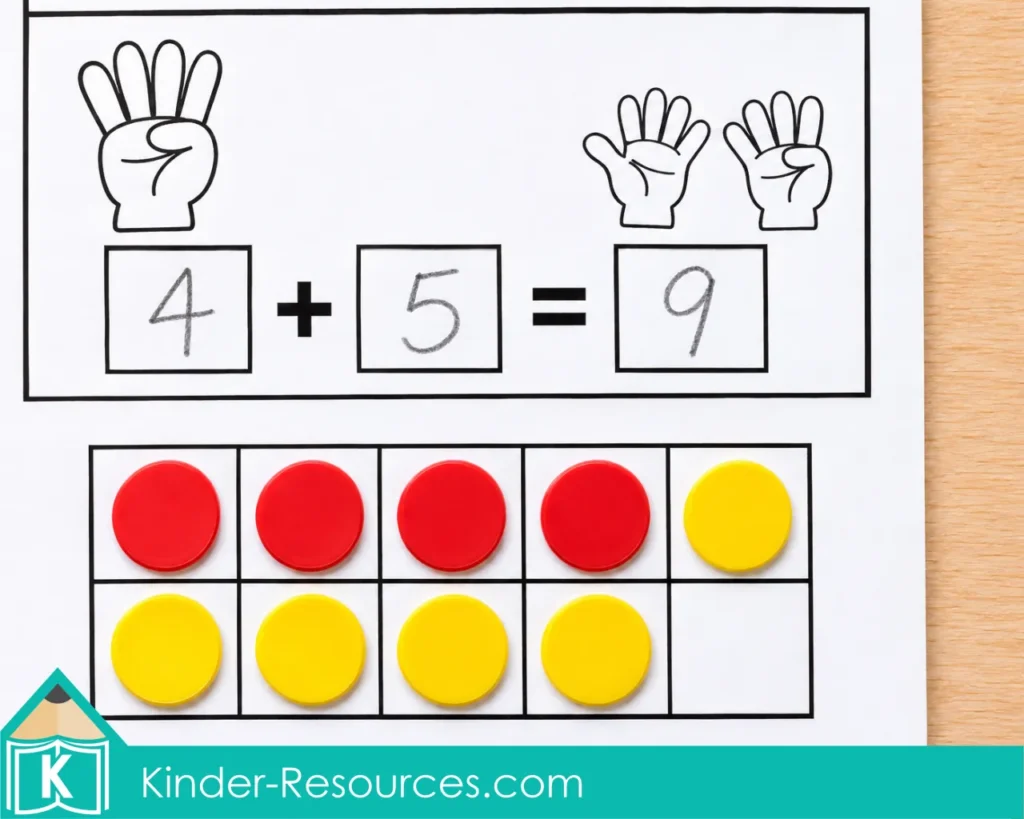
A missing addend is the part you need to add to reach a given total. In this example, the finger pictures show four at the start and nine at the end. Place four red counters on the ten frame and ask, “How many more will get you to nine?”
Invite your child to add yellow counters one at a time, counting aloud until there are nine altogether. Then ask, “How many yellow counters did you add?” Counting just the yellow counters helps your child find the missing part. They added five, so 5 belongs in the middle box. The completed number sentence is 4 + 5 = 9.
There’s still one empty space on the ten frame. If your child notices it, ask, “Why did you stop there?” It’s a chance for them to explain in their own words that they were making nine.
Download FREE Finger Addition Worksheets for Kindergarten
Print the free sample and grab a few counters in two colors. Try the first problem together. Invite your child to count the fingers in the picture, use the frame to work out the answer, and write the numbers in the boxes.

Get the Finger Addition Worksheets for Kindergarten
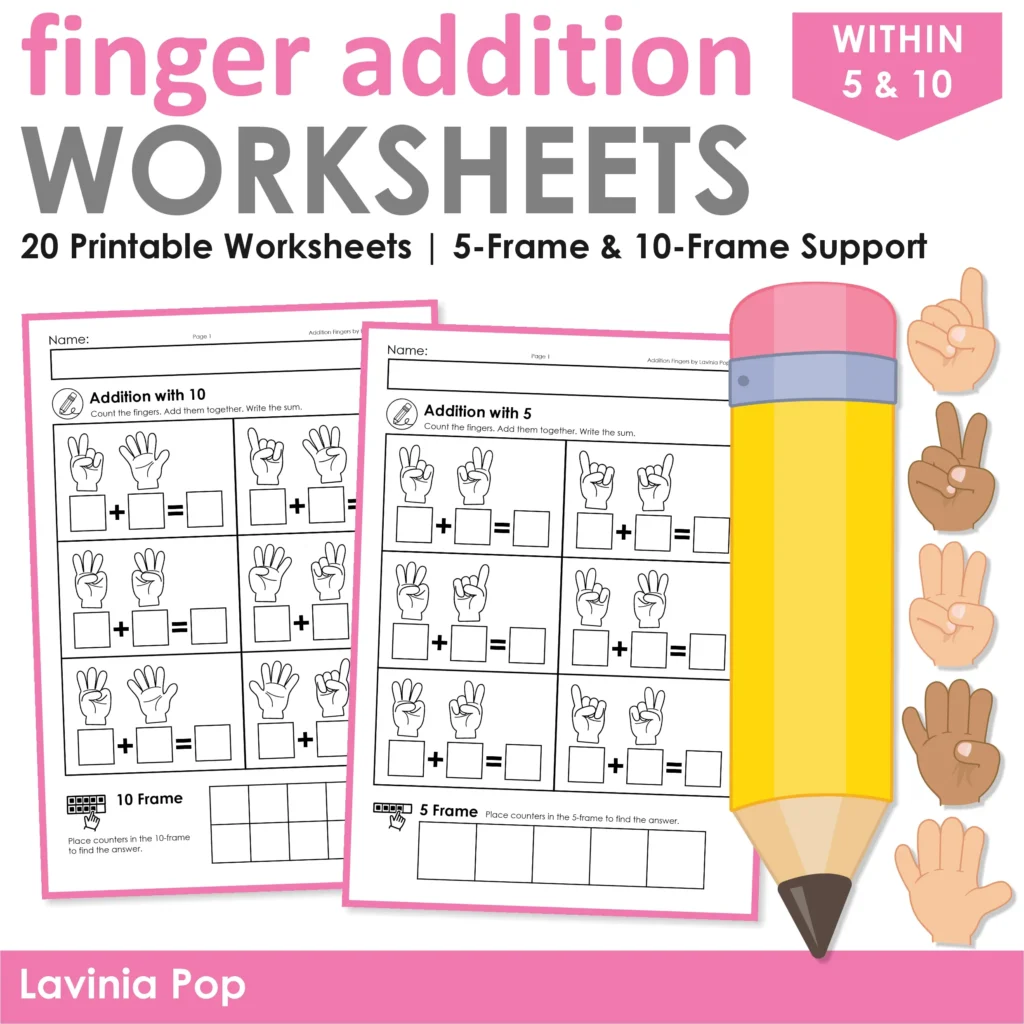
The printable pack includes 20 worksheets, with five pages for each skill:
- Addition within 5
- Missing addends within 5
- Addition within 10
- Missing addends within 10
Choose one page for a small group lesson, set it out with counters at a math center, or use it for extra practice at home. Each page has its own frame, so children can clear the counters and use them again for the next problem. If you don’t have counters handy, small circles cut from red and yellow paper work, too.

Happy Teaching! 😊
You Might Also Like