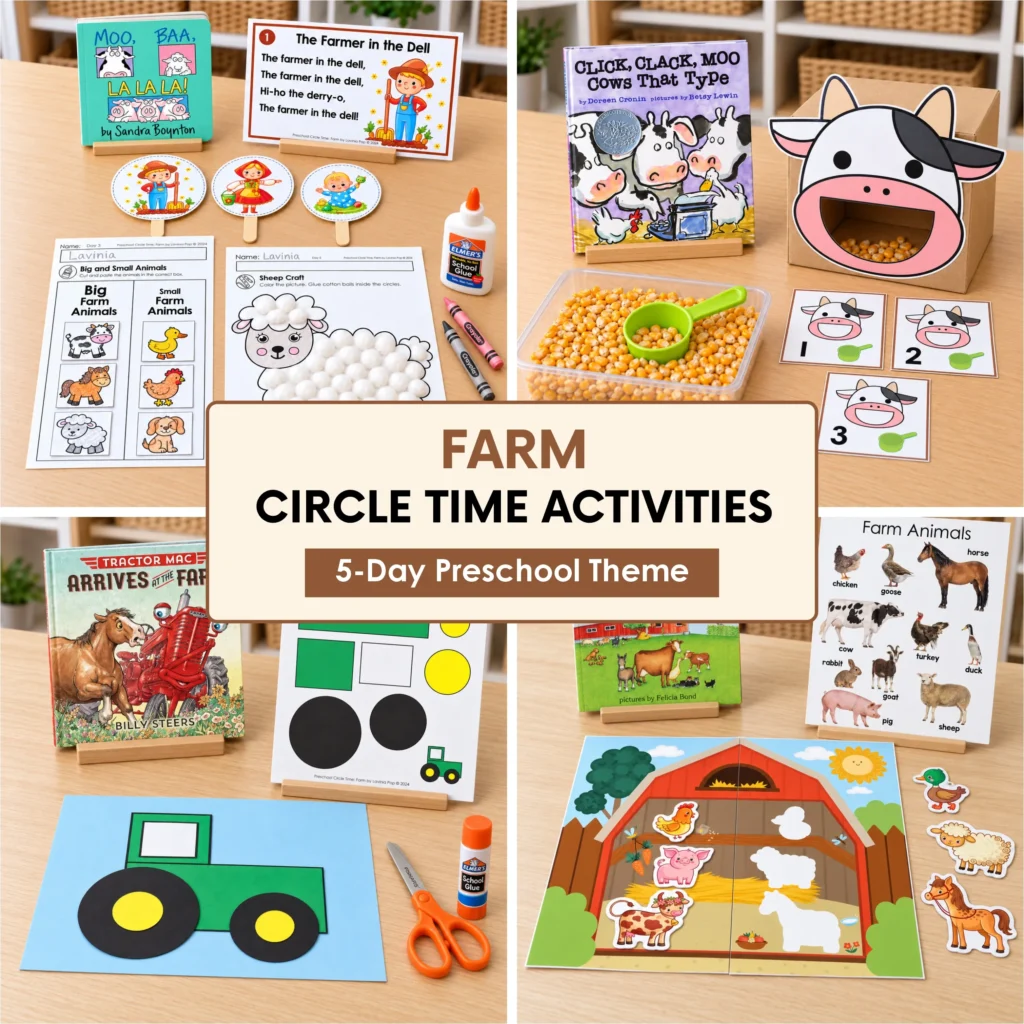
These farm circle time activities for preschool bring animal sounds, familiar songs, picture books, and hands-on learning into one five-day theme. Children match farm animals, learn the names of their babies, act out animal movements, build a tractor, and practice counting as they pretend to feed the animals.
My Farm Preschool Circle Time resource includes daily lesson plans, song posters and props, classroom posters, games, crafts, and follow-up worksheets. Use the complete sequence for a week of farm learning, or choose activities to add to your preschool, pre-K, kindergarten, or homeschool plans.
Download the Free Farm Circle Time Sample
Would you like to try the first day’s activities? The free Farm Circle Time sample includes the Day 1 lesson plan, “Old MacDonald Had a Farm” song posters and animal props, a Farm Animals poster, the barn matching game, and the pre-writing and shadow matching worksheets. It also gives you a look at the rest of the week’s materials.

A Week of Farm Circle Time Activities for Preschool
The five daily topics build on one another as children explore farm life:
| Day | Focus | Main activity |
|---|---|---|
| Day 1 | Introduction to the farm | Match farm animals to the barn |
| Day 2 | Farm animals and their babies | Match parent and baby animal cards |
| Day 3 | Animal sounds and movements | Play animal sound charades |
| Day 4 | Machines and tools on the farm | Make a tractor from paper shapes |
| Day 5 | Caring for animals | Count scoops in a pretend animal feeding activity |
Each day includes an introduction, a song, a suggested read-aloud with discussion prompts, and a main activity. Keep the group gathering focused on conversation, singing, movement, and a shared game or story. Offer the crafts and worksheets during small groups, centers, or table time, choosing the pages that suit your children.
Preparing Farm Circle Time Activities for Preschool
Gather the books and organize the printables by day before you begin. Print the reusable posters, matching cards, and puppets on cardstock. The barn game can be laminated and prepared with hook-and-loop dots so children can attach and remove the animals.
Attach song props to craft sticks and keep each set together in a cup or small container. For the follow-up activities, gather crayons, pencils, scissors, glue, colored paper, and cotton balls. Prepare the animal feeding box, tray, and scoop for Day 5.
You can start with a few matching cards or one song verse and add more as children become familiar with the materials. Books and classroom supplies are gathered separately from the printable pack.
Day 1: Introduction to the Farm
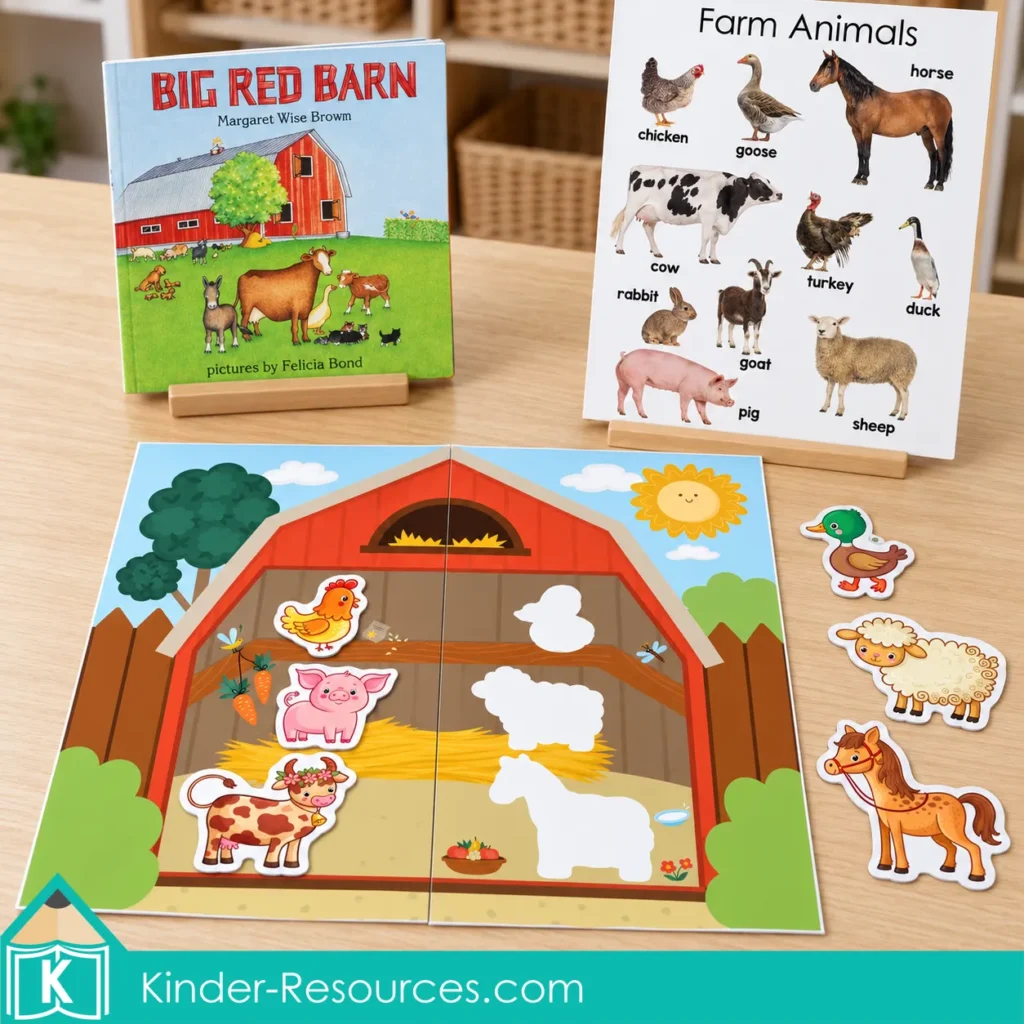
Begin by asking children which animals they might find on a farm. Use the Farm Animals photo poster to name familiar animals and introduce any that are new to the group. Invite children to notice features such as feathers, hooves, ears, and tails.
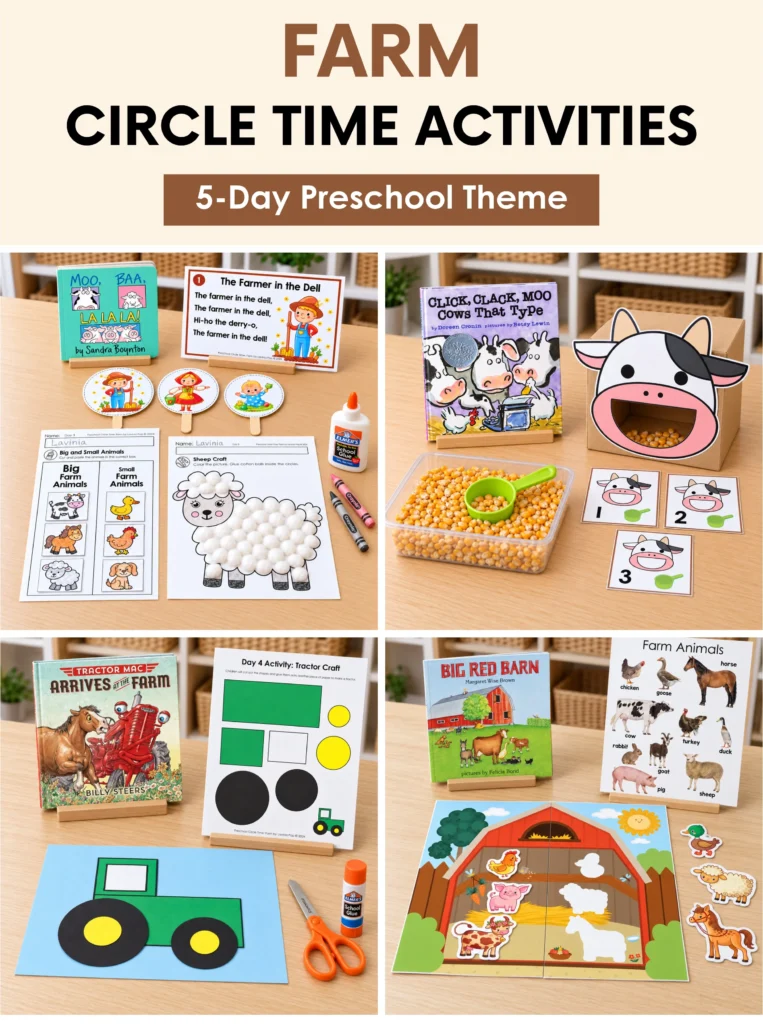
Read Big Red Barn by Margaret Wise Brown. Before reading, look at the cover and predict which animals might live near the barn. Afterward, invite children to name an animal they remember and describe something it did.
Farm Animal Matching Game
Bring out the barn mat and animal pieces. Model how to look closely at an animal’s outline, then invite children to take turns finding the matching space.
Ask questions such as, “Which animal has a long neck?” or “What do you notice about this tail?” Children can name their animal and make its sound before placing it in the barn. Start with two or three pieces when a smaller choice is helpful.
Old MacDonald Song and Puppets
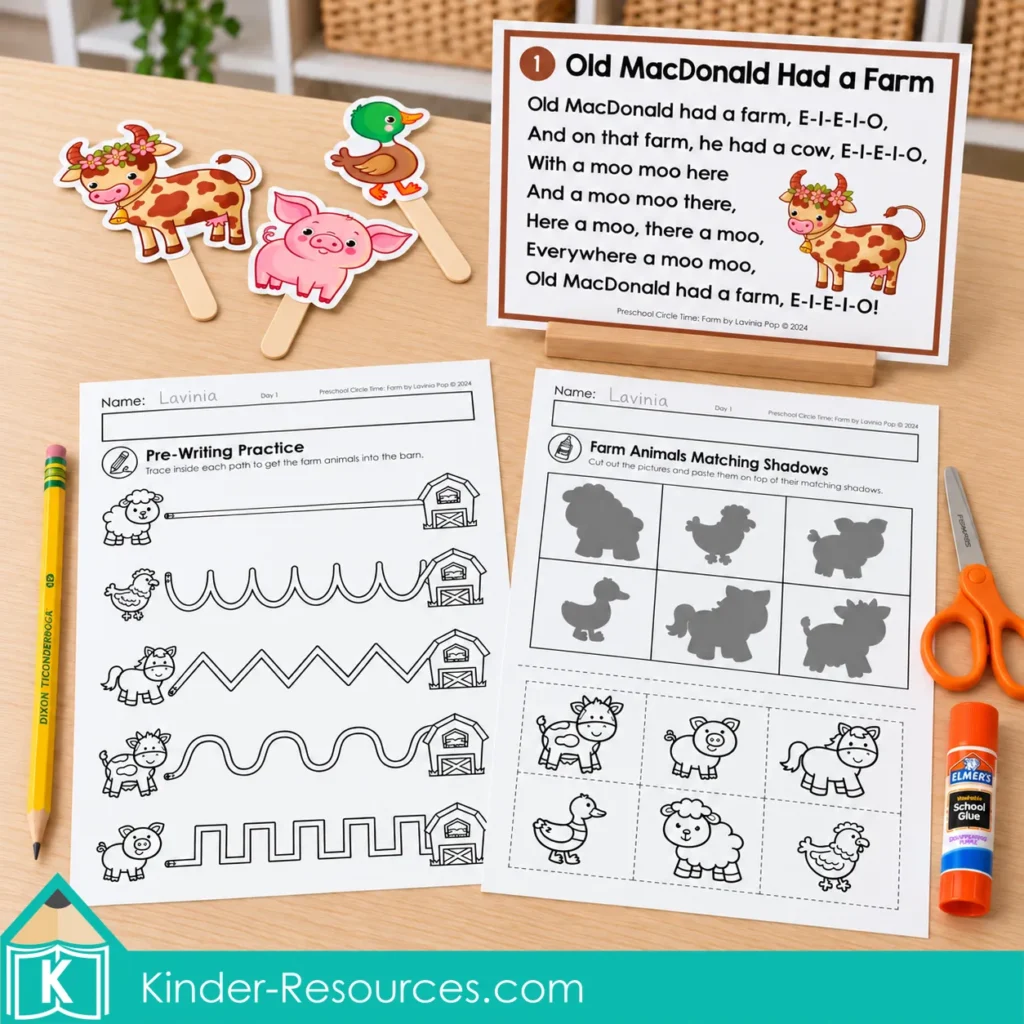
Sing “Old MacDonald Had a Farm” with the printable animal puppets. Children can hold up the matching puppet when its animal appears in the song and join in with the sound.
Pause before introducing the next animal so children can identify the prop. Revisit the same verse when the group wants another turn, or invite a child to choose the next puppet.
Farm Shadow Matching and Pre-Writing
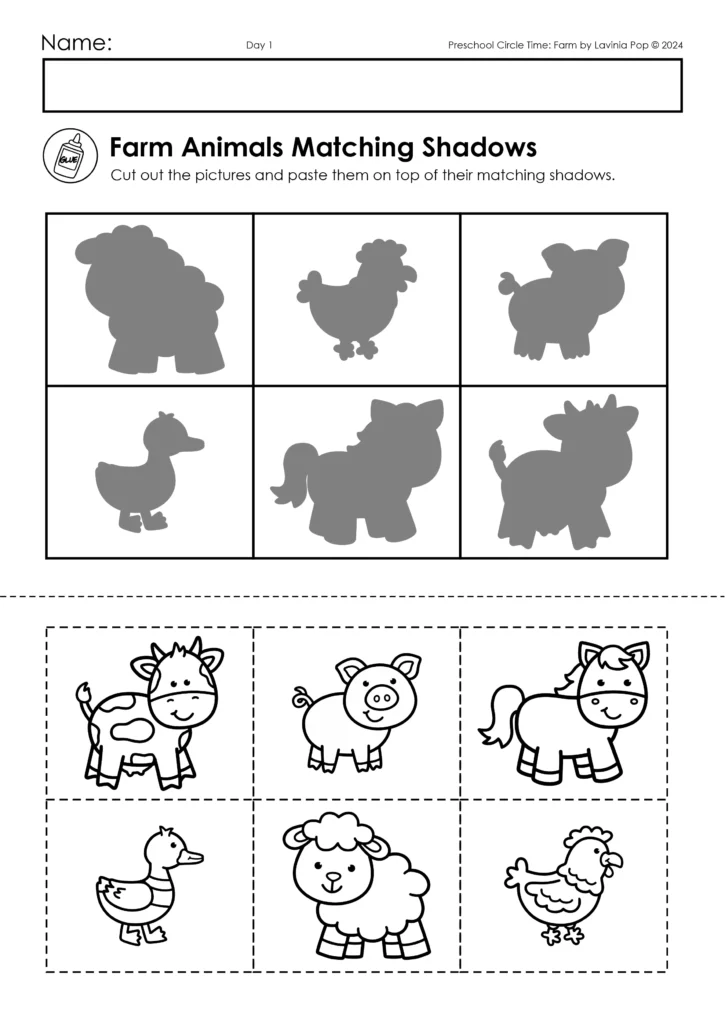
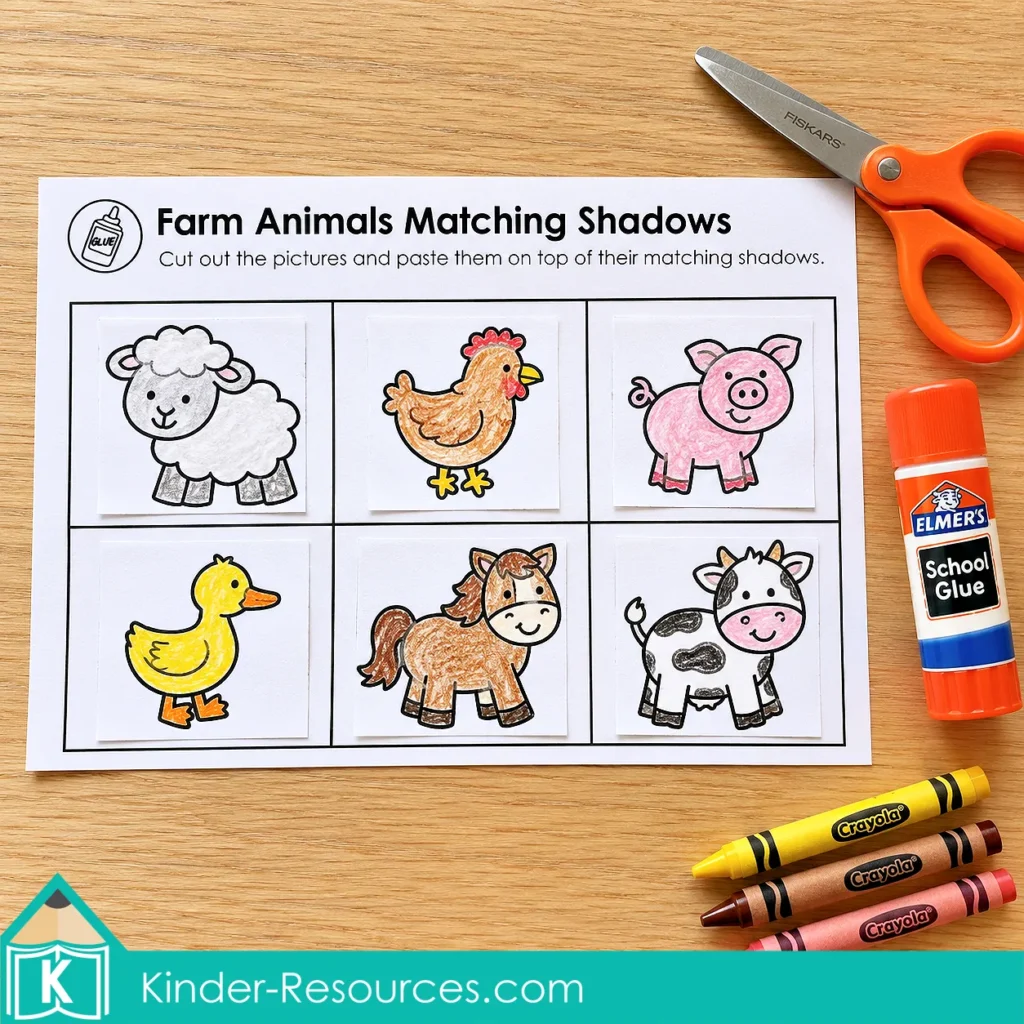
The shadow matching worksheet gives children a paper version of the matching task. They color and cut out the animals, arrange them over the corresponding shadows, and glue them in place. Encourage children to check their choices before adding glue.
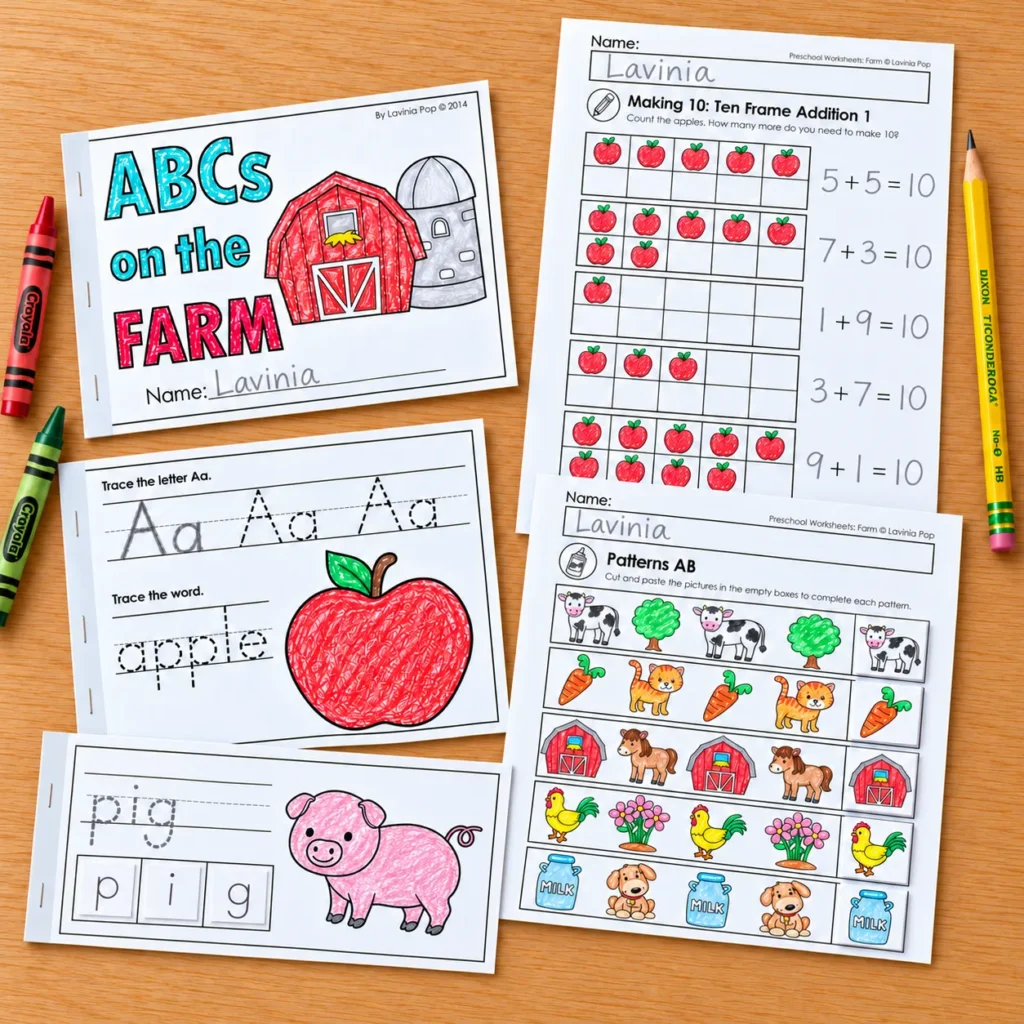
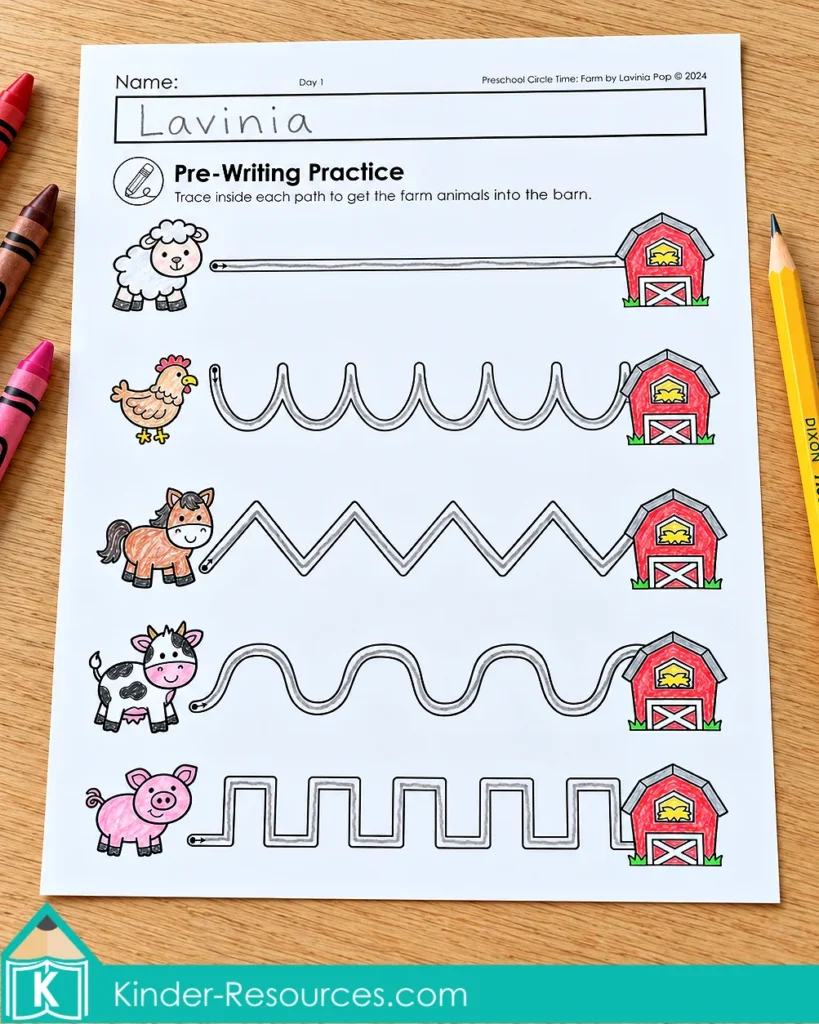
The pre-writing page has five different paths leading from farm animals to barns. Children can follow a path with a finger before tracing inside it with a pencil or crayon. Offer one or two paths at a time when a shorter task is more appropriate.
Day 2: Farm Animals and Their Babies
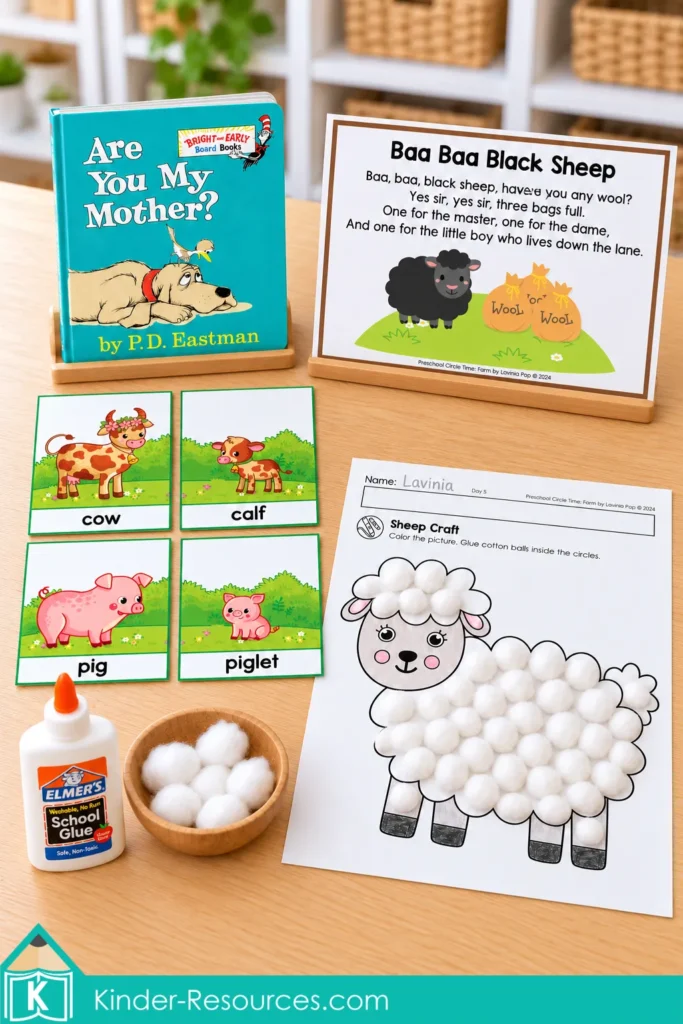
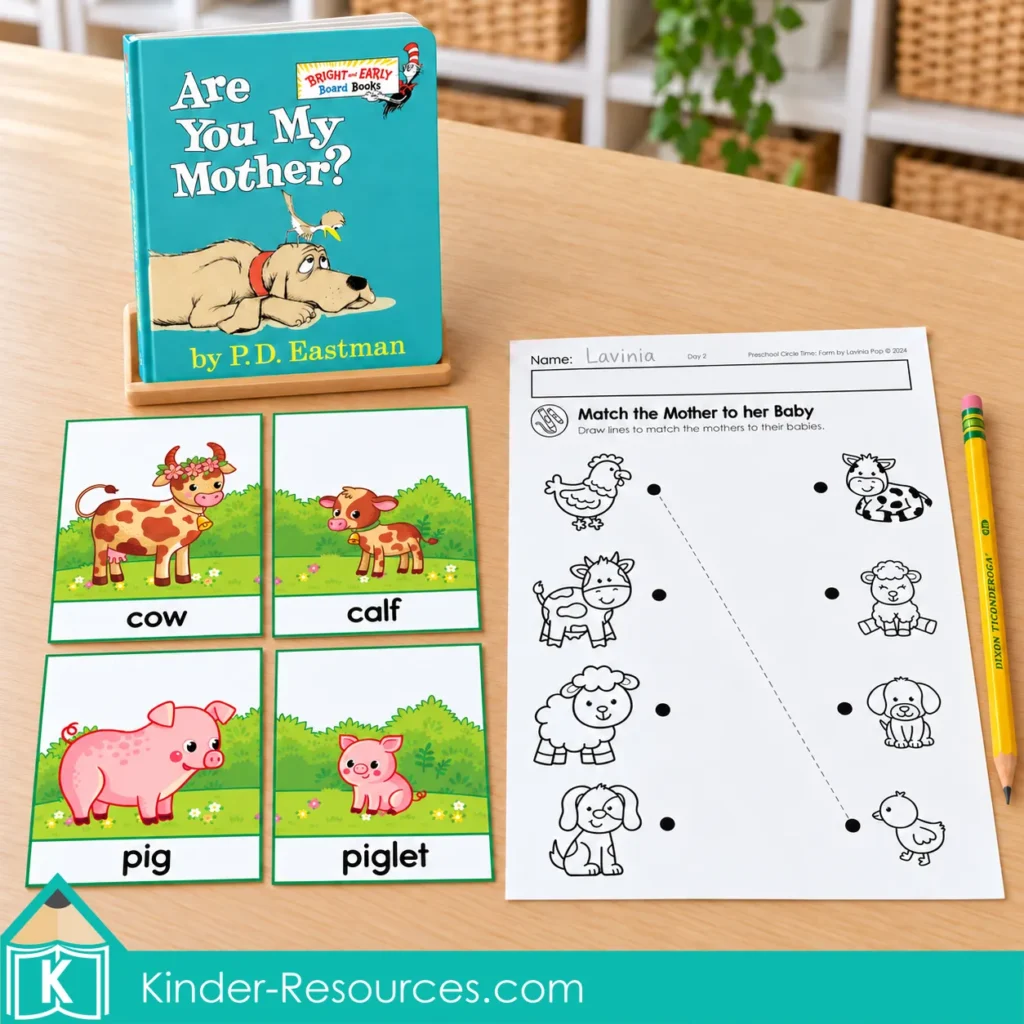
These farm circle time activities for preschool help children learn the names of animal parents and their babies. Read Are You My Mother? by P. D. Eastman to introduce the topic. Ask how the baby bird felt while searching and what changed when it found its mother.
Farm Animal Matching Activities for Preschool
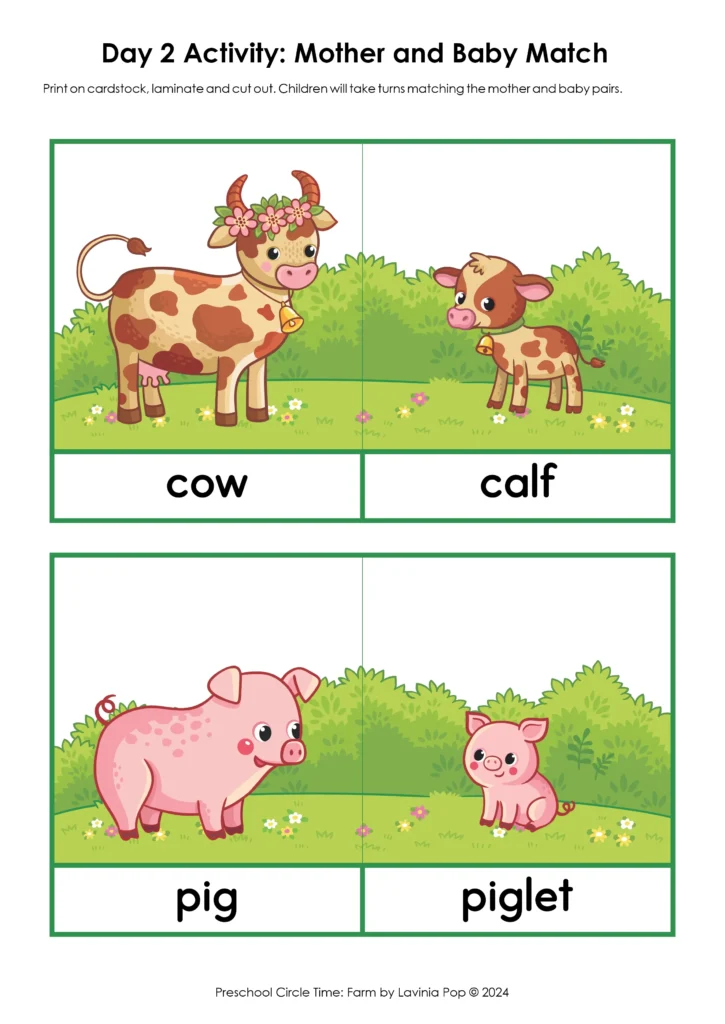
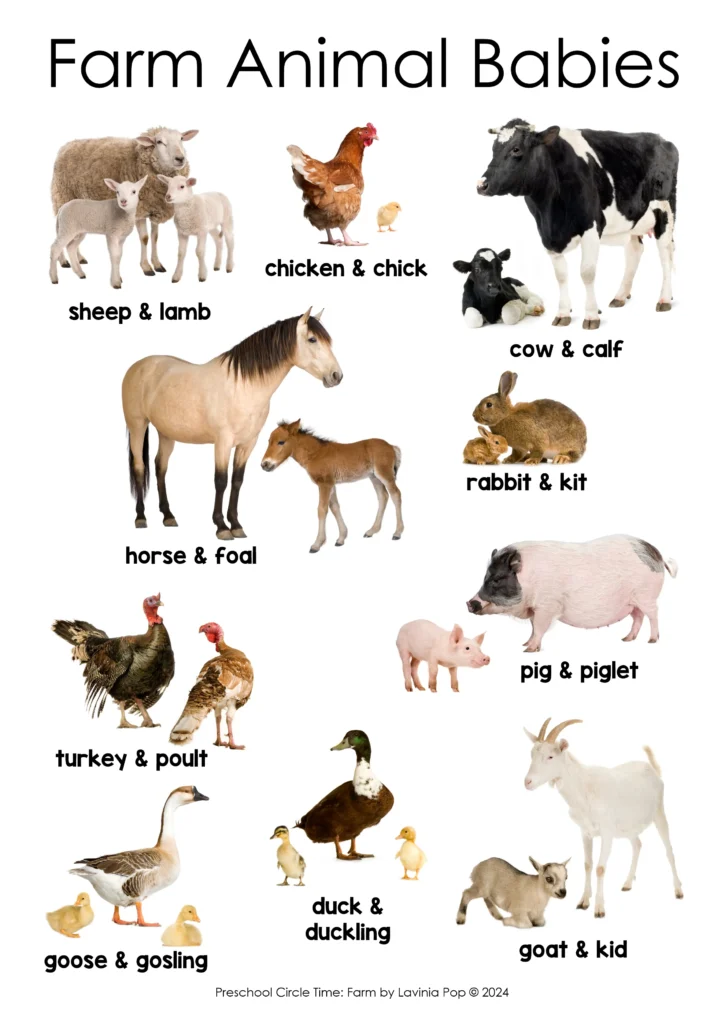
Show a few pairs of animal cards and name them together: cow and calf, pig and piglet, sheep and lamb. Place the parent cards in front of the children, then invite them to find the matching babies.
Model a short sentence such as, “A baby cow is called a calf.” Children can point to a pair, repeat its names, or use the sentence themselves. Add more pairs when they are ready.
The matching worksheet extends the activity with lines connecting mothers to their babies. Name the pictures together before children begin drawing.
Baa Baa Black Sheep and a Farm Maze
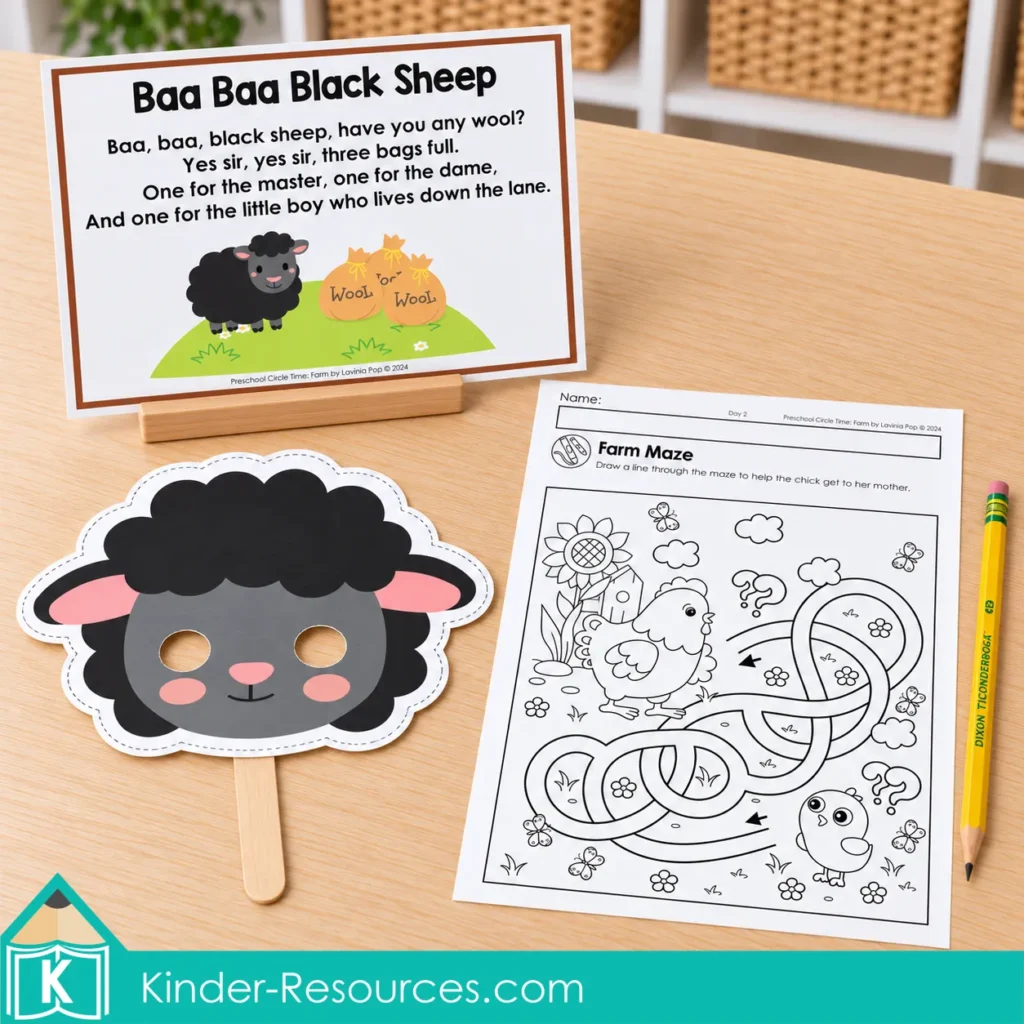
Sing “Baa Baa Black Sheep” with the sheep prop or mask. Children can make a gentle “baa” sound and pretend to carry the bags of wool. Revisit the words sheep and lamb as you connect the song to the day’s animal pairs.
For a table activity, the Farm Maze invites children to help a chick reach its mother. Let children explore the route with a finger first, then draw a line through the maze. Talking through the route gives them practice using words such as around, past, and toward.
Day 3 — Farm Circle Time Songs, Sounds, and Movements
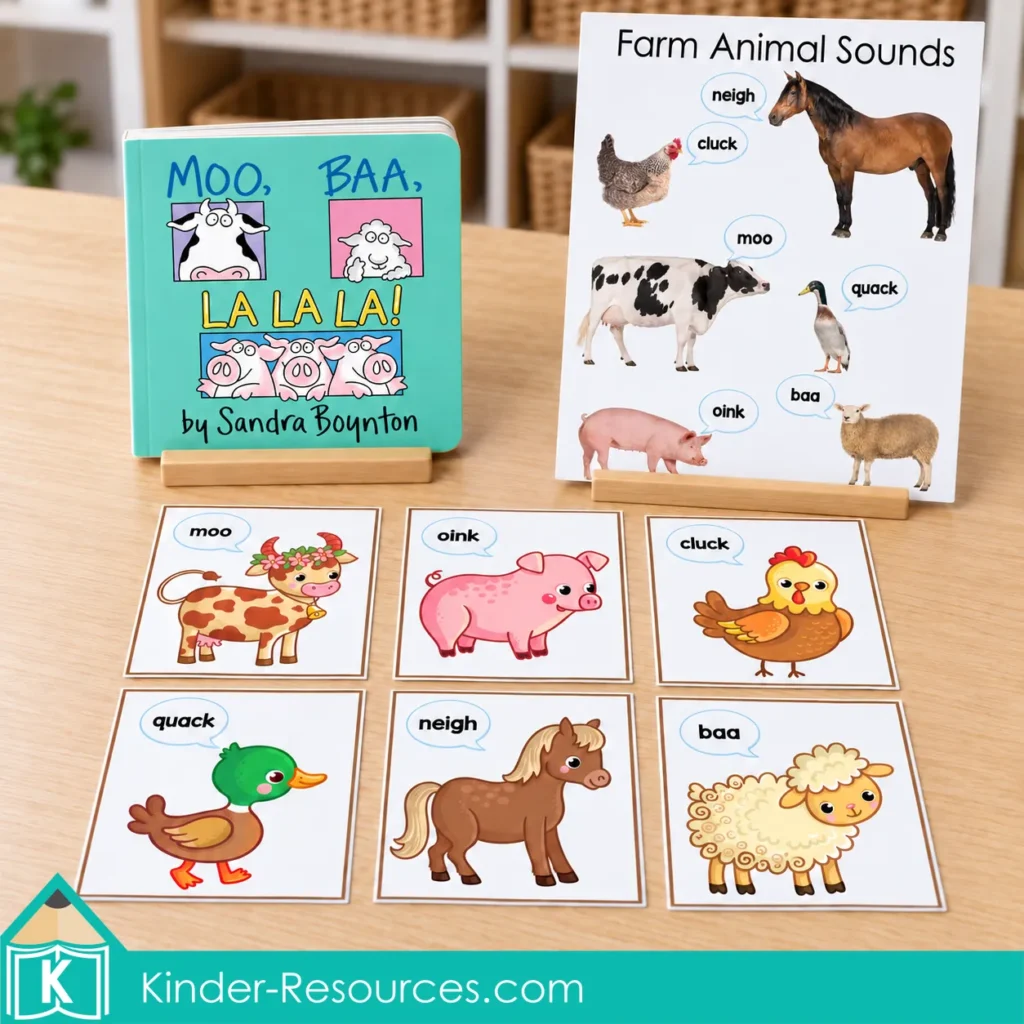
Begin with Moo, Baa, La La La! by Sandra Boynton. Invite children to join in with the familiar animal sounds and notice the silly surprises in the story.
Use the Farm Animal Sounds poster and picture cards to connect each animal with its sound. Point to an animal, pause, and give children time to respond by making the sound, naming the animal, or choosing its card.
Animal Sound Charades
Choose a card and model an animal’s sound or movement. Children might waddle like a duck, gently flap like a chicken, or make a horse sound while moving in place.
Take turns choosing a card for the group to guess. Children who prefer to watch can hold a picture, point to their answer, or join in with a partner.
The Farmer in the Dell Puppets
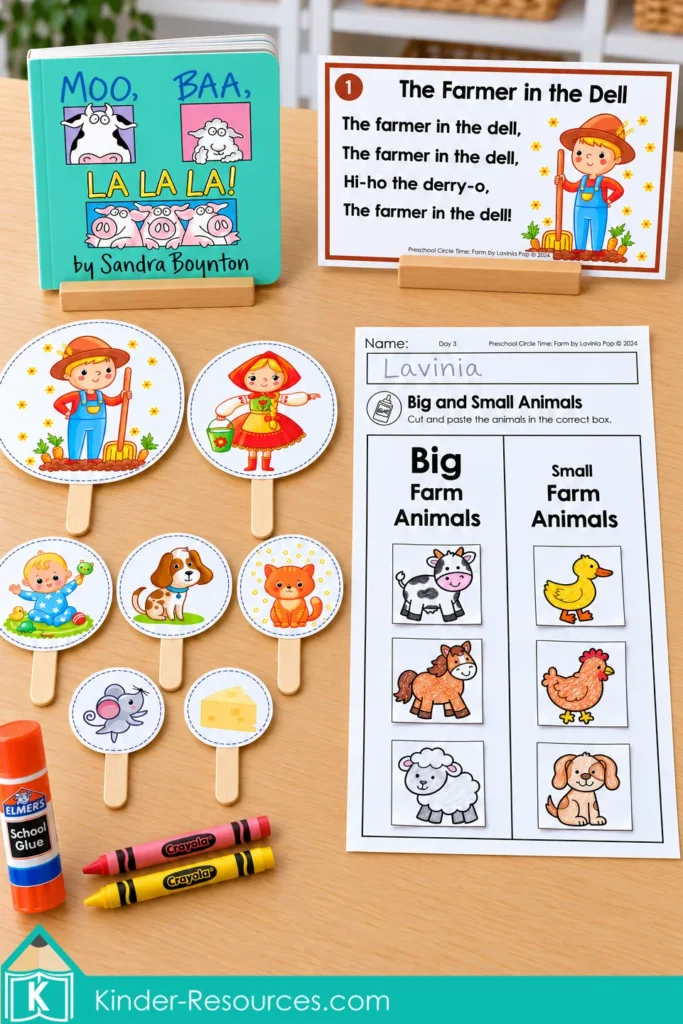
Sing “The Farmer in the Dell” using the farmer, wife, child, dog, cat, mouse, and cheese props. As each character appears, add its puppet to the sequence or invite the child holding it to join the group.
After singing, lay the puppets in order and talk about who came first and who came next. The pictures give children a way to revisit the sequence without needing to read the words.
The Big and Small Animals worksheet provides a separate sorting activity. Name the animals, discuss their relative sizes, and let children arrange the cutouts in the two columns before gluing. Use the conversation to hear how children explain their choices.
Day 4: Farm Machines and a Tractor Craft
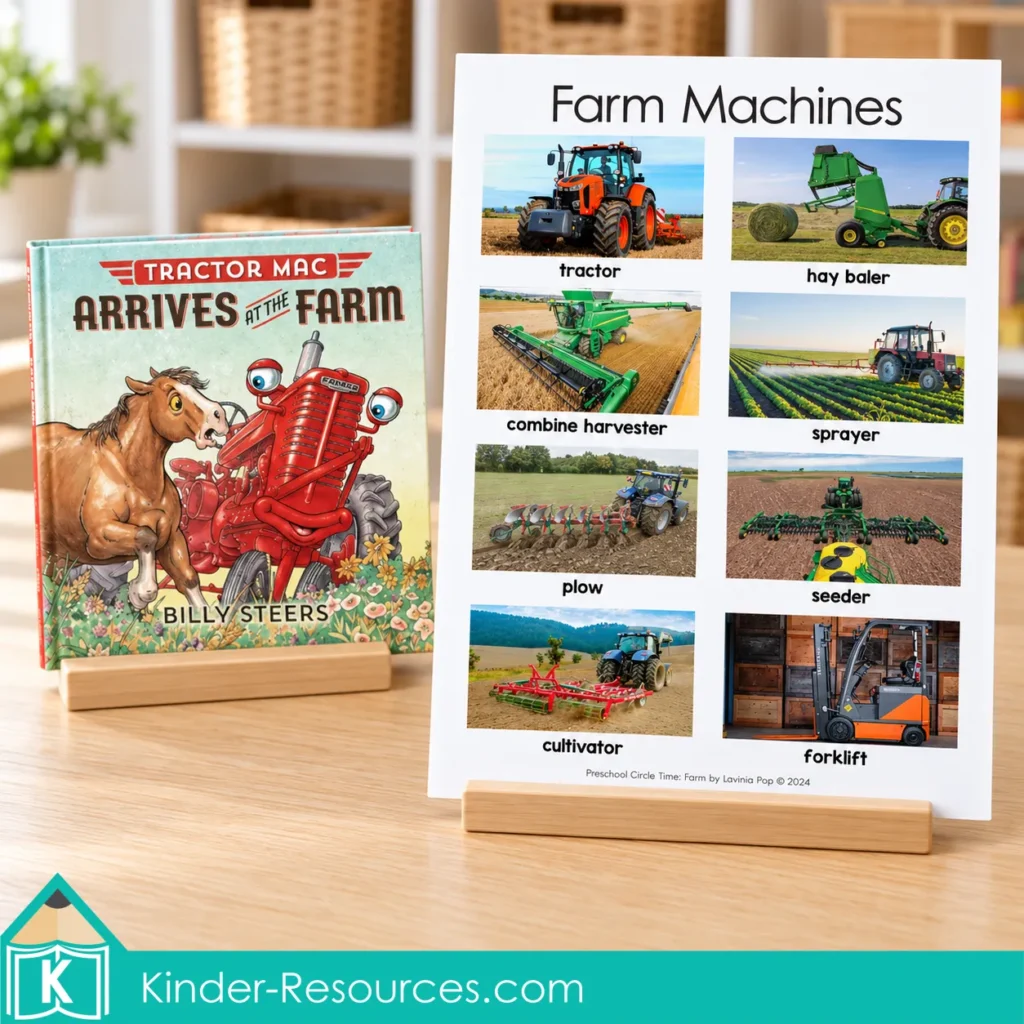
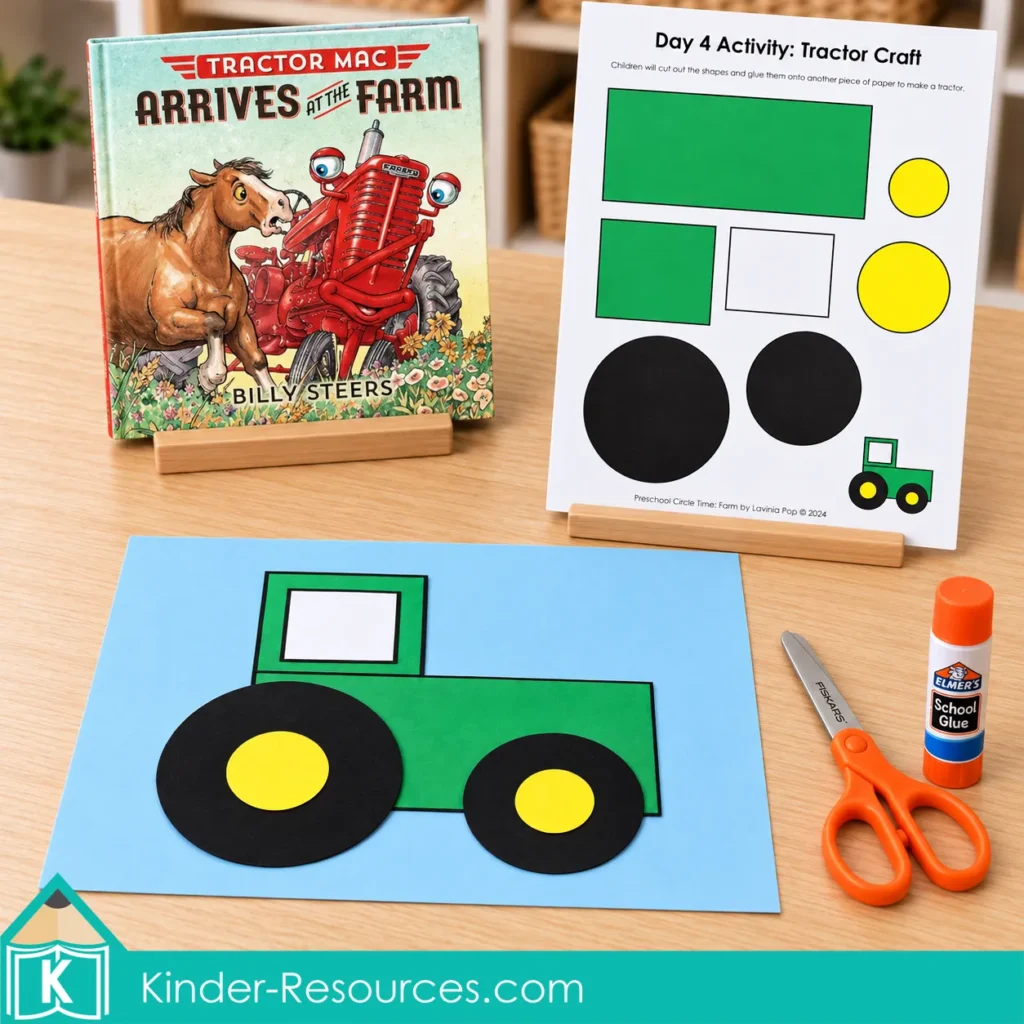
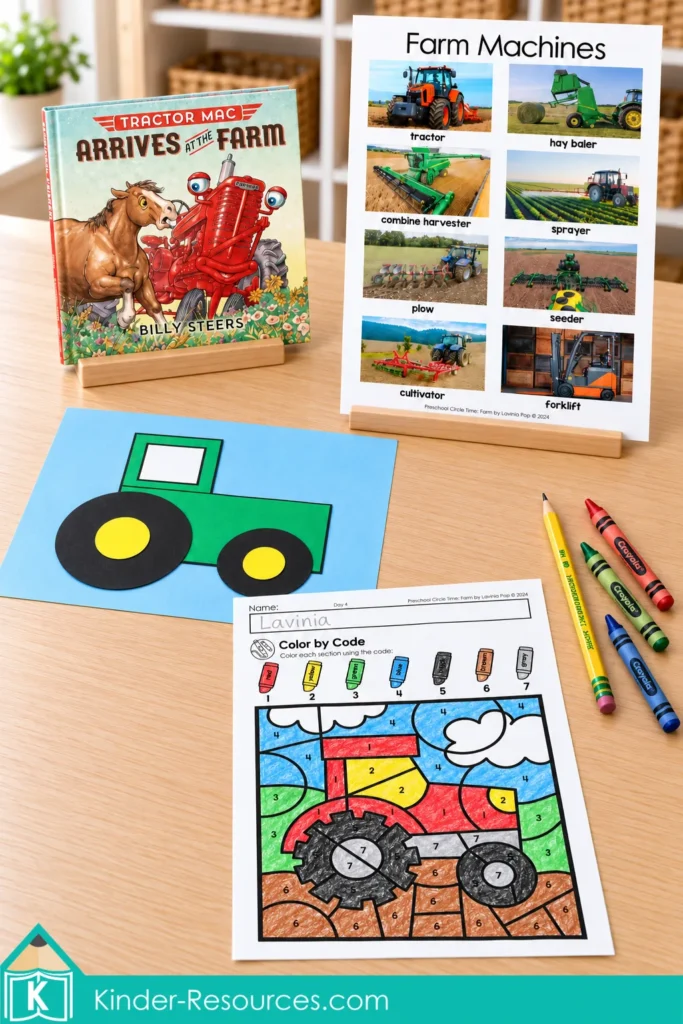
Day 4 introduces some of the equipment farmers use. Read Tractor Mac Arrives at the Farm by Billy Steers and discuss how Mac helps with farm work.
Look at the Farm Machines poster together. Start with the tractor, then choose a few other photographs to explore. Ask children what they notice about the wheels, attachments, and shapes. Introduce one new machine name at a time and explain its job in simple language.
Farm Tractor Craft for Preschool
Sing “The Wheels on the Tractor,” using rolling arm movements to represent the wheels. Then bring out the tractor craft pieces.
Children cut out and arrange the rectangles, window, wheels, and wheel centers on a backing sheet before gluing them down. Compare the large and small wheels and talk about where each piece belongs. Color and black-and-white templates give you a choice of ready-colored pieces or a version children can color themselves.
Prepare some pieces in advance for children who need help cutting. They can still make decisions about placement and practice applying glue.
Farm Counting Activities for Preschool
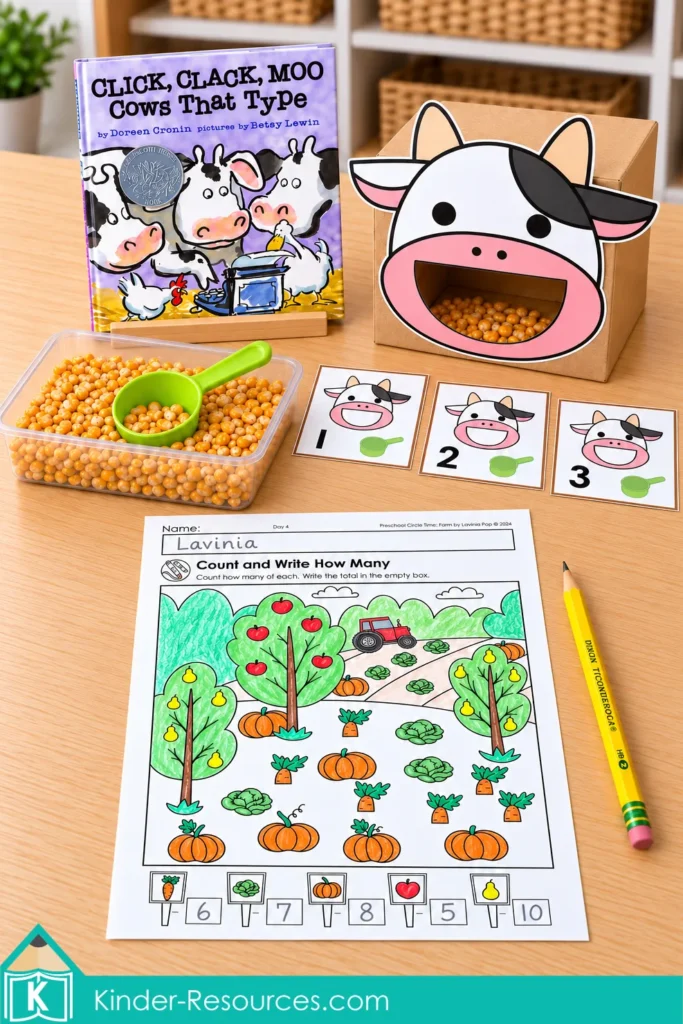
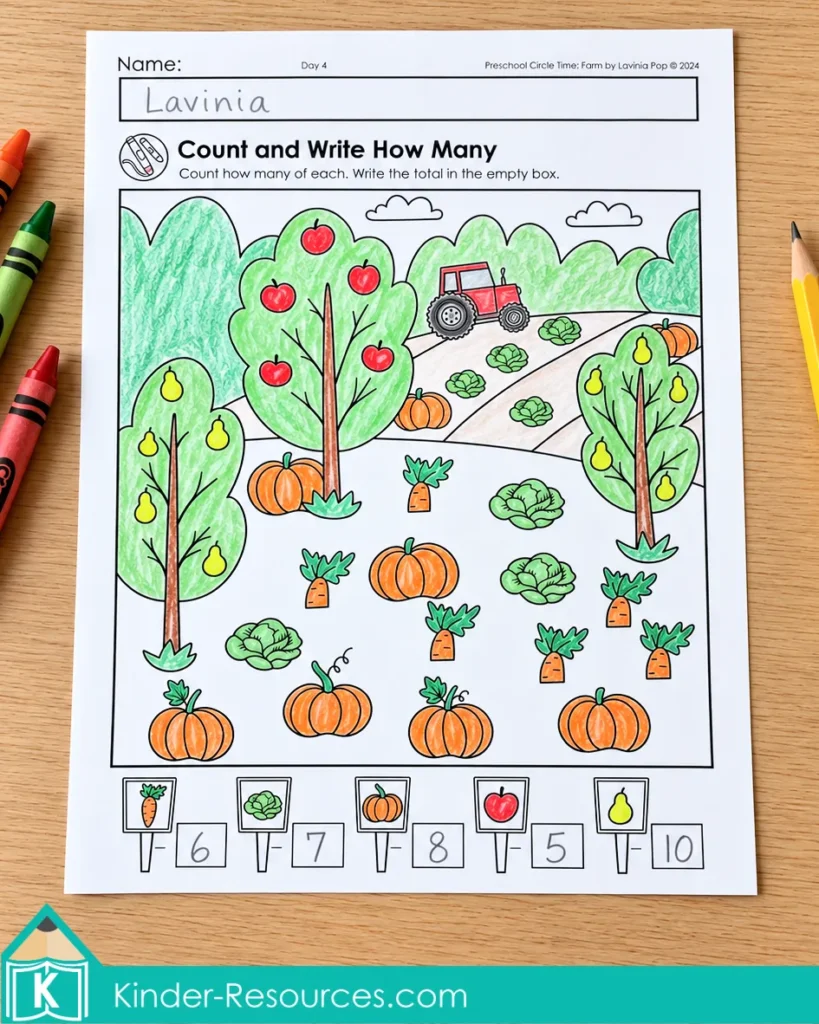
Extend your farm circle time activities for preschool with a counting task during small-group or table time. The Count and Write How Many worksheet invites children to find and count each type of fruit or vegetable in the farm scene, then record its total in the matching box.
Model counting just one type at a time. Point out that the small pictures beside the answer boxes identify what to count; they are not part of the scene’s totals. Children can point as they count and tell you the answer if writing numerals is still challenging.
Day 5: Caring for Farm Animals
Finish the week by talking about how farmers care for animals. Ask children what animals need each day, including suitable food, clean water, shelter, and care when they are unwell.
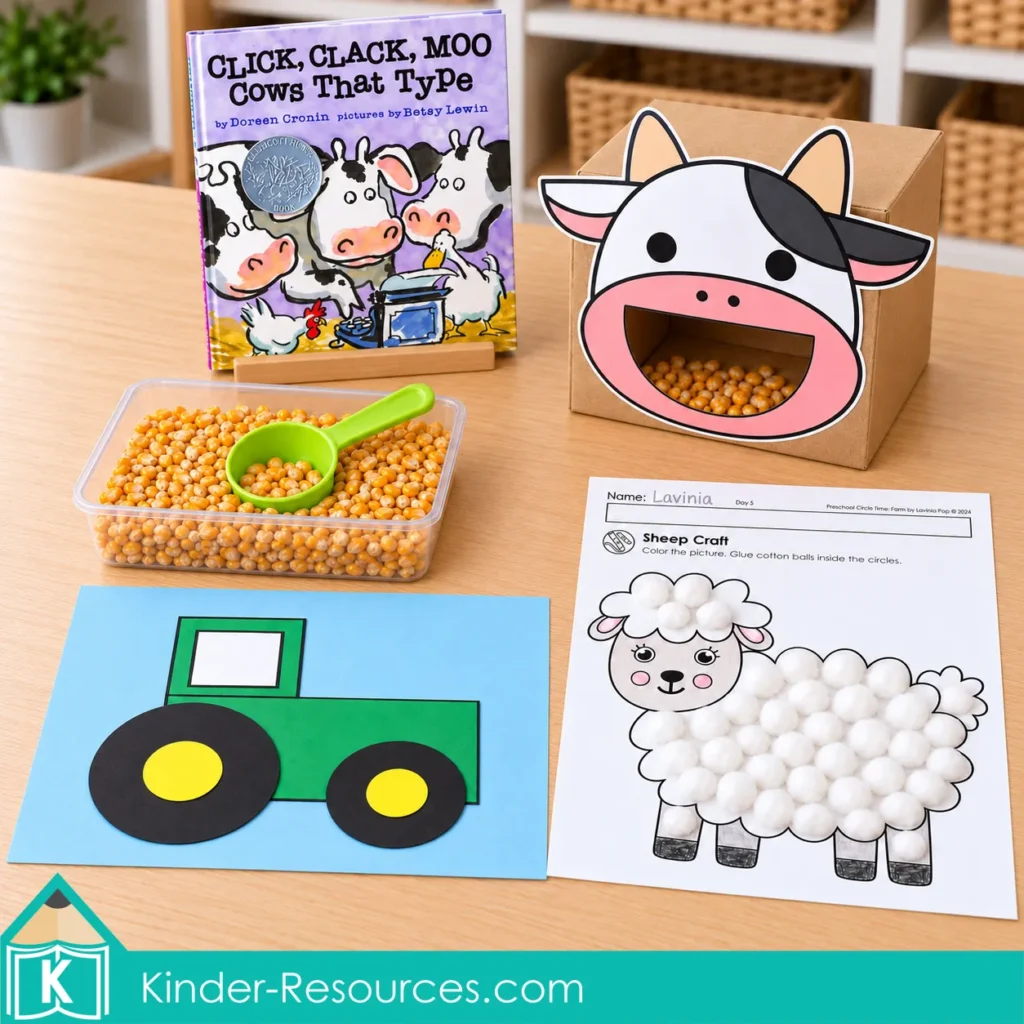
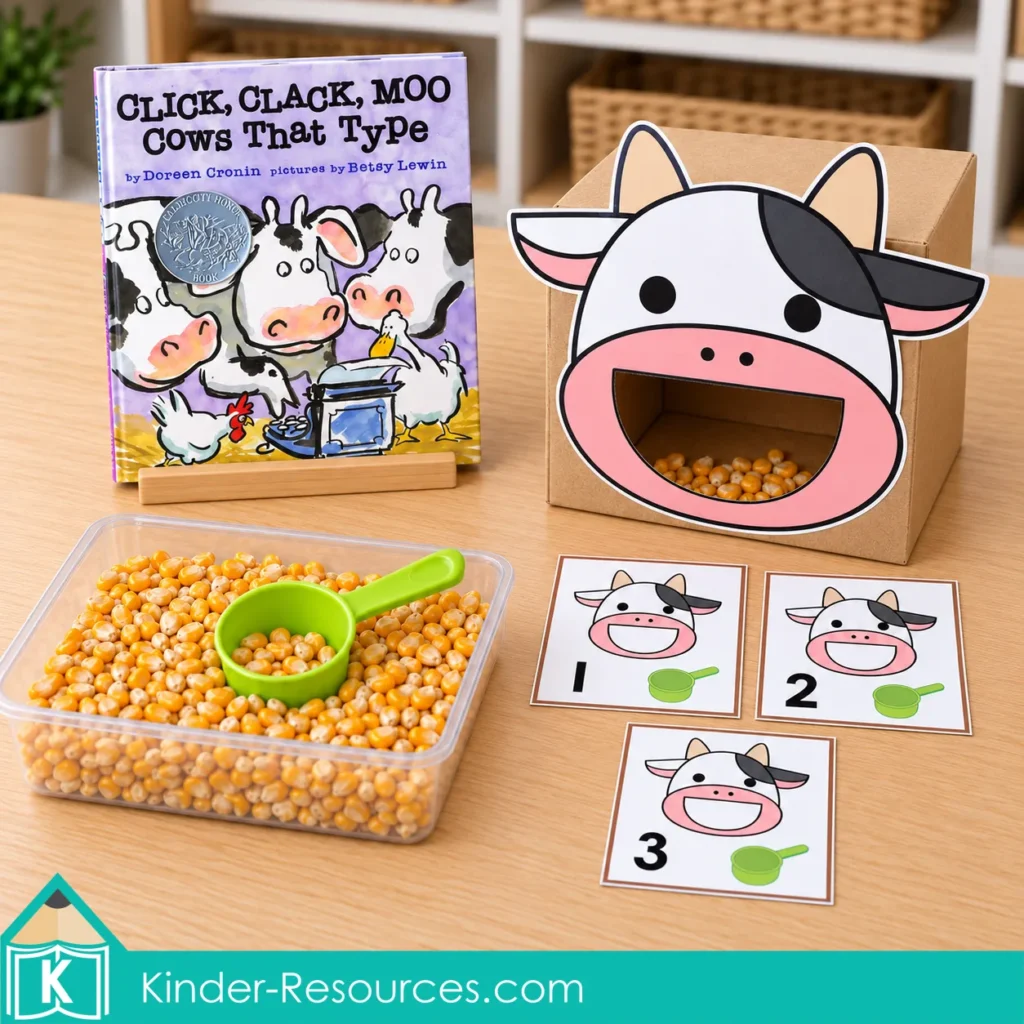
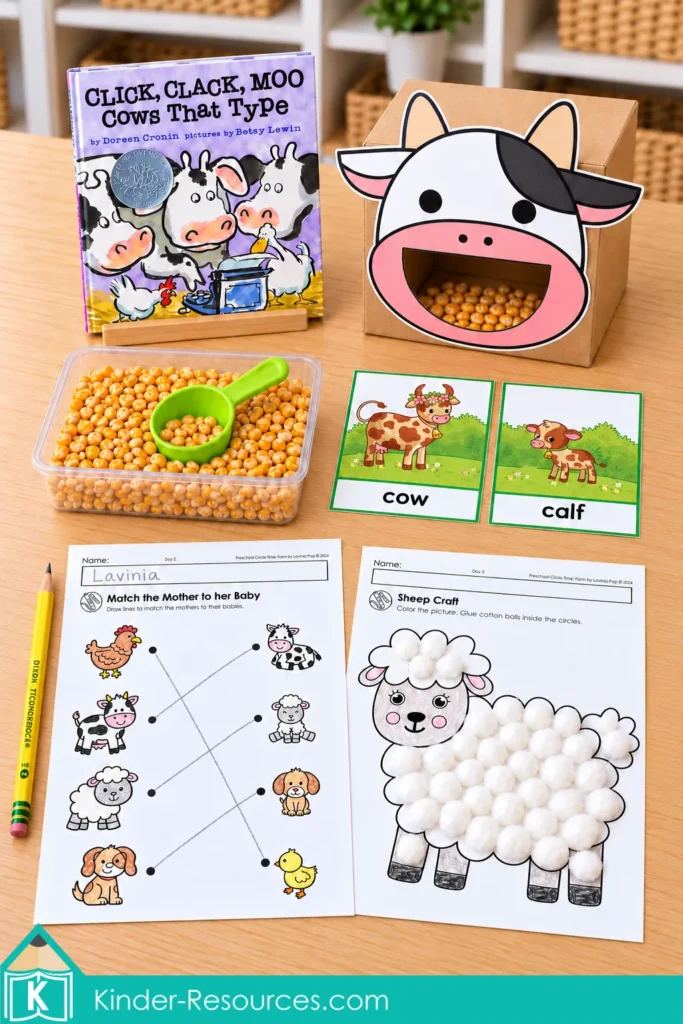
Read Click, Clack, Moo: Cows That Type by Doreen Cronin. Discuss what the cows ask for in this pretend story, then return to the things real farm animals need. Invite children to suggest a job a farmer might do to help an animal.
Feed the Farm Animals Counting Activity
Prepare the printable animal face on a box with an opening at the mouth. Place it beside a tray of dried corn, a scoop, and the feeding cards.
Children choose a card, identify its numeral, and count that many scoops into the animal’s mouth. The number represents scoops, so count once for each scoop added. Begin with cards 1–3 and introduce larger numbers as appropriate.
This pretend feeding activity combines counting, turn-taking, and controlled scooping. Use dried corn only with close supervision and children who no longer mouth materials; choose an age-appropriate alternative for other groups.
Taking Care of the Animals Song and Sheep Craft
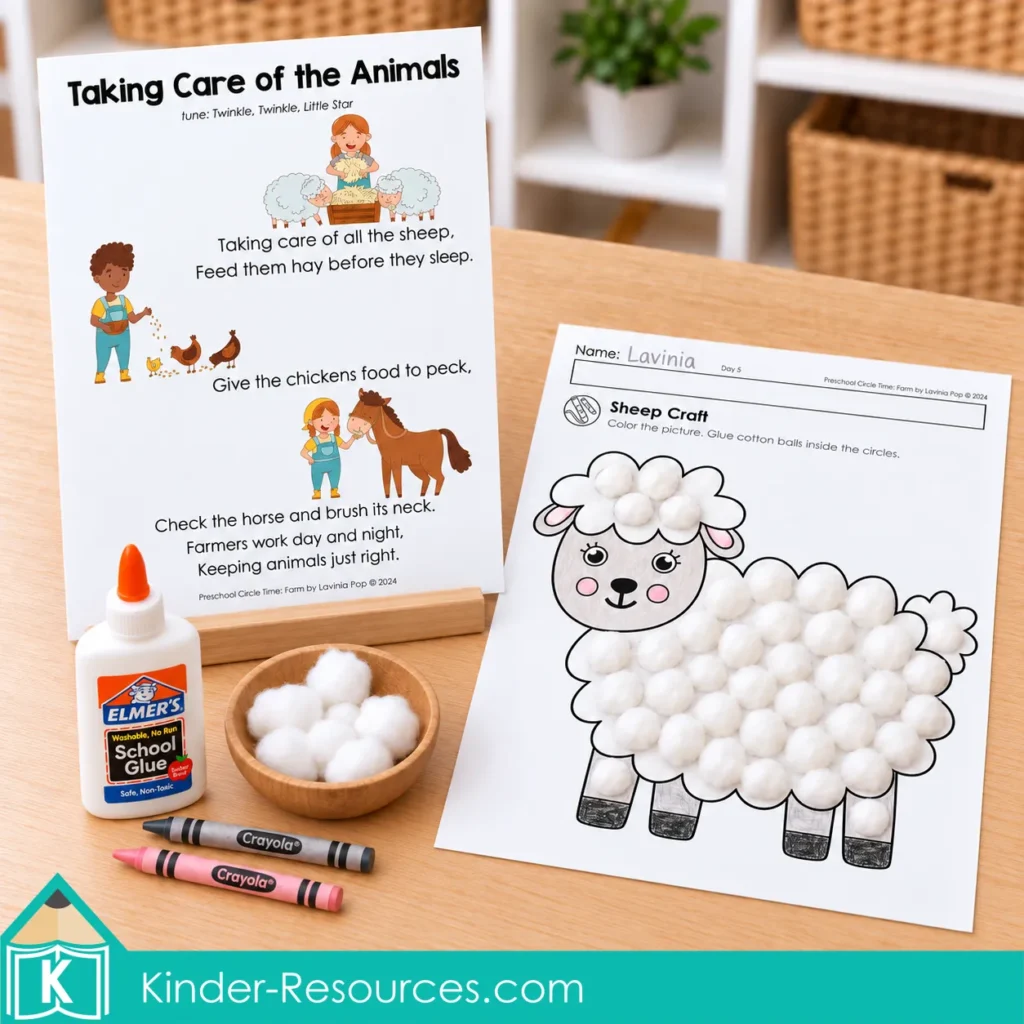
Sing “Taking Care of the Animals” to the tune of “Twinkle, Twinkle, Little Star.” Children can pretend to feed sheep, scatter food for chickens, and brush a horse as they sing.
For the sheep craft, children color the picture and glue cotton balls inside the circles. Offer a small amount of glue at a time so children can practice placing each cotton ball with care. The finished sheep adds a textured picture to your farm display.
End with a short conversation about the week. Invite each child to name a favorite animal, show an animal movement, or explain one way farmers care for animals.
Adapting Farm Circle Time Activities for Preschool
For children who need a simpler starting point, offer fewer matching cards, prepared craft pieces, or a single tracing path. Let children respond by pointing, moving, making sounds, or talking with a partner.
For children ready for more, ask them to explain a match, retell the puppet sequence, compare two animals, or record a counted quantity. Keep familiar props available so children can return to the songs and games during play.
You can spread this farm theme across more than one week. Choose the follow-up pages that serve your children, and allow time to repeat activities they want to explore again.
Get the Complete Farm Circle Time Printables and Lesson Plans
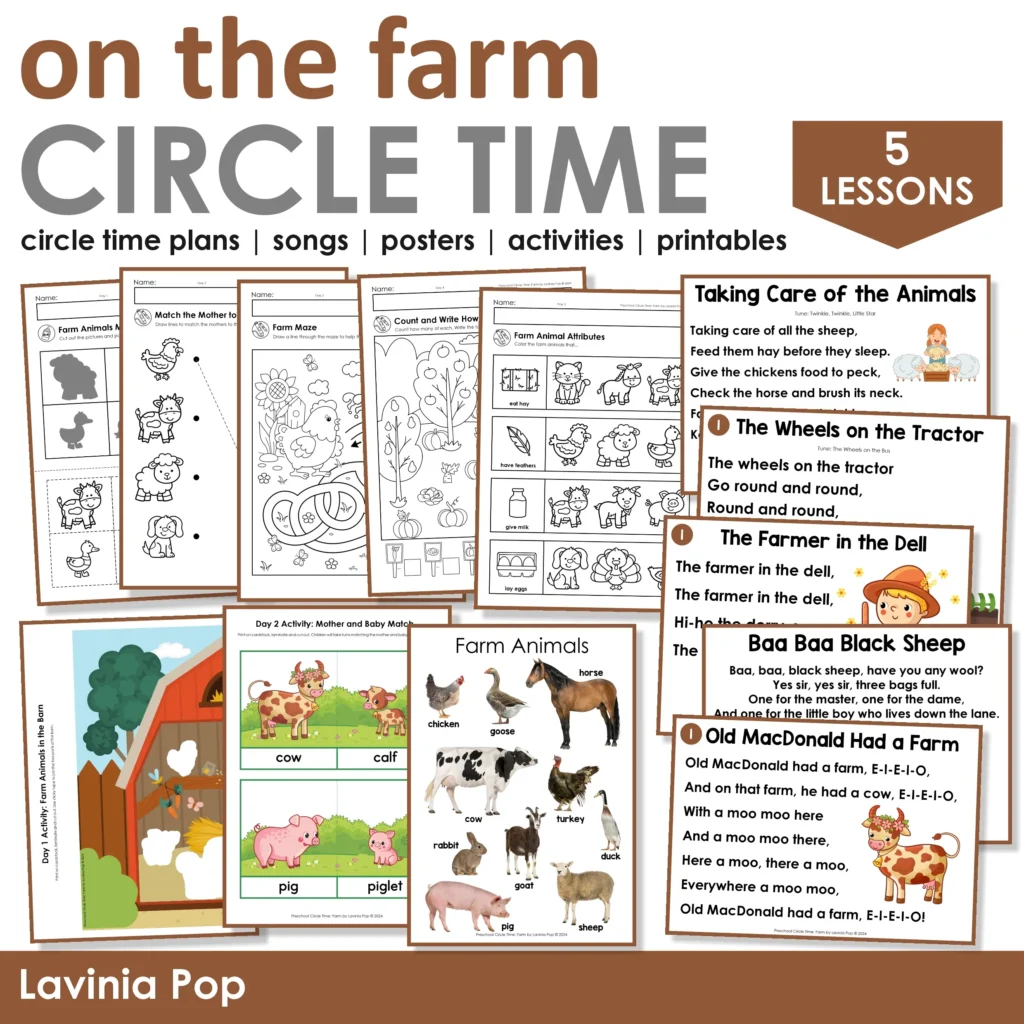
Plan a week of farm circle time activities for preschool with my Farm Preschool Circle Time resource. The daily plans bring together songs, suggested stories, discussion prompts, and hands-on learning, with follow-up printables to use throughout the day. The printable pack includes:
- A weekly overview and five daily lesson plans.
- Suggested read-alouds with discussion prompts.
- Farm songs, song posters, and printable props.
- Classroom posters for farm vocabulary and discussion.
- Animal matching, baby animal matching, and sound activities.
- Tractor craft templates and animal feeding materials.
- Follow-up pages for tracing, matching, sorting, coloring, counting, and the sheep craft.
The picture books and classroom supplies shown in the photos are not included in the printable resource.

Happy Teaching! 😊
You Might Also Like