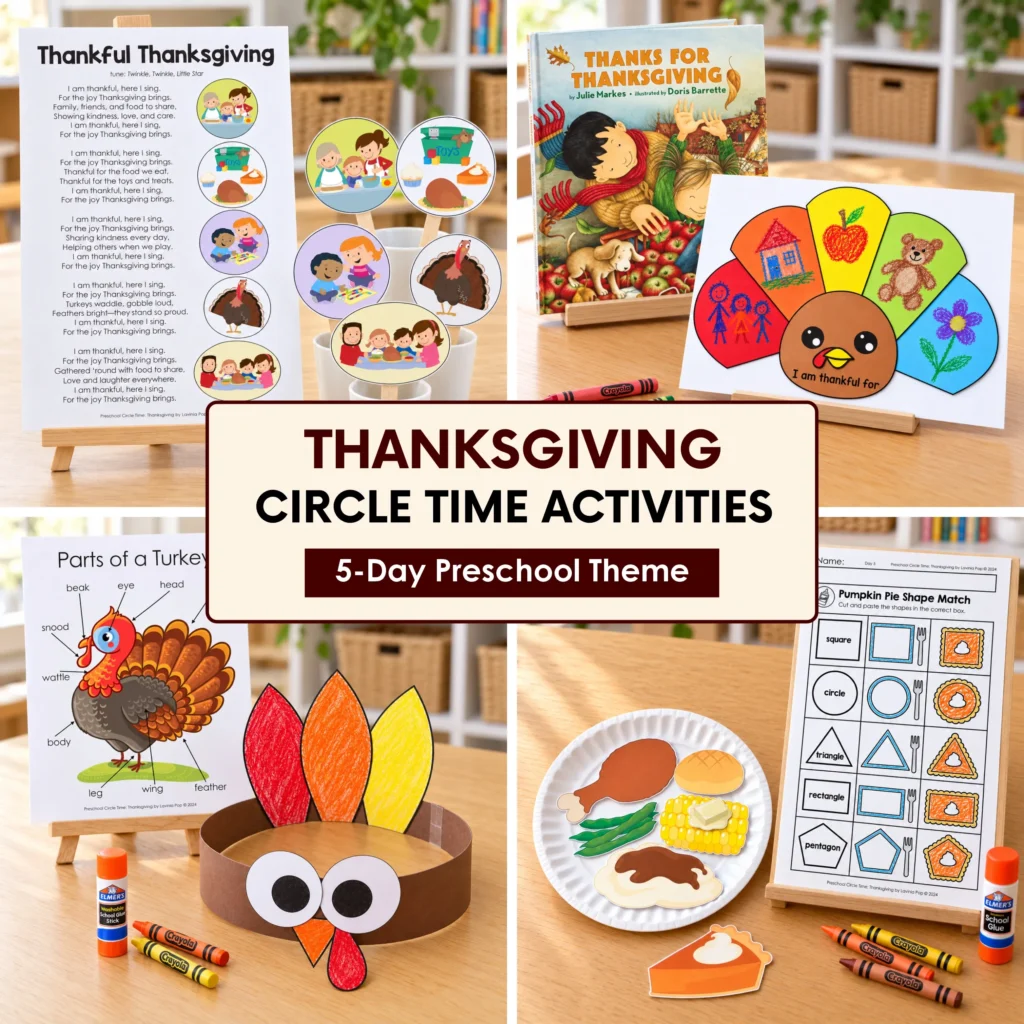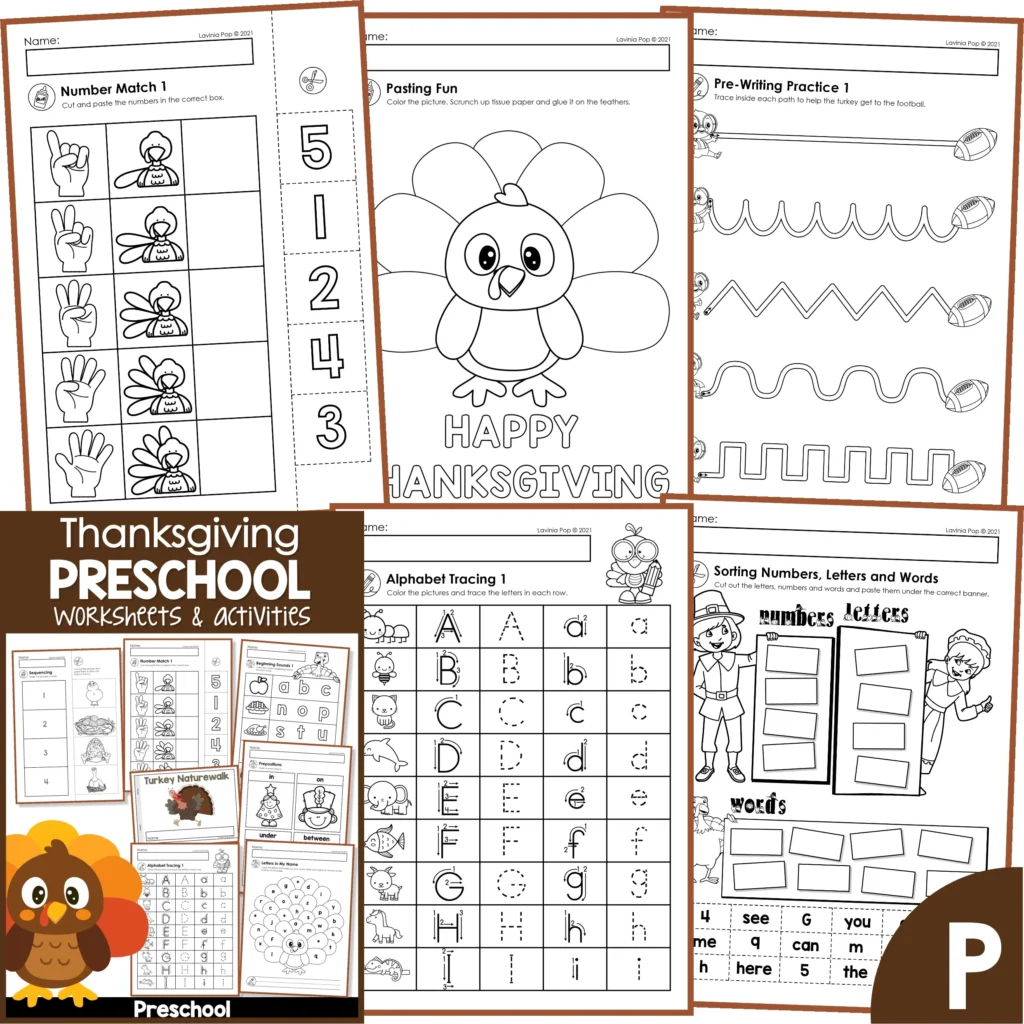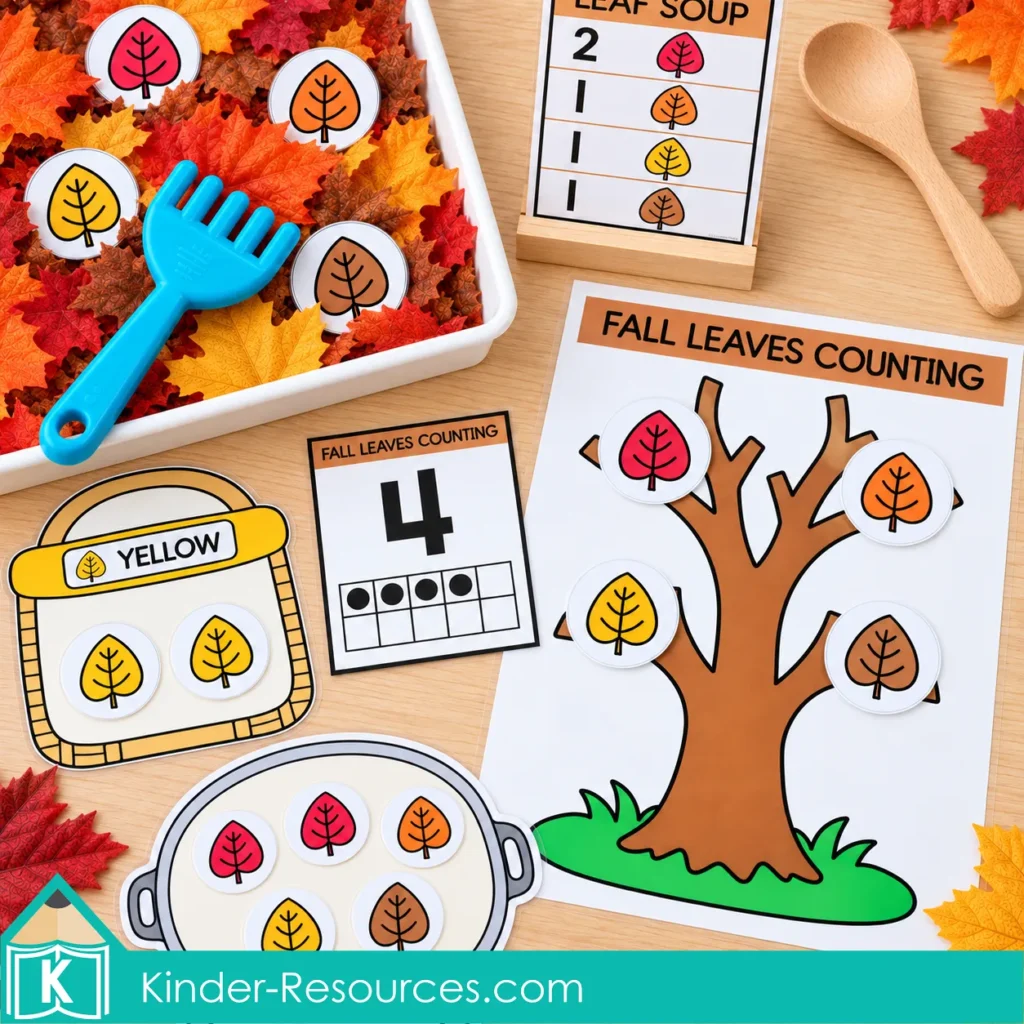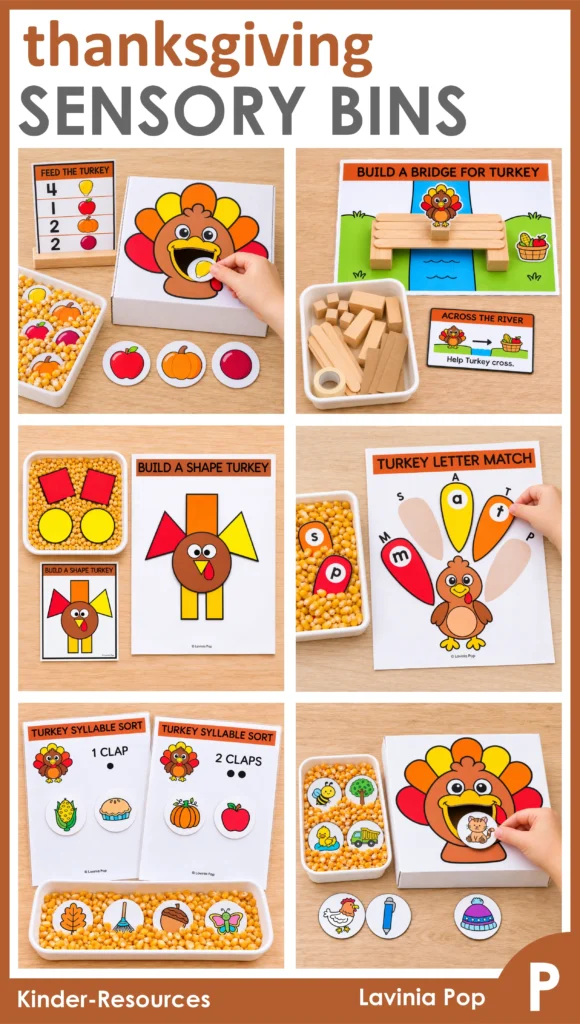
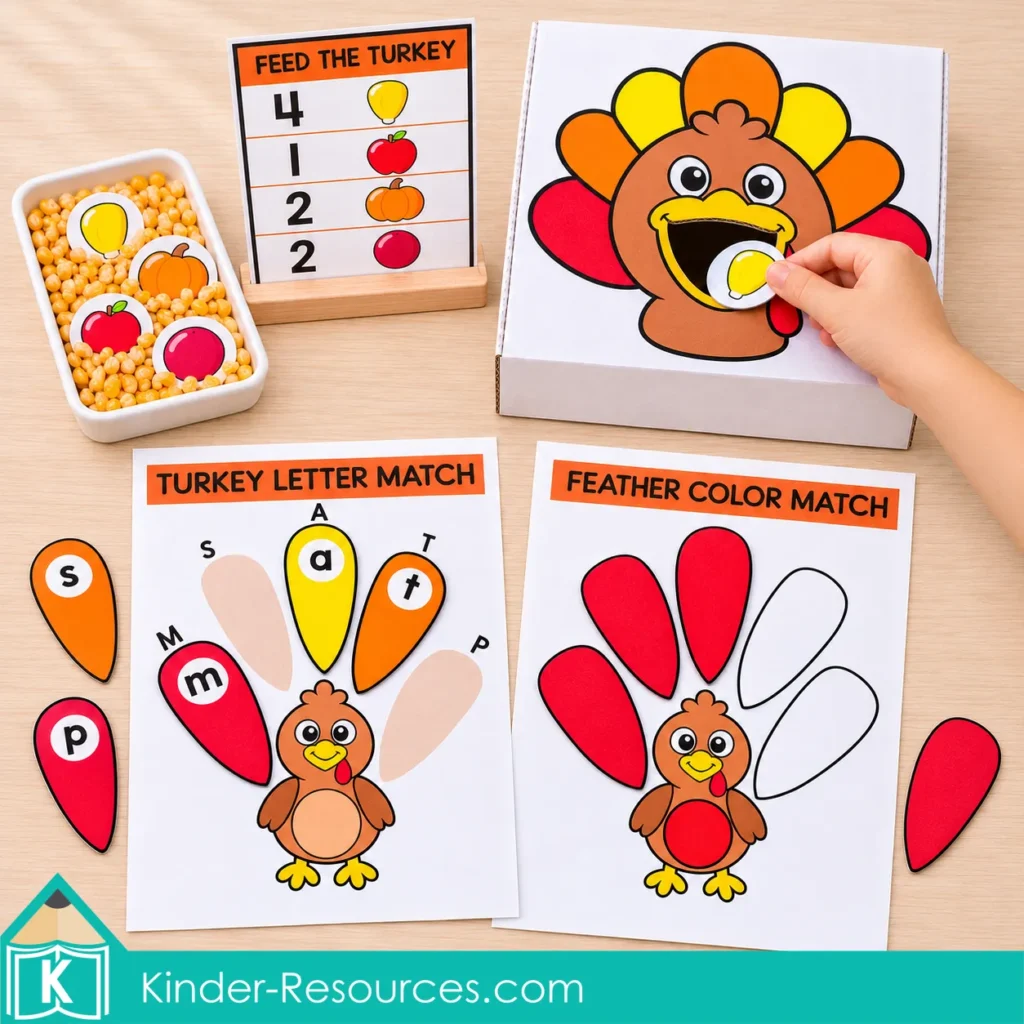
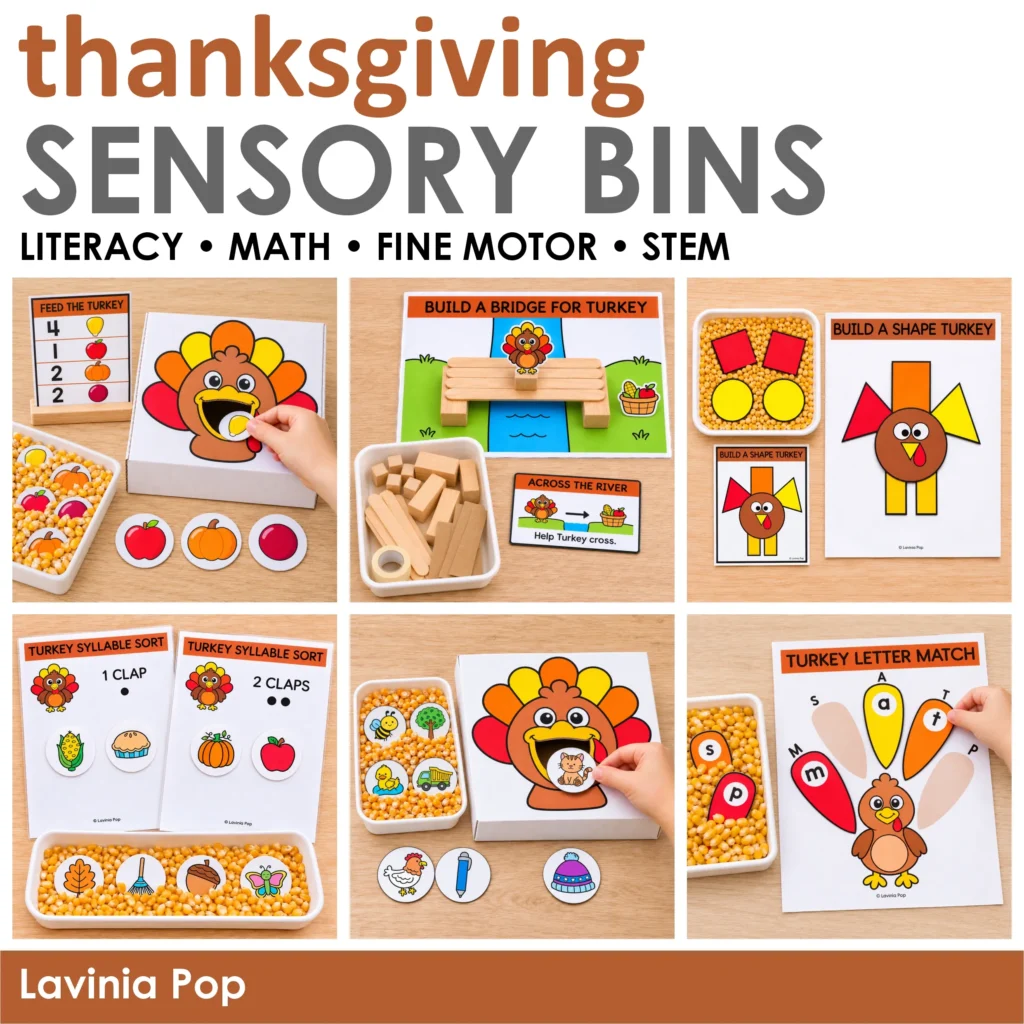
These Thanksgiving sensory bin activities for preschool give children ten ways to count, match, sort, trace, and build with a turkey theme. They can feed a hungry turkey, search for matching letters, arrange colorful feathers, or build a bridge to help Turkey reach a basket of food.
I created this collection so you can prepare a few activities at a time and bring them out throughout your Thanksgiving theme. Most use a familiar search-and-match routine with printable pieces and a corn bin. Turkey Trails adds a sand tracing tray, while Build a Bridge for Turkey gives children a tub of building materials to explore.
Use the activities during preschool centers, small groups, morning tubs, or learning at home. Each one includes directions and extra play ideas to help you adjust the activity as children become more confident.
Free Thanksgiving Sensory Bin Activity: Turkey Feather Match
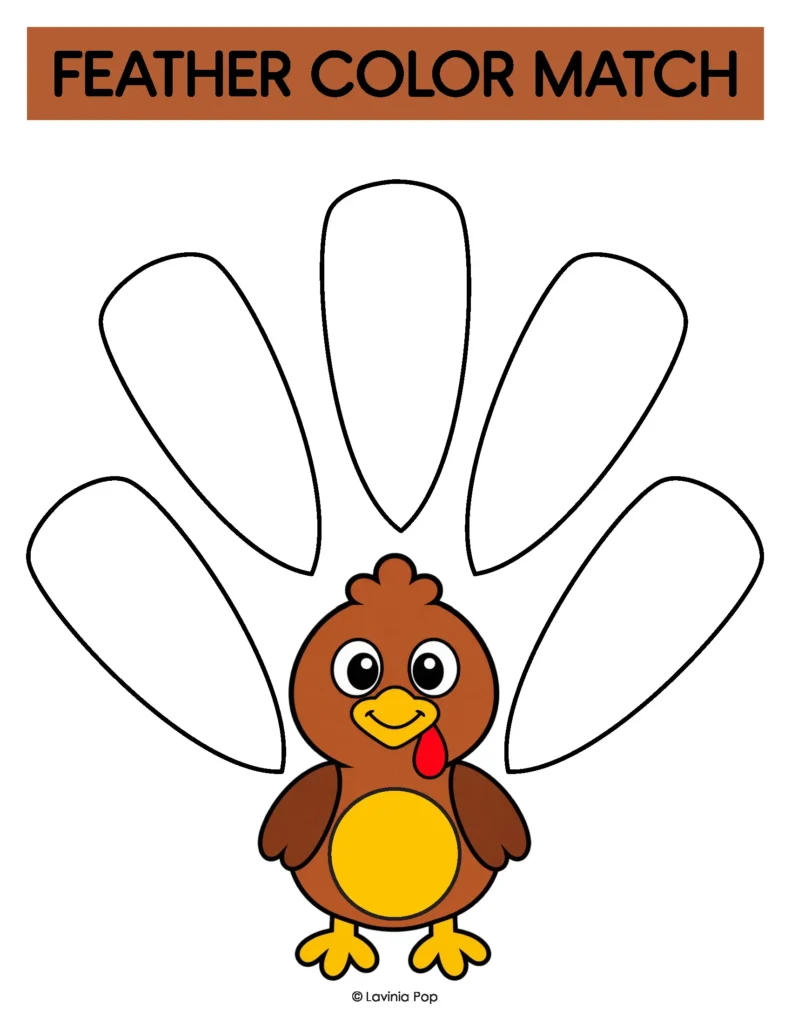
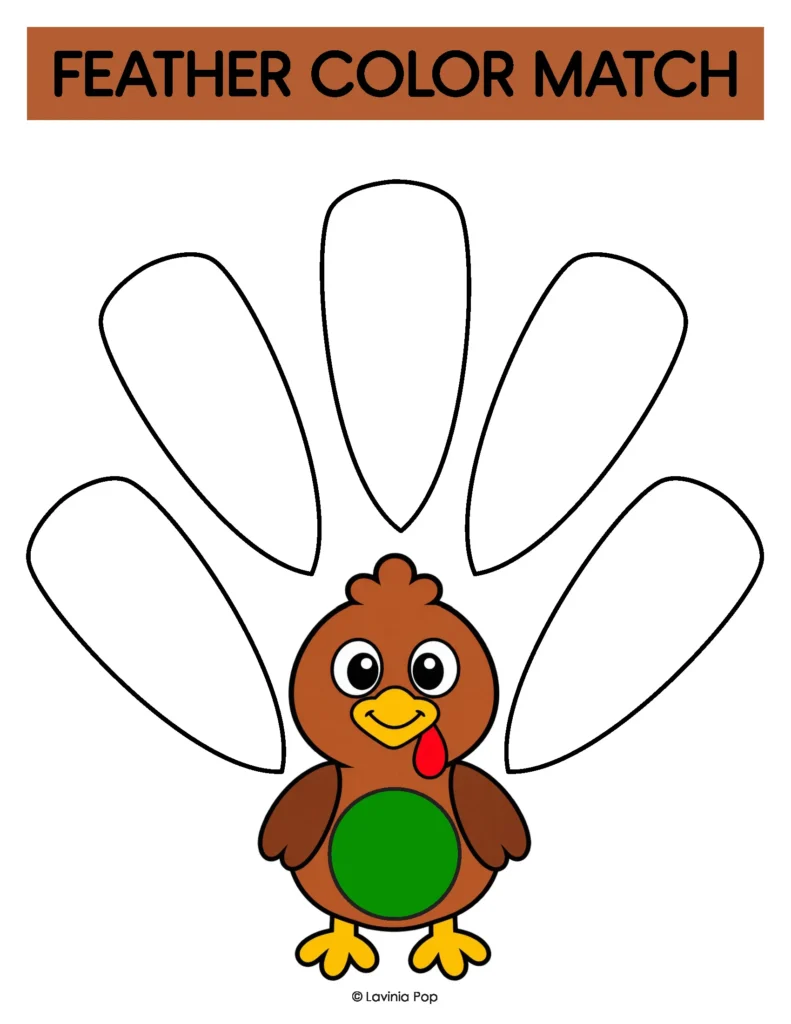
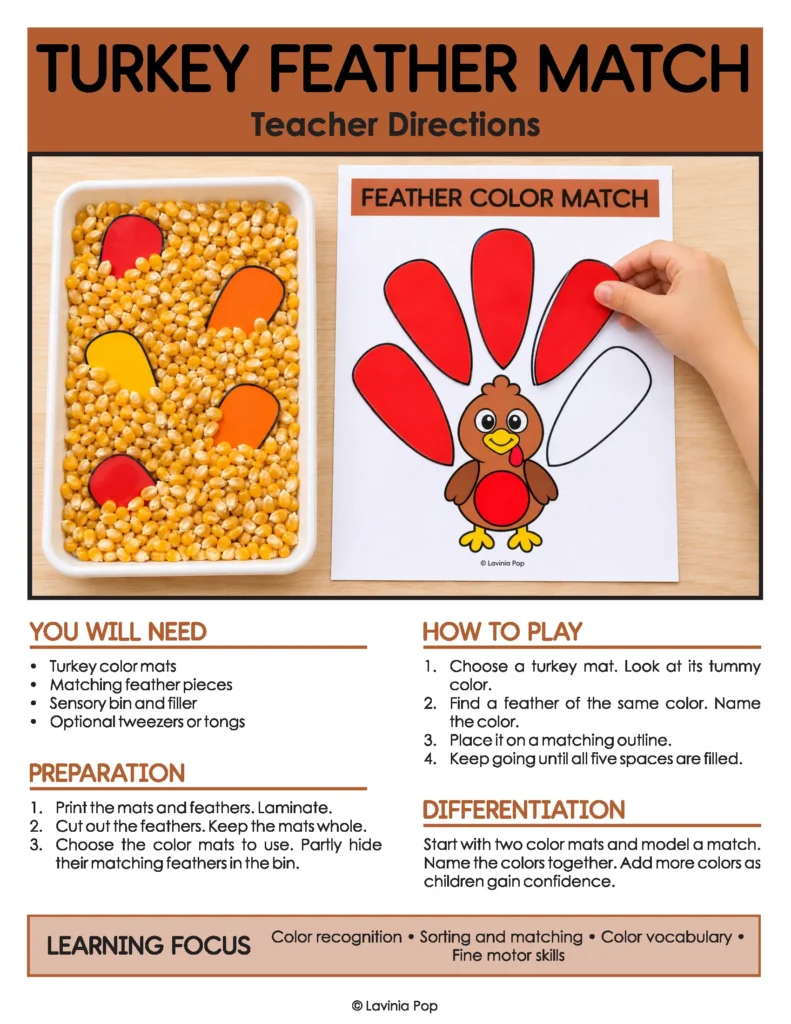
Try Turkey Feather Match with the free printable sample! Children choose a turkey mat, look at its tummy color, and search for matching feathers to complete its tail.
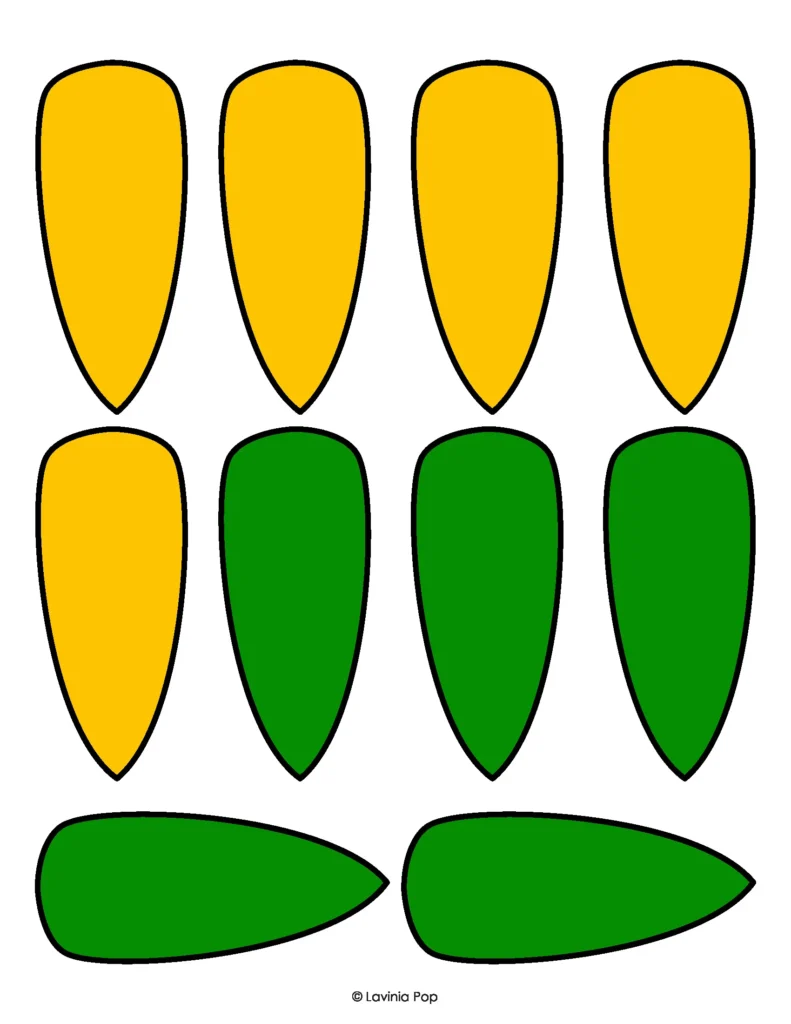
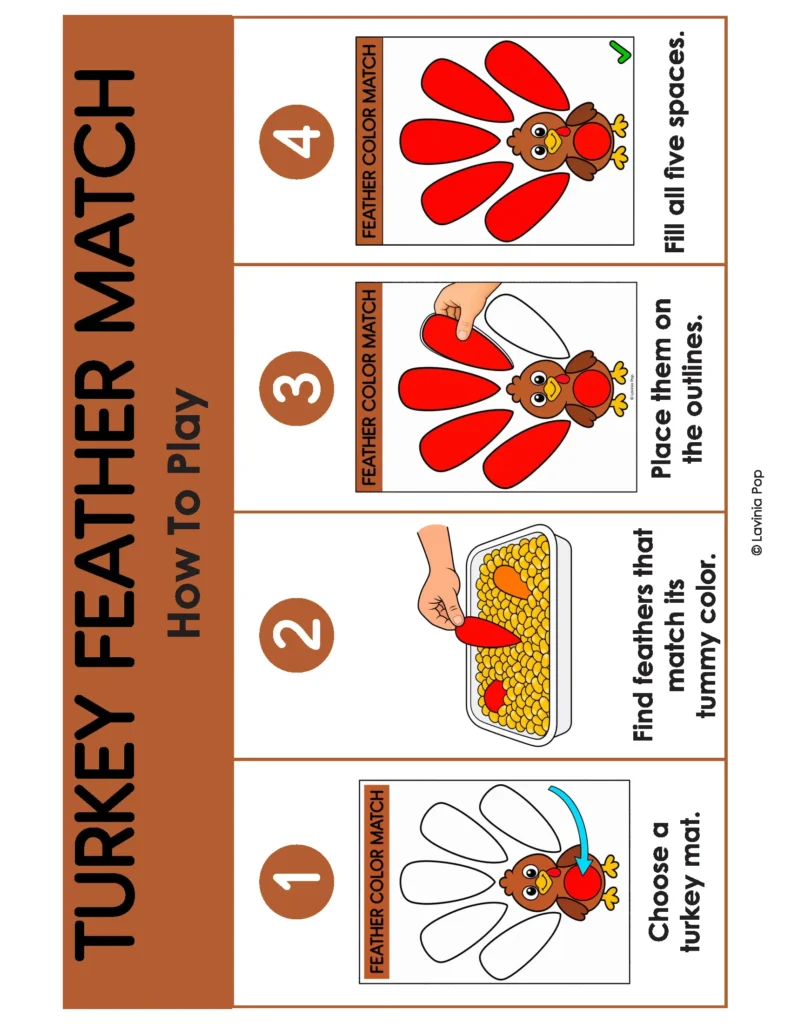
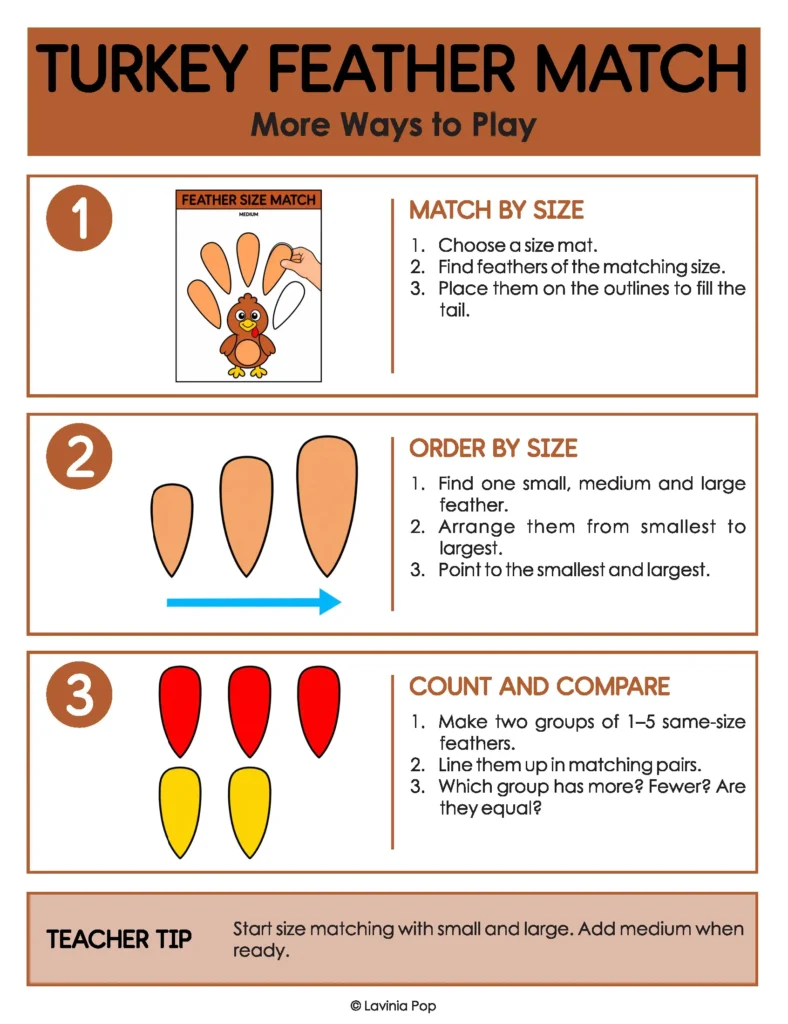
The sample includes red, orange, yellow, and green turkey mats, along with five matching feathers for each color. You’ll also find Teacher Directions, an illustrated How to Play page, and a More Ways to Play page.
Print and laminate the mats and feathers, then cut out the feather pieces. Partly hide them in a sensory bin and invite children to find the colors they need. Start with two turkey mats and their matching feathers, then add more colors when children are ready.
As children place each feather, encourage them to name the color: “This feather is red. It matches the red tummy.” This gives color matching a simple language component while children practice picking up and positioning the pieces.
How to Set Up Your Thanksgiving Sensory Bins
You don’t need ten bins or every printable on the table at once. Choose an activity, prepare its mat and pieces, and add only the cards or tokens children will use. Print matching mats and pieces at the same scale, laminate if desired, and cut out the movable pieces.
For the search-and-find activities, use a shallow tray of dried corn and partly bury a small selection of pieces. Keep the matching mat beside the tray so children have somewhere clear to work. A smaller set makes it easier to focus on the letter, color, number, or sound you are practicing.
Set up Turkey Trails with a thin layer of clean play sand in a separate tray. For the bridge activity, fill a tub with blocks, jumbo craft sticks, and sturdy cardboard pieces. Children need to see and compare the materials as they decide how to build.
Choose fillers and tools suitable for the children using them, supervise play, and offer the printable pieces on an empty tray when loose filler isn’t appropriate.
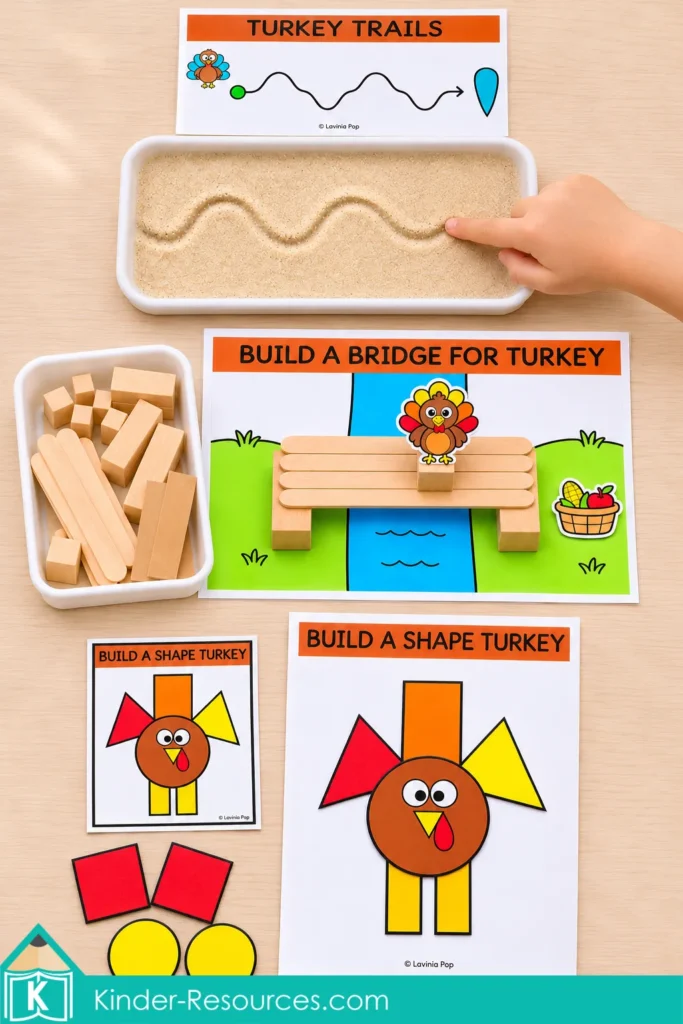
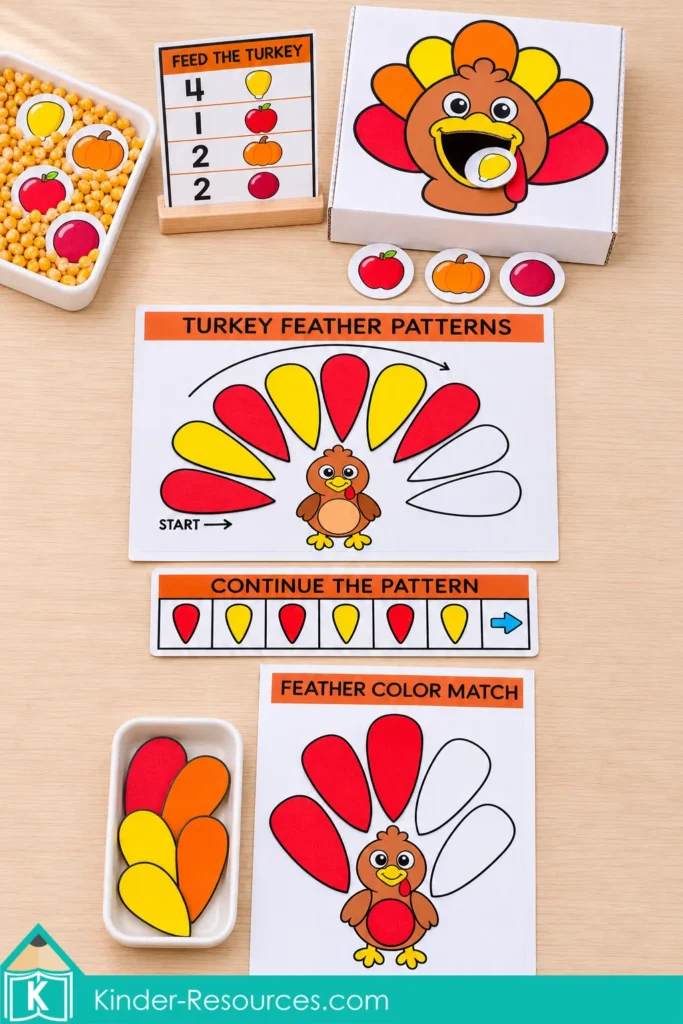
Counting, Color Matching, and Feather Patterns
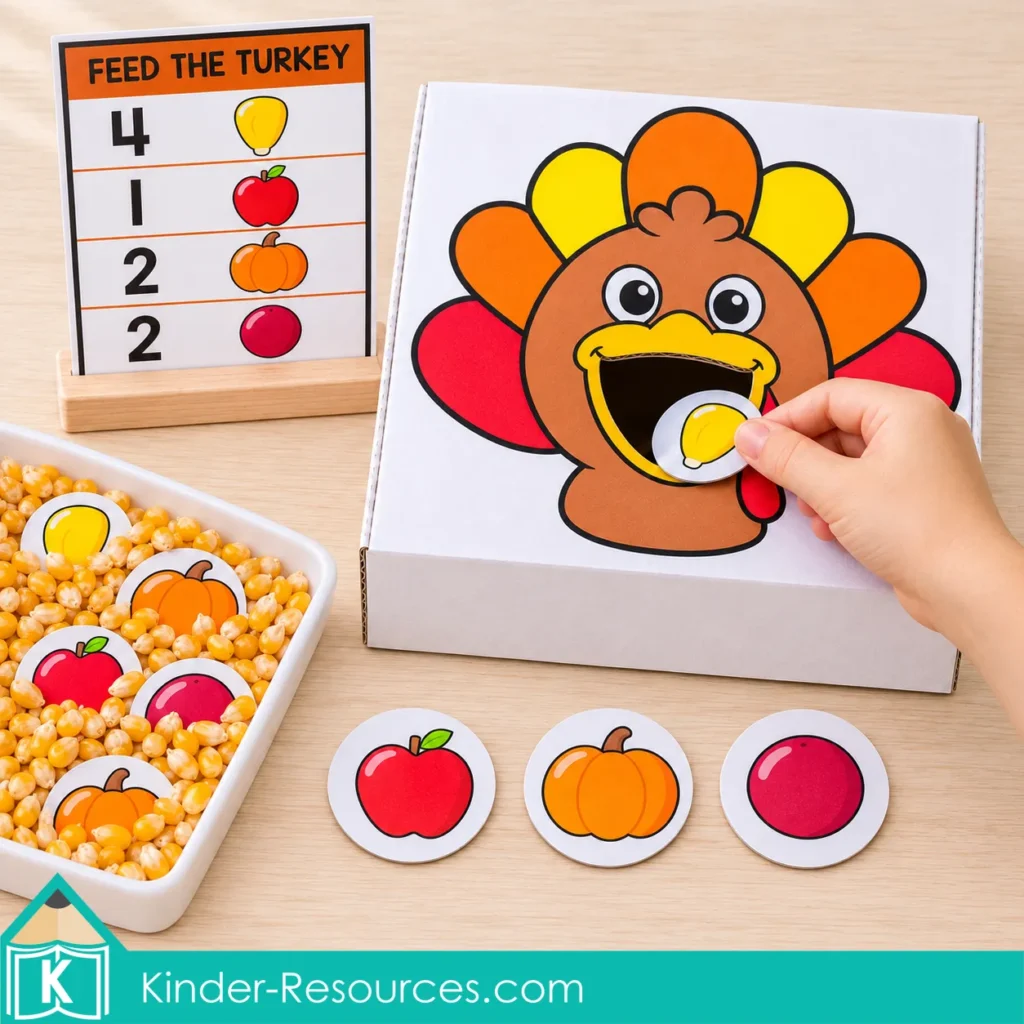
Feed the Turkey
Children choose a number card, find the matching quantity of food pieces, and feed Turkey one piece at a time. The cards cover numbers 0–10, so you can begin with 0–5 and add larger quantities when children are ready. The zero card is a useful opportunity to talk about “none.”
The mixed-food feeding cards add another way to play. Children collect the amount shown for each food, keeping the corn, apples, pumpkins, and cranberries separate as they count. Touching or moving each piece as they say a number helps connect the counting words with the objects.
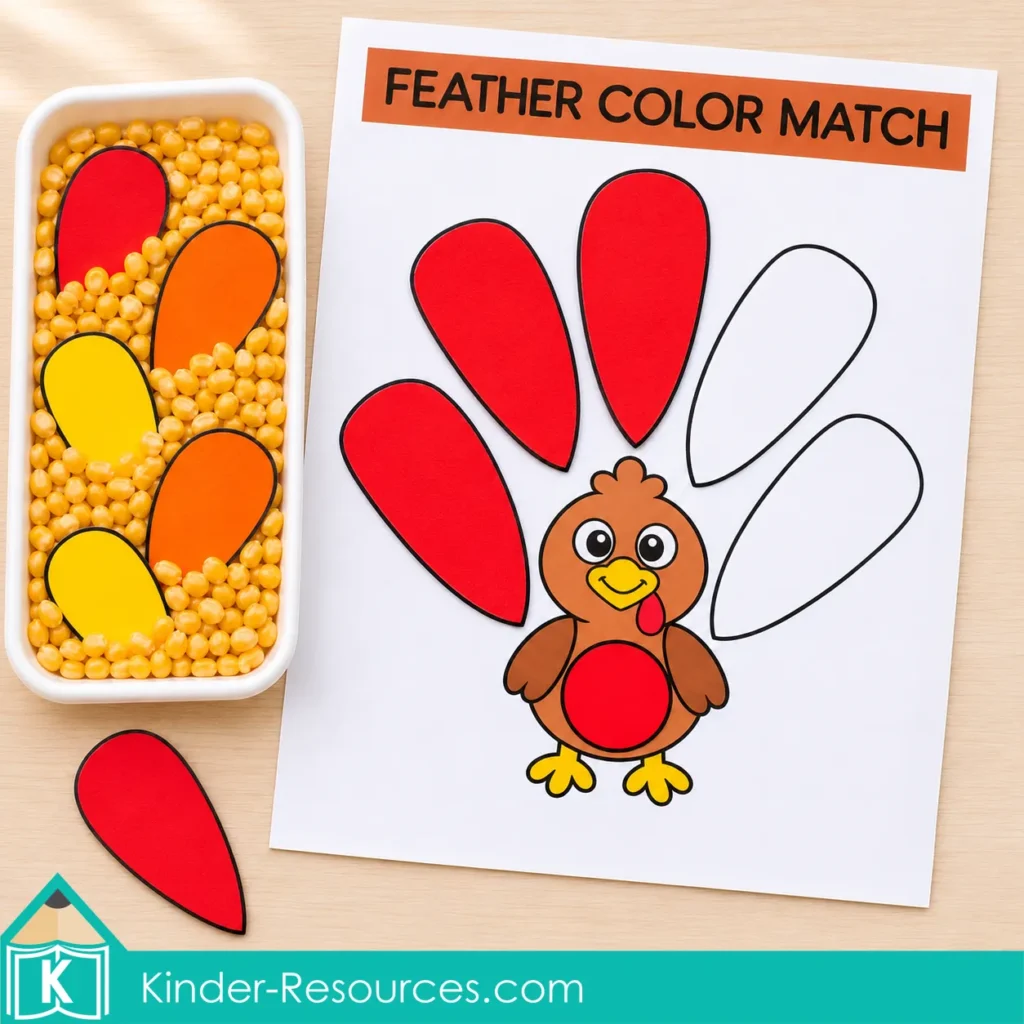
Turkey Feather Match
Turkey needs feathers that match the color on its tummy. Children search the corn, find a feather, and decide whether it belongs on their turkey mat. Start with two contrasting colors, then add more choices as the matching routine becomes familiar.
Encourage children to name the color as they place each feather. In the full collection, the size-matching materials offer another way to compare feathers and talk about small, medium, and large.
Turkey Feather Patterns
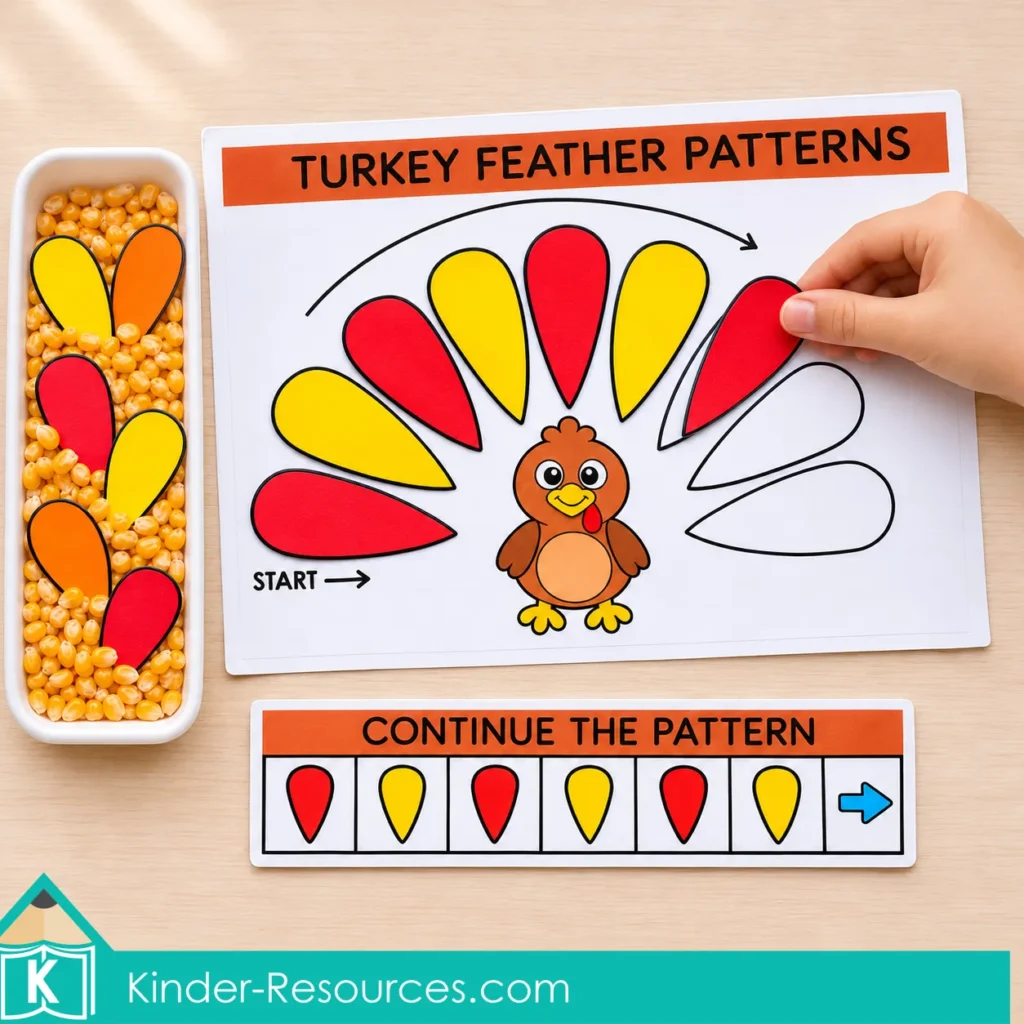
Children use a pattern card to arrange the first six feathers, then continue the pattern around the turkey’s tail. Begin with a simple alternating pattern, such as red, yellow, red, yellow. Say the colors together and pause before the next feather so children can predict what comes next.
The ten pattern cards include AB, AAB, ABB, and ABC patterns. Once children can copy a card, ask them to point to the part that repeats or make a new pattern for a partner to continue.
Letter Matching and Listening for Word Sounds
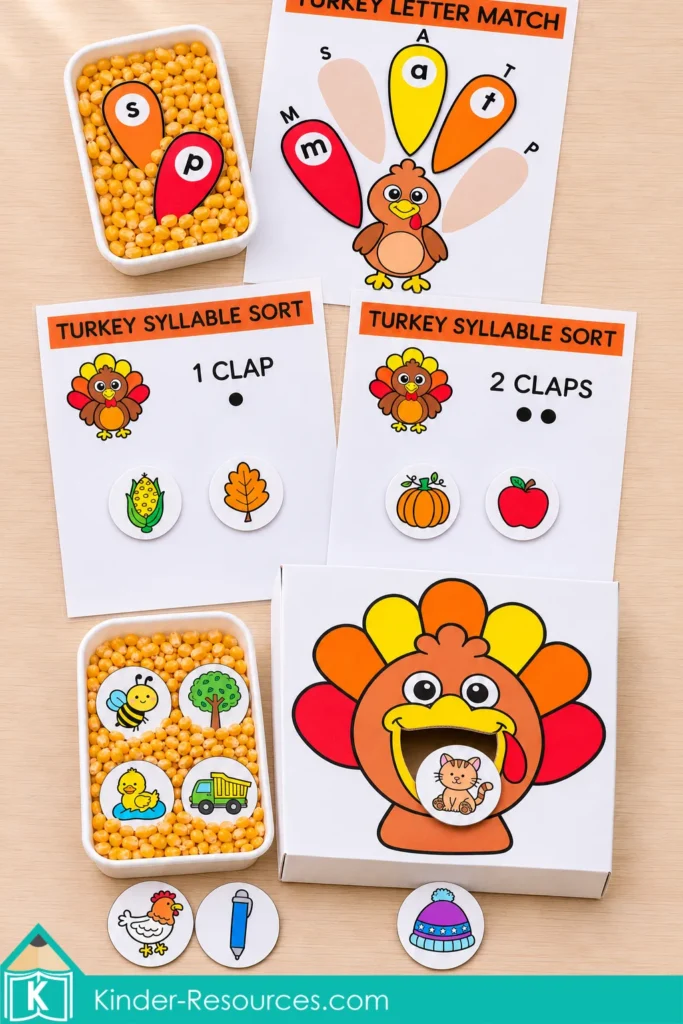
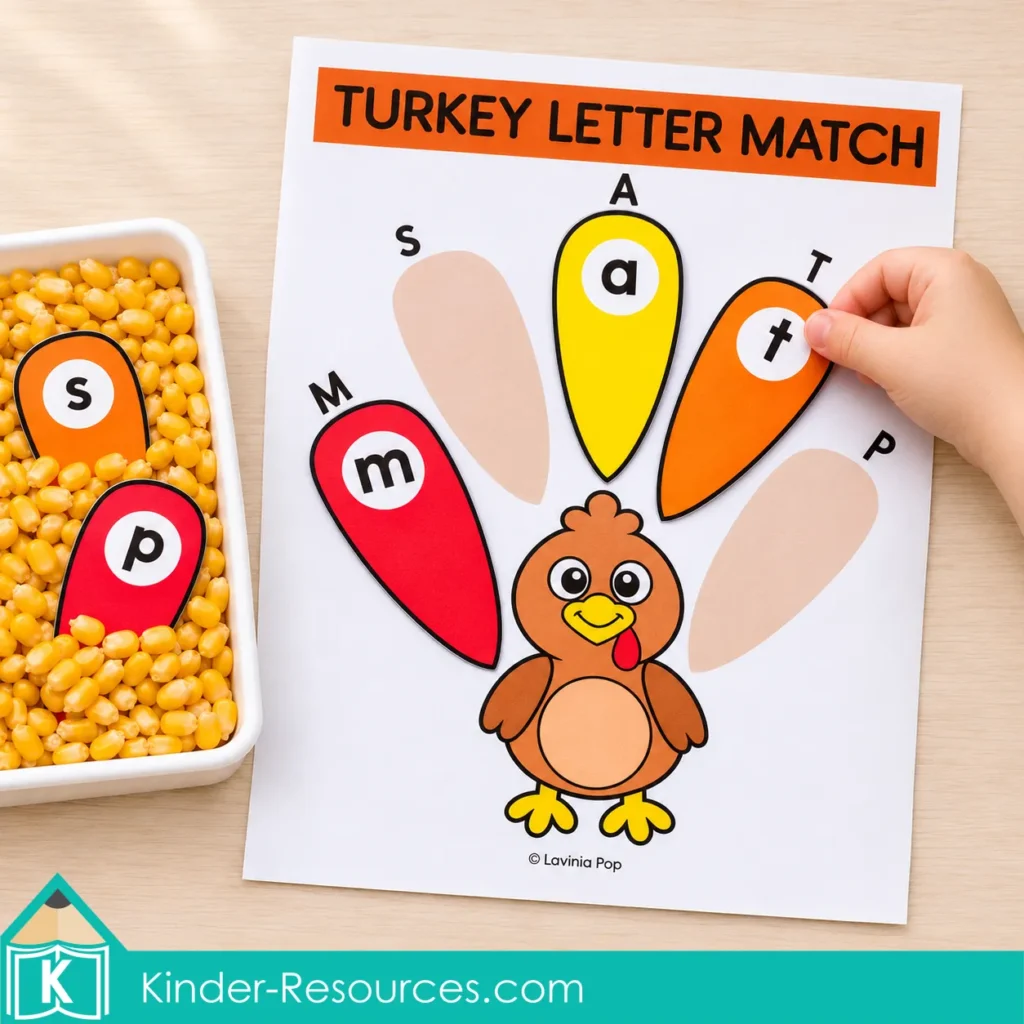
Turkey Letter Match
Children search for letter feathers and place them on the matching spaces. Use a small set of familiar letters first, such as letters from a child’s name. Matching identical letters provides a clear starting point before you introduce uppercase and lowercase pairs.
The picture feathers extend the activity to beginning sounds. Name the picture together, listen for its first sound, and find the matching letter. You can also use the letter pieces for name building, keeping a name model nearby when children need one.
Turkey Syllable Sort
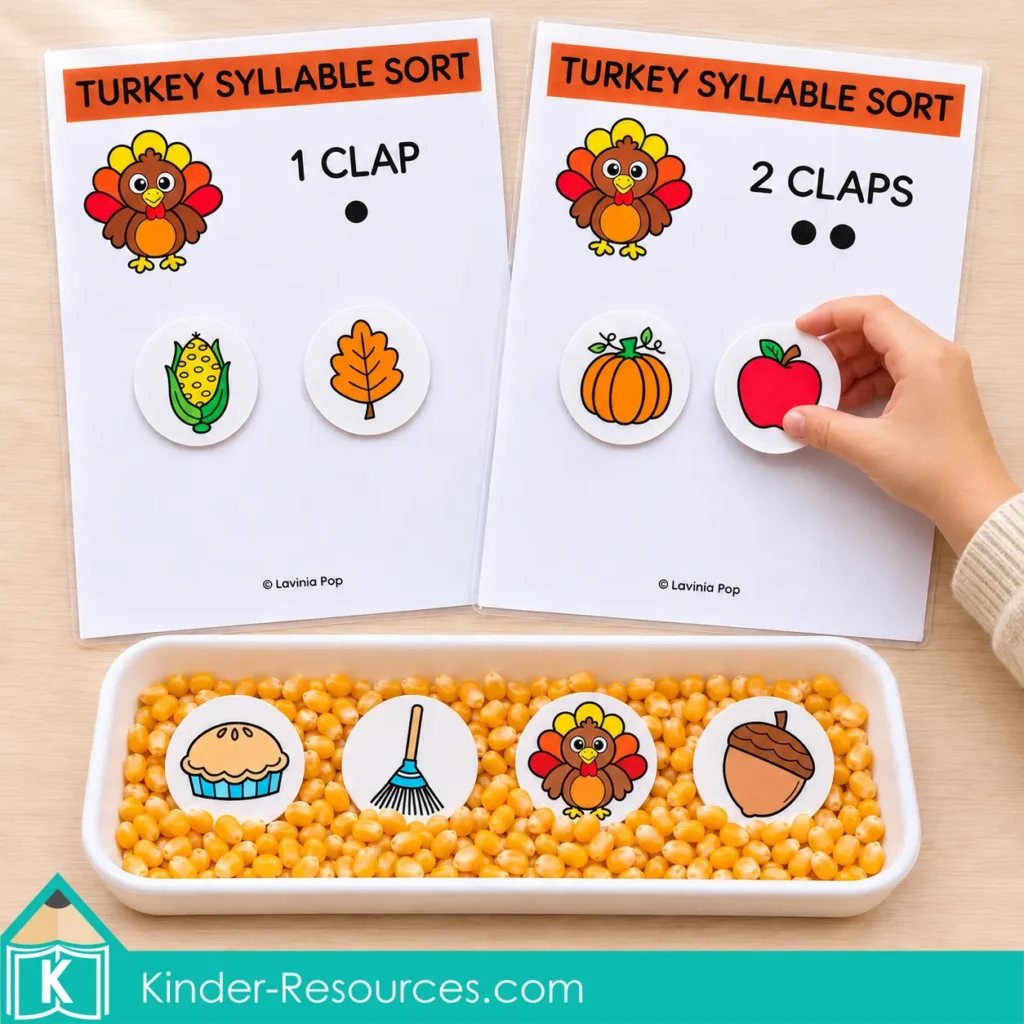
Say the picture name together, clap its spoken parts, and place the token on the mat with the matching number of claps. For example, corn has one clap, while pump-kin has two. Naming each picture first keeps the activity focused on listening rather than guessing what the picture represents.
Begin with the one-clap and two-clap mats and a few familiar pictures. Add the three-clap mat when children are ready, using words such as ba-na-na. The full set includes twelve picture tokens to sort across the three mats.
Feed the Rhymes
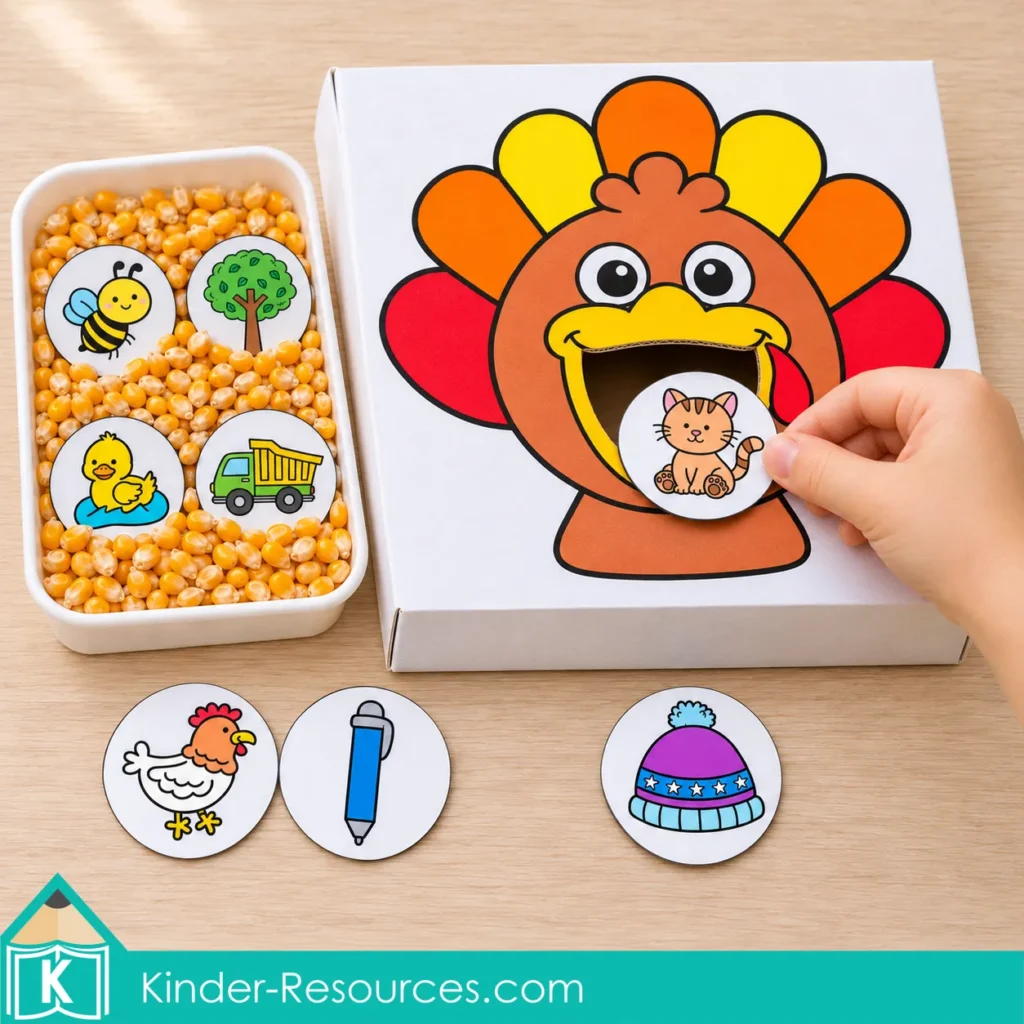
Turkey is hungry for rhyming pairs! Children find two pictures whose names rhyme, say the words aloud, and feed them to Turkey. Try familiar pairs such as cat and hat or hen and pen, emphasizing the matching endings as you say them.
There are twelve rhyming pairs, but you can begin with just two pairs in the tray. Say the picture names for children and model a match before asking them to choose. This is a listening game, so children can join in without reading printed words.
Exploring Shapes and Position Words
Set Turkey’s Table
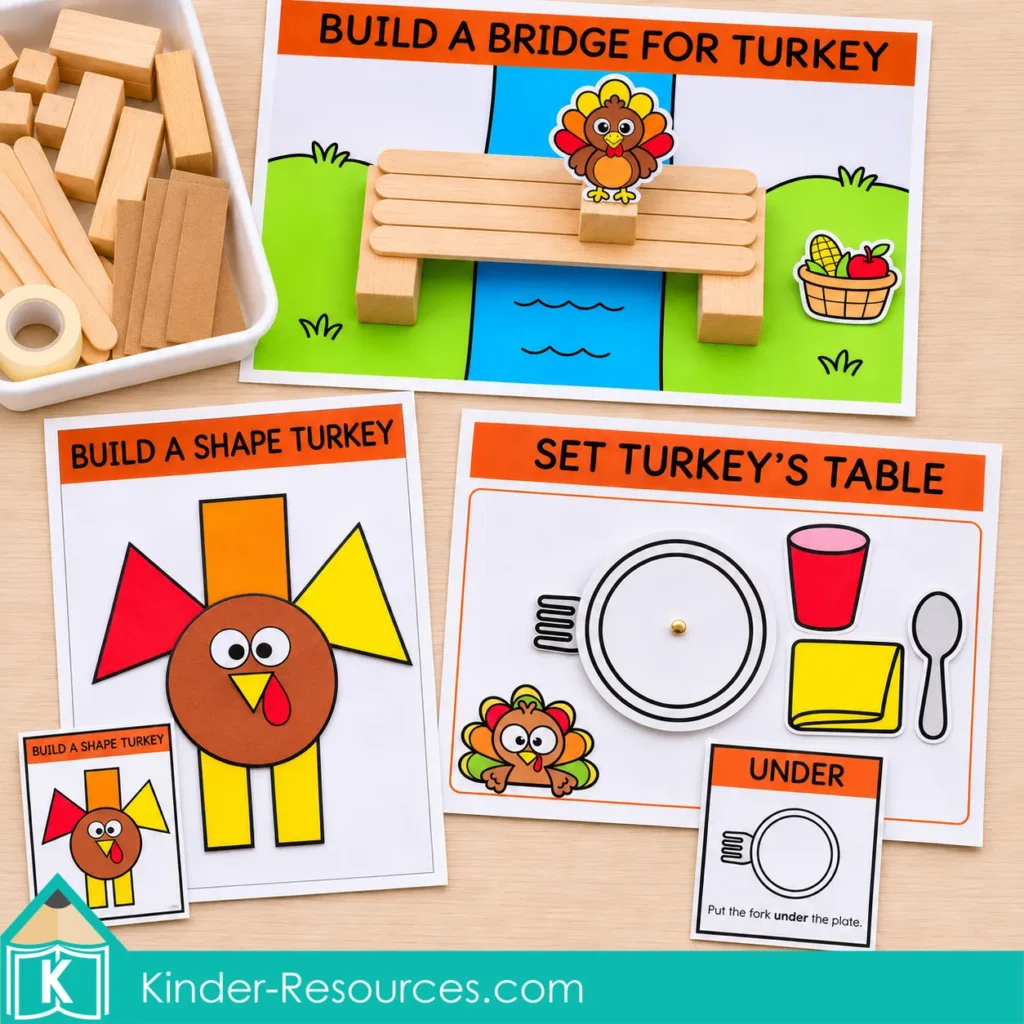
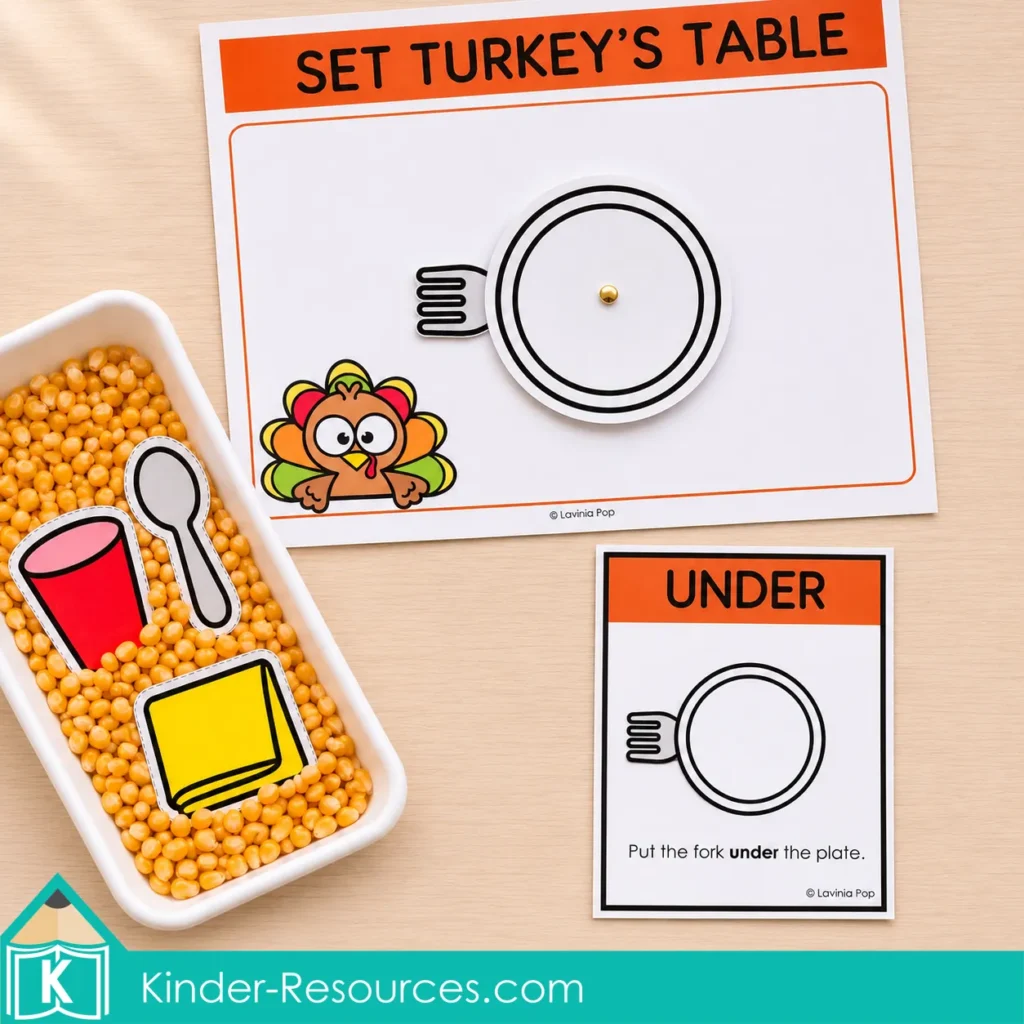
Children choose a direction card and place a cup, napkin, spoon, or fork in relation to the plate. The eight cards practice above, below, under, and beside. After placing the piece, encourage a short sentence such as, “The spoon is beside the plate.”
Attach the cut-out plate to the gray dot on the placemat with a paper fastener, following the preparation directions. This lets children gently lift the plate’s edge to slide a piece underneath.
Show the difference between placing something below the plate on the mat and placing it under the plate, where part of the piece is hidden. Moving the pieces makes these position words easier to demonstrate and discuss.
Build a Shape Turkey
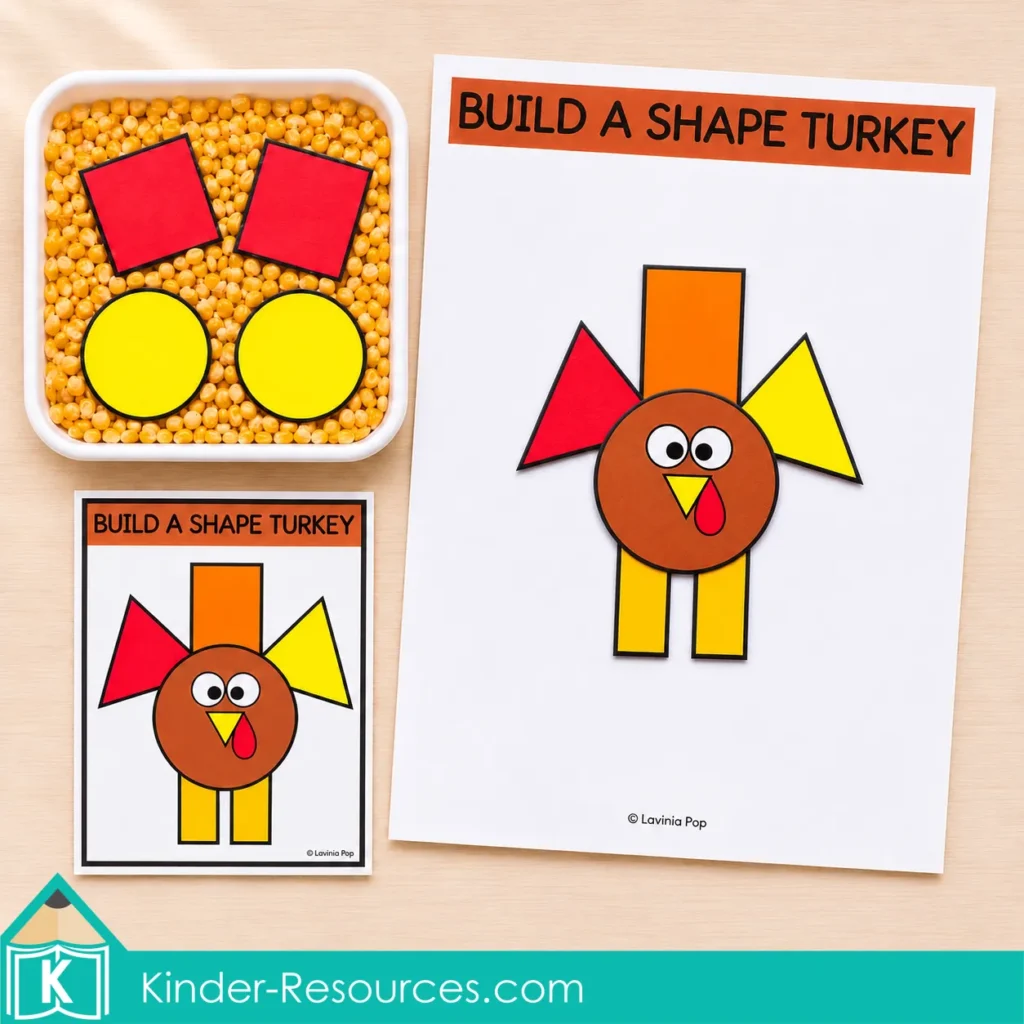
Children choose one of eight model cards and use circles, squares, triangles, and rectangles to build a matching turkey on the mat. They can arrange the tail shapes and legs first, then place the round turkey body over the pieces.
Talk about the shapes as children move and rotate them: “You turned the triangle so its point faces up.” Once they have copied a model, invite them to design their own turkey and describe the shapes they used.
Sand Tracing and a Turkey Bridge Challenge
Turkey Trails
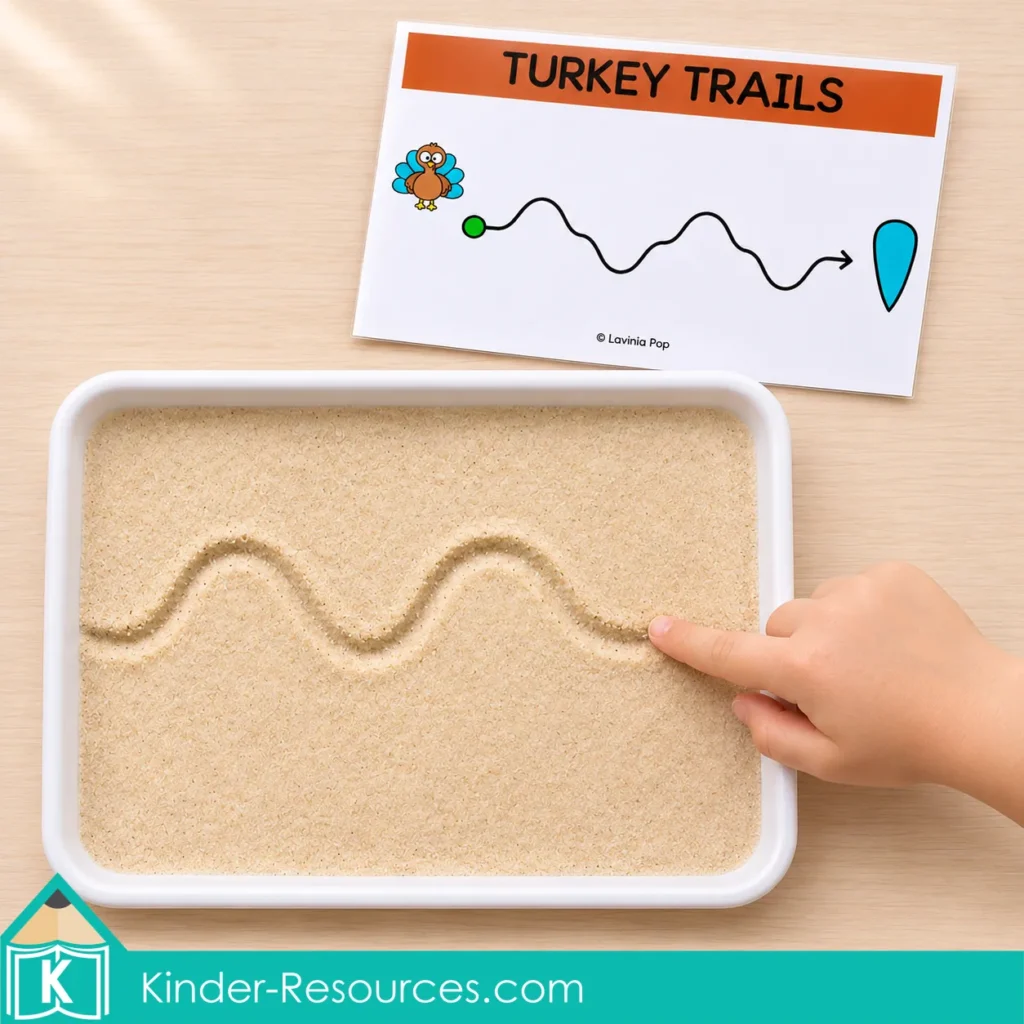
Each trail begins at a green dot and travels toward a feather. Children follow the printed path with an index finger, then try making the same kind of line in the sand. Keeping the card beside the tray gives them a model to look back at as they trace from left to right.
The set includes eight trails and blank cards for creating new paths. Start with a straight trail before introducing curves, waves, zigzags, and a loop. Smooth the sand and try again, giving children plenty of chances to explore the movements.
Build a Bridge for Turkey
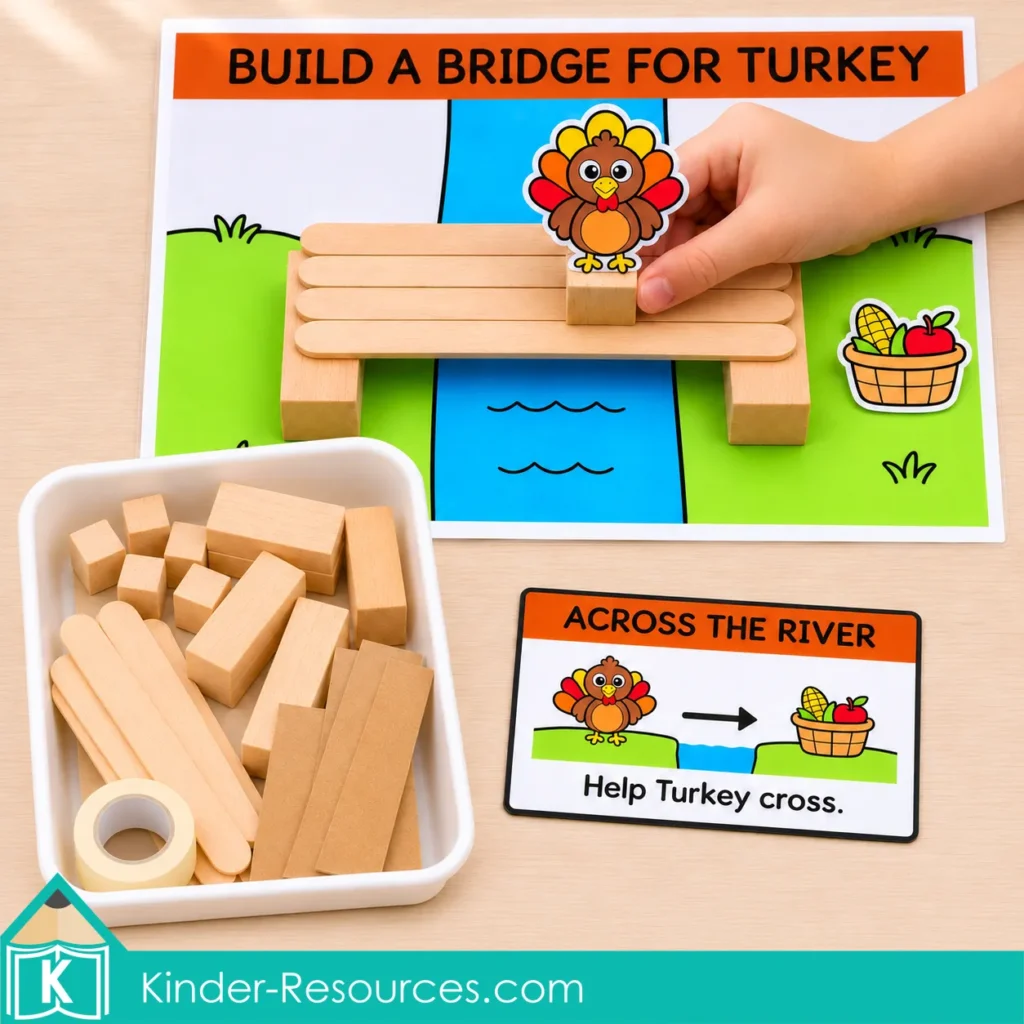
Place Turkey on one riverbank and the food basket on the other. Children choose materials from the building tub and make a bridge that reaches across the river, with support on both banks. Blocks can hold a deck made from craft sticks or sturdy cardboard.
Test the bridge by gently moving Turkey across it. If the bridge tips or bends, pause and ask, “What could we change?” Children can adjust the supports, try a different deck, and test again.
The wider-river and stronger-bridge challenge cards offer further problems to explore once their first bridge works. Encourage children to explain what they changed and whether it helped.
Directions, Extra Play Ideas, and Simple Storage
Each activity includes Teacher Directions, an illustrated How to Play page, and a More Ways to Play page. The teacher pages explain materials, preparation, learning goals, and ways to adjust the activity. The picture directions give children a reminder of what to do, while the extra play ideas help you revisit familiar materials in a new way.
Introduce one activity at a time and model a short turn before children begin. Reduce the number of choices when a task feels difficult, or invite children to explain a match, make a new pattern, or plan a different bridge when they are ready for more.
When play is finished, check the filler for hidden pieces and store each activity’s mat, cards, and tokens together. The included storage labels make the sets easier to find, and a small bag inside each activity pouch helps keep loose pieces together for next time.
Get the Thanksgiving Sensory Bins Pack
The full Thanksgiving Sensory Bins pack brings these ten activities together with printable mats, matching pieces, activity cards, teacher support, setup guidance, and storage labels.
Children can practice early math, literacy, fine motor skills, and problem solving through hands on activities with a familiar turkey theme. Choose the activities that fit your group and return to the others as children are ready for new challenges.
Happy Teaching! 😊
You Might Also Like