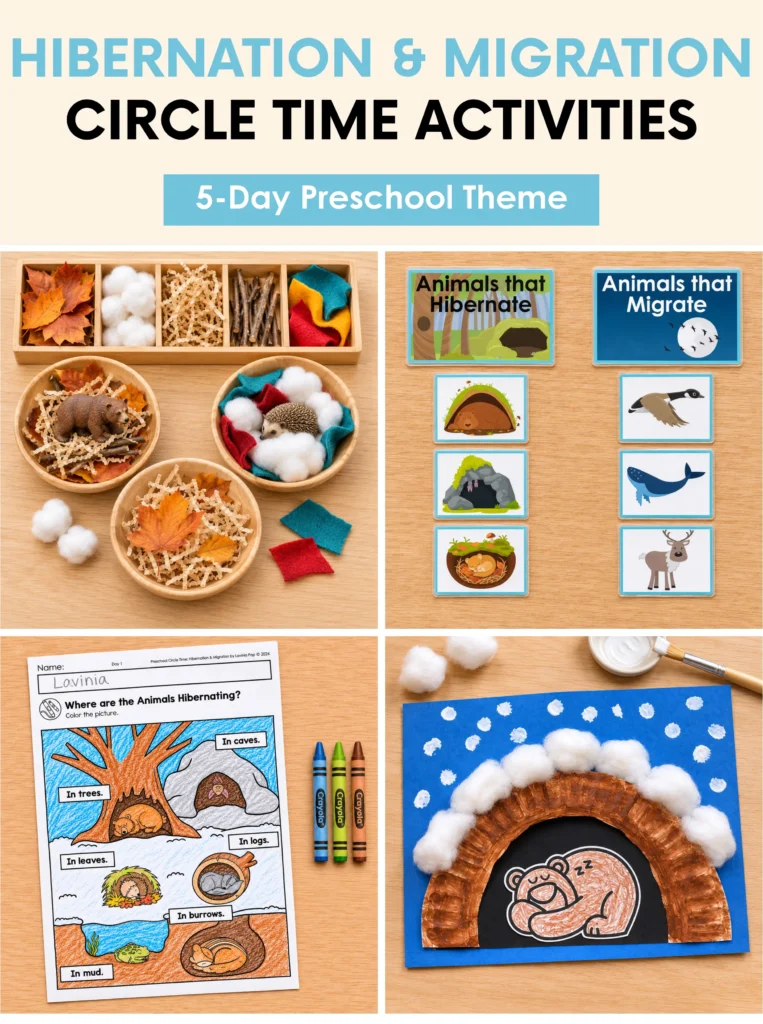
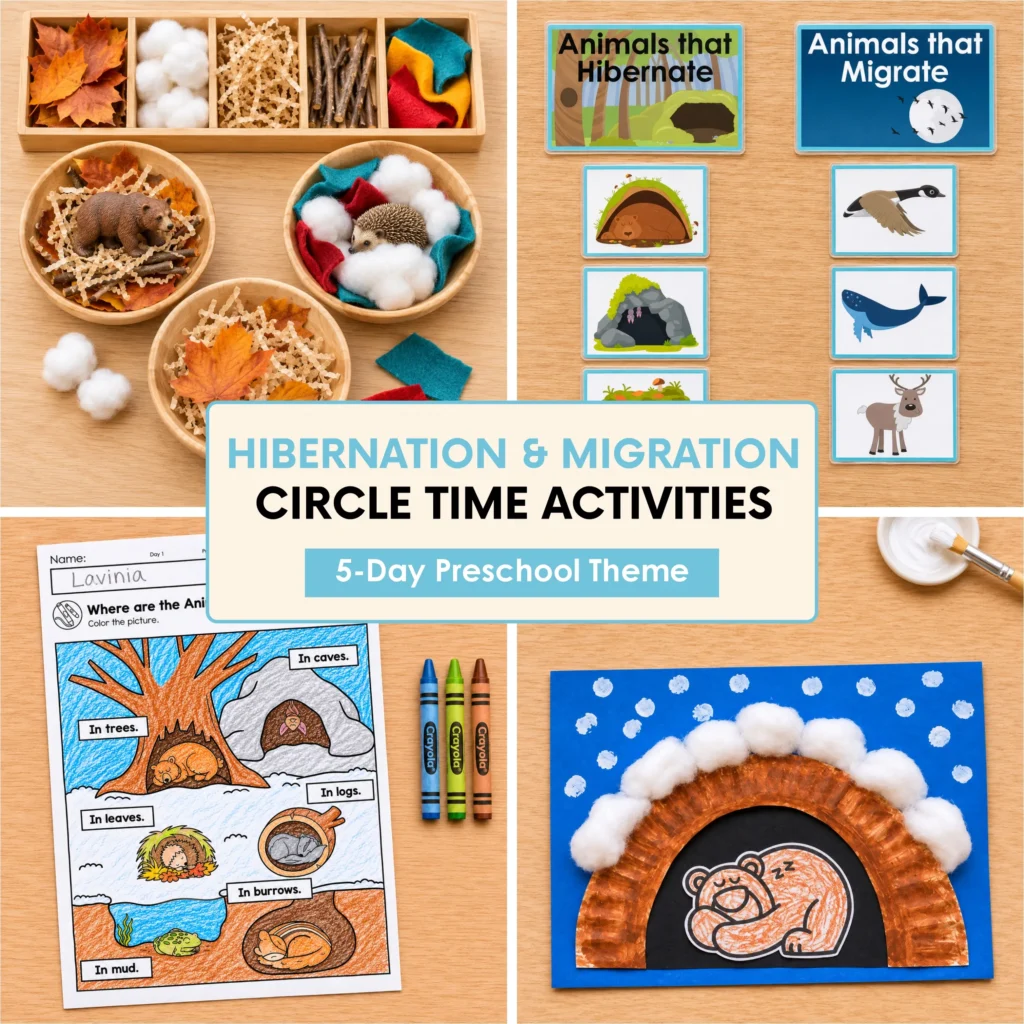
Where do animals go when winter arrives? These hibernation and migration activities for preschool give children ways to explore that question through stories, songs, crafts, sorting, and hands on discovery.
Children can make a snowy bear cave, investigate materials for a toy animal’s bed, create a sea turtle, and act out a bird’s journey. Along the way, they practice describing, comparing, counting, cutting, and sharing their ideas.
My Preschool Circle Time Hibernation & Migration packet brings the theme together in five days of lessons and printable activities. Follow the sequence for a themed week, or choose activities for your preschool, Pre-K, kindergarten, or homeschool group.
Free Hibernation and Migration Printable Sample
Take a closer look at the resource with a free printable sample. You can explore the lesson format and selected materials before planning your week of winter animal learning.

Planning Hibernation and Migration Activities for Preschool
Begin with a short conversation, introduce a song or picture prop, and share the day’s suggested book. The craft, investigation, and additional printables can follow during small groups or centers.
You can spread one day’s ideas across several sessions. Choose the activities that suit your children, and leave time to revisit an interesting question or favorite story.
| Day | Circle time focus | Suggested book | Main activity |
|---|---|---|---|
| 1 | What is hibernation? | Bear Snores On by Karma Wilson | Bear in a Cave Craft |
| 2 | Why do animals hibernate? | Time to Sleep by Denise Fleming | Animal Bedding Investigation |
| 3 | What is migration? | Home at Last: A Song of Migration by April Pulley Sayre | Paper Plate Sea Turtle Craft |
| 4 | Why do animals migrate? | Is This Panama? A Migration Story by Jan Thornhill | Migration Bird Craft |
| 5 | Comparing hibernation and migration | Animals in Winter by Henrietta Bancroft and Richard G. Van Gelder | Animal Sorting Activity |
Gather the suggested books, song props, paper plates, construction paper, crayons, paint, glue, scissors, tissue paper, cotton balls, and materials for the bedding investigation. The storybooks are borrowed or purchased separately; they are not included in the printable packet.
Explaining Hibernation and Migration to Preschoolers
Start with words children can use during their play:
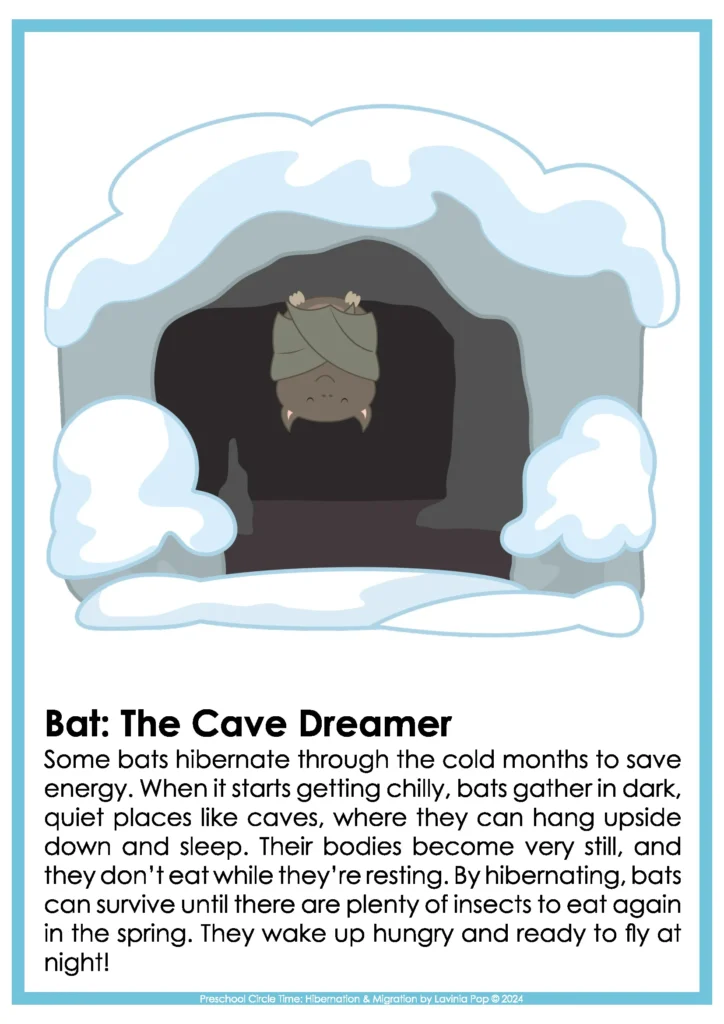
- Hibernate: An animal’s body slows down so it uses less energy when food is hard to find.
- Migrate: Animals travel between places to find food, suitable conditions, or places to have their young.
- Den: A sheltered place an animal uses.
- Compare: Look for things that are the same and things that are different.
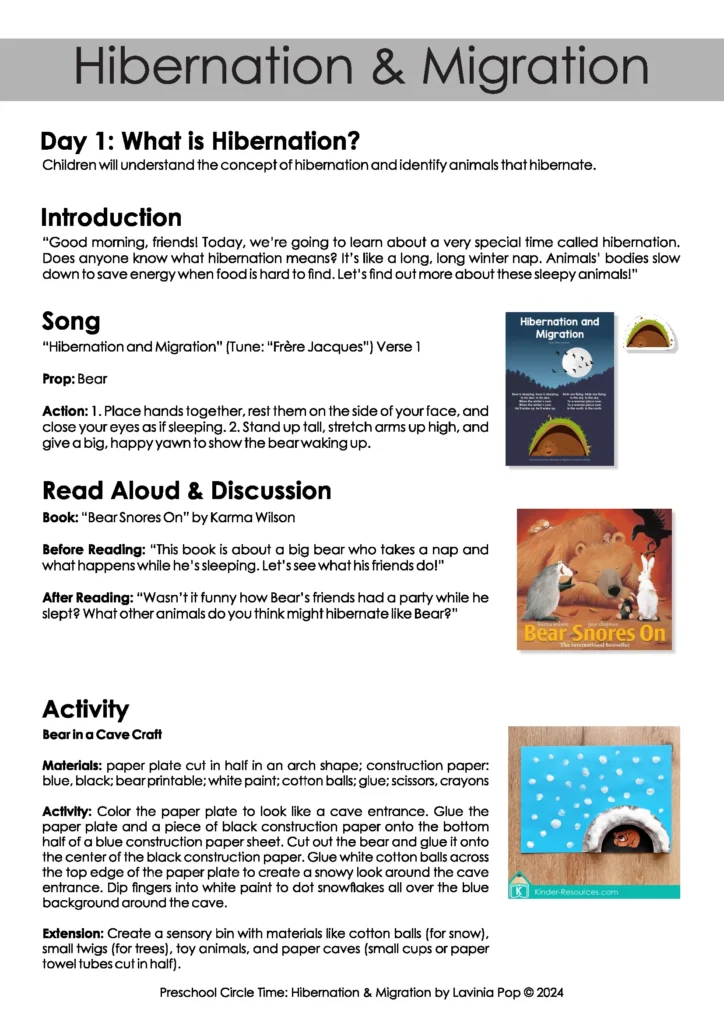
You might introduce hibernation by saying, “A bear’s body slows down during winter. It uses energy stored in its body.” Bears prepare by building fat reserves and may use several different kinds of dens.
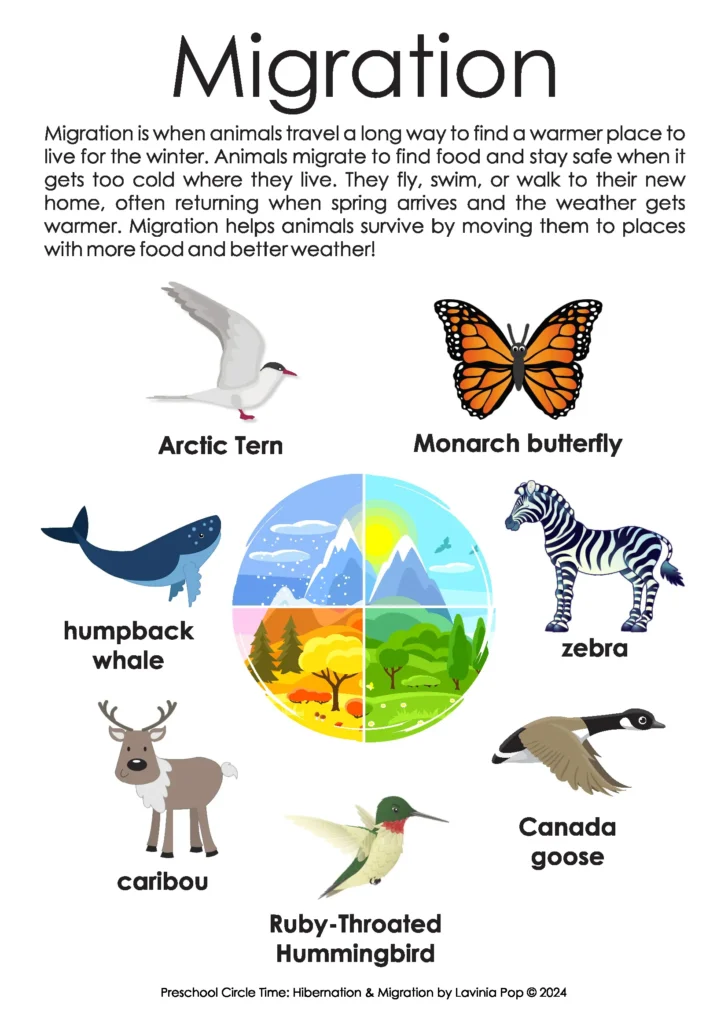
For migration, try, “When an animal cannot find what it needs in one place, it may travel to another place.” Food is an important part of this discussion. Birds migrate to take advantage of resources, including food and suitable breeding places.
Use specific animal examples and the word some. Some birds migrate, while others stay in the same area. Children can learn the main ideas without needing to memorize every animal’s winter behavior.
A Hibernation and Migration Song with Picture Props
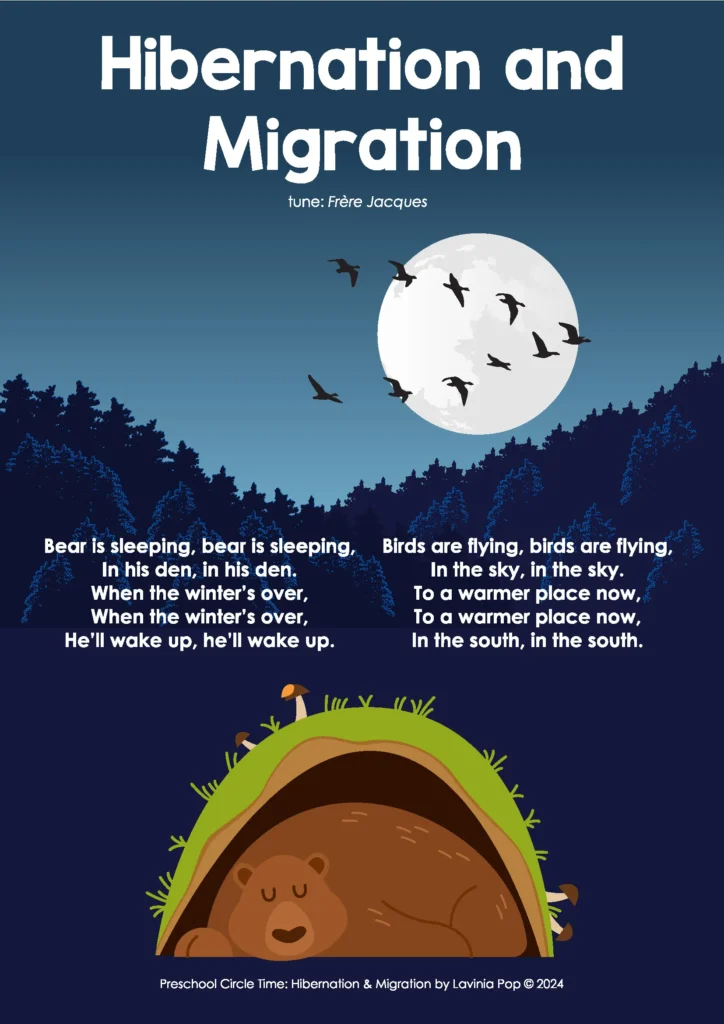
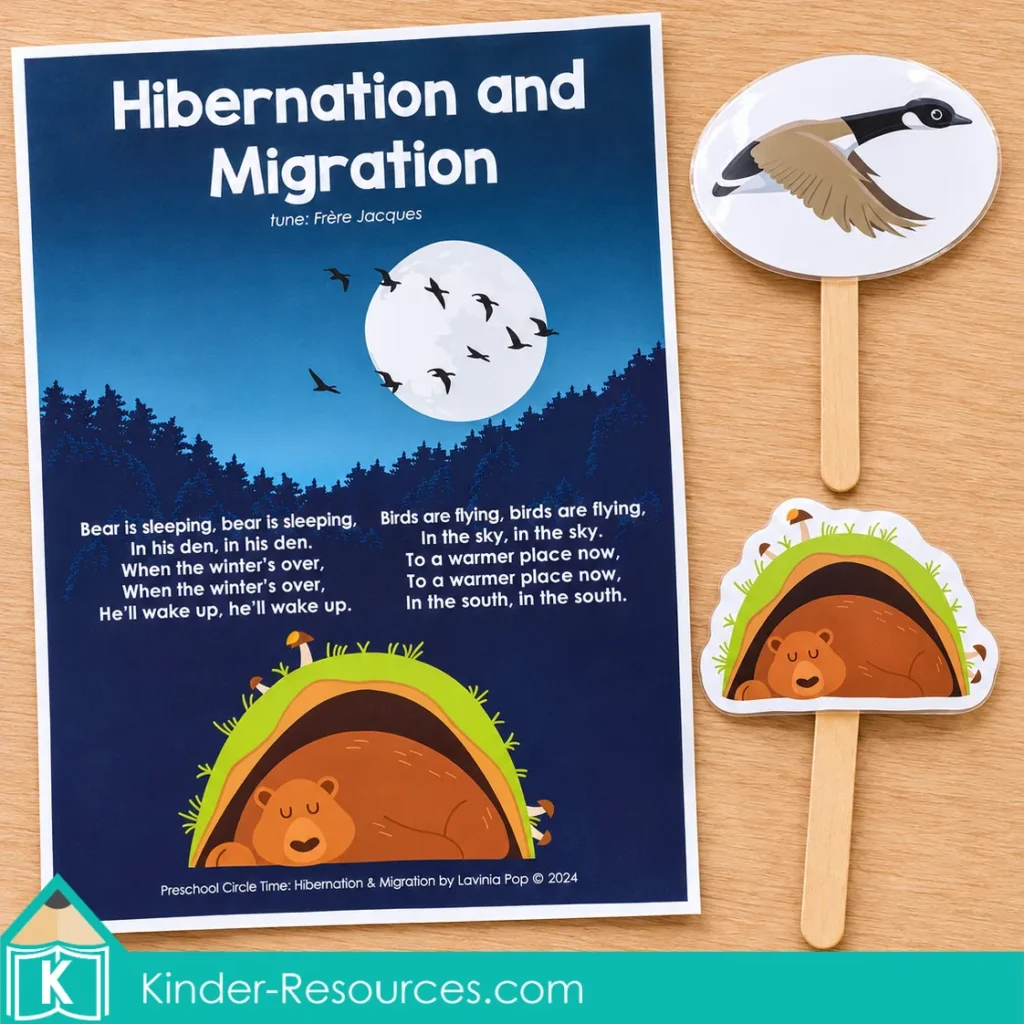
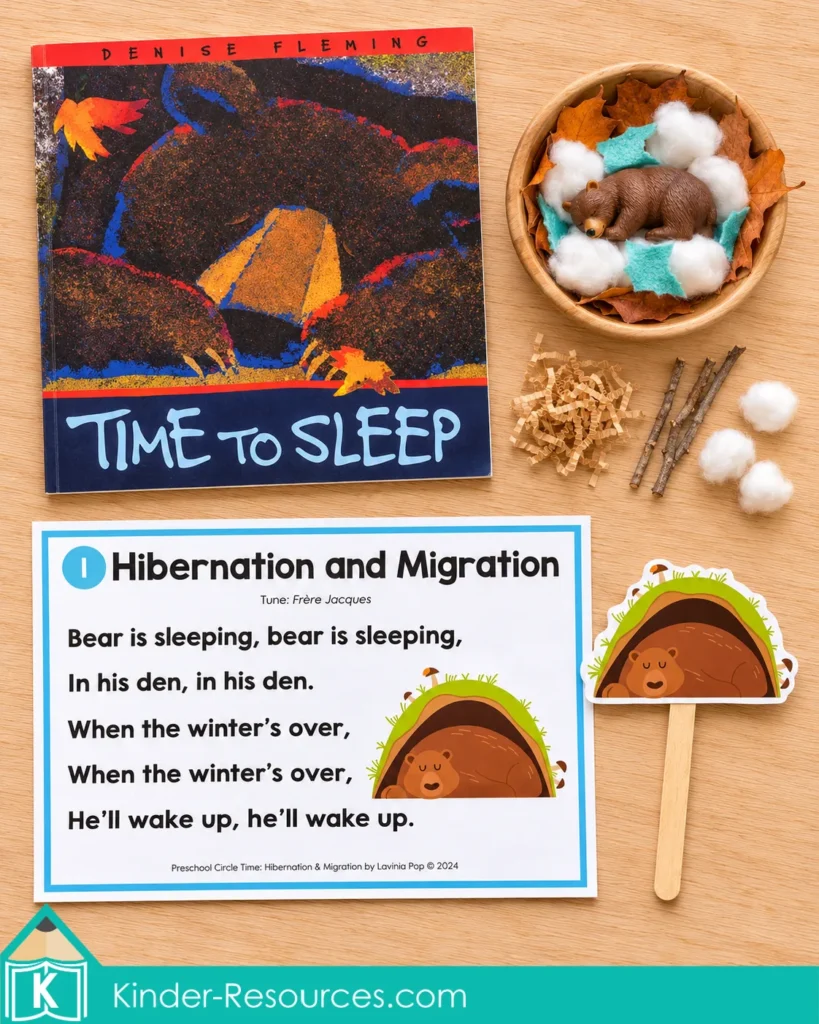
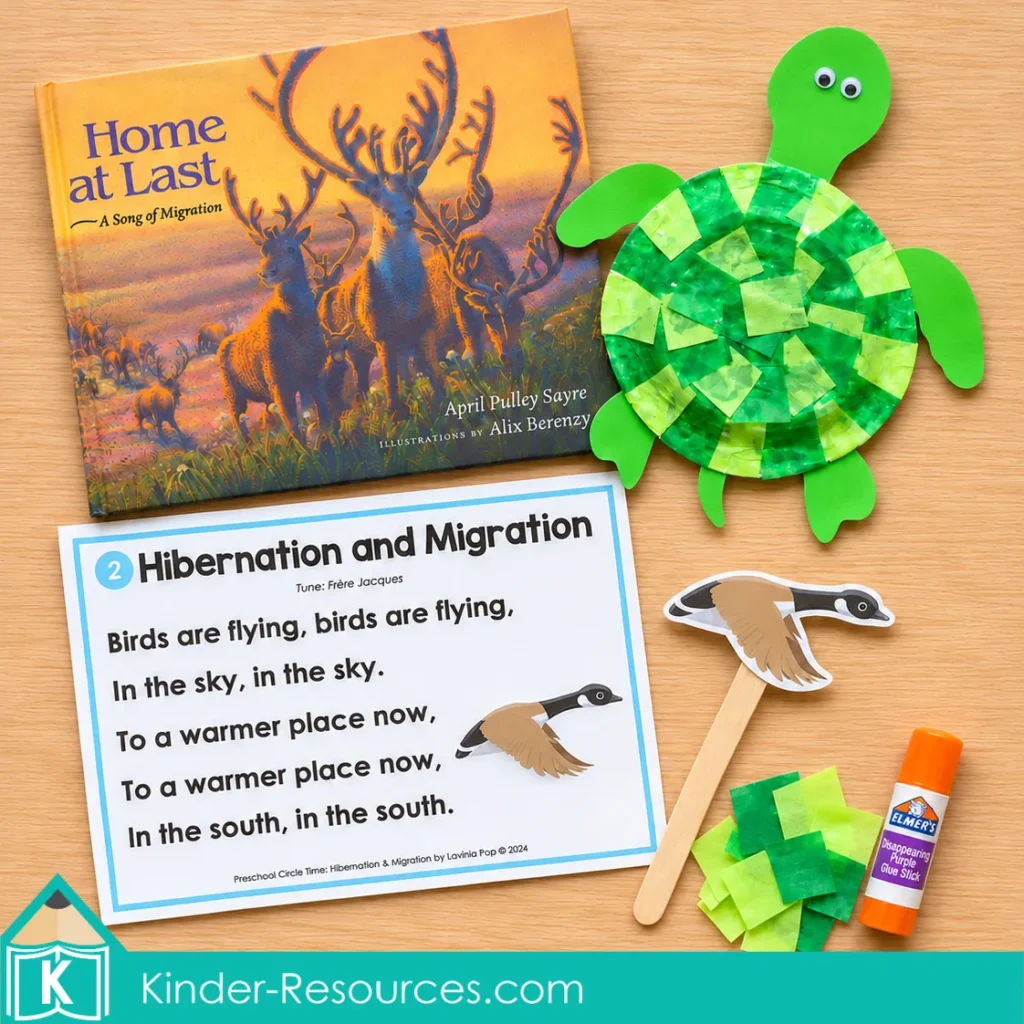
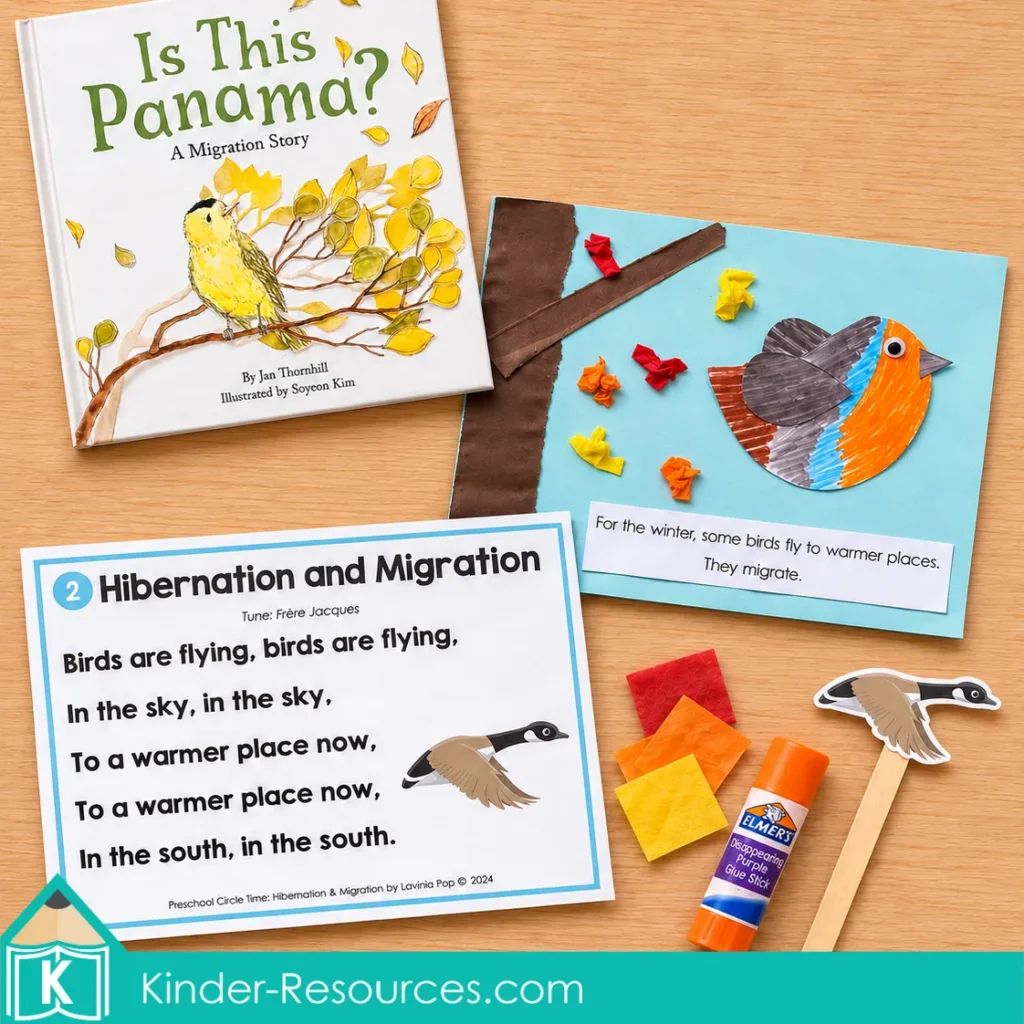
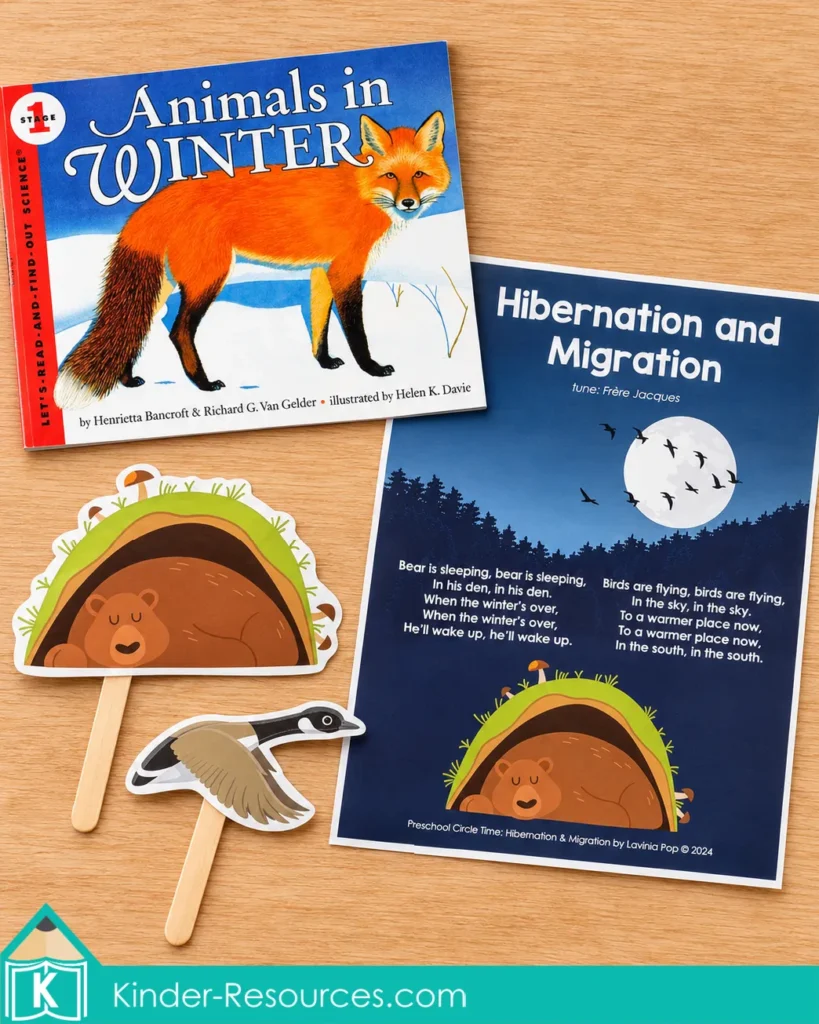
The packet’s Hibernation and Migration song uses the tune of Frère Jacques. It includes a complete song poster, separate bear and bird verse cards, and matching picture props.
Introduce the bear verse during the first two days. Children can rest their heads on their hands, then stretch as the bear wakes. Add the bird verse when you introduce migration, inviting children to move their arms like wings.
Attach the bear and goose pictures to craft sticks. Children can hold up a prop, copy an action, or join in with a familiar part of the song. On the final day, sing both verses and talk about the two different animal behaviors.
Day 1 — What Is Hibernation?
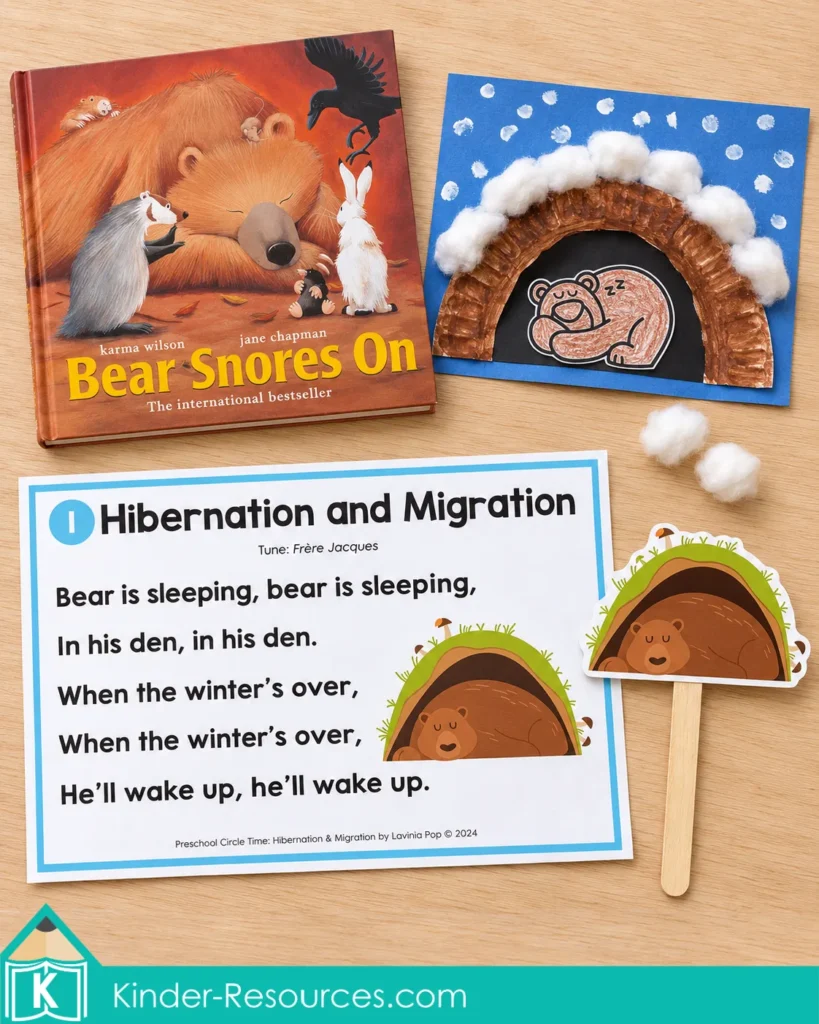
Begin with Bear Snores On by Karma Wilson. Look at the cover and invite children to predict what might happen while Bear sleeps.
After reading, talk about the characters and events:
- What were Bear’s friends doing while he slept?
- How did Bear feel when he woke up?
- What makes the cave a sheltered place?
Enjoy the story’s pretend animal party, then connect it with a simple real-world idea: some animals spend winter resting in sheltered places while their bodies use less energy.
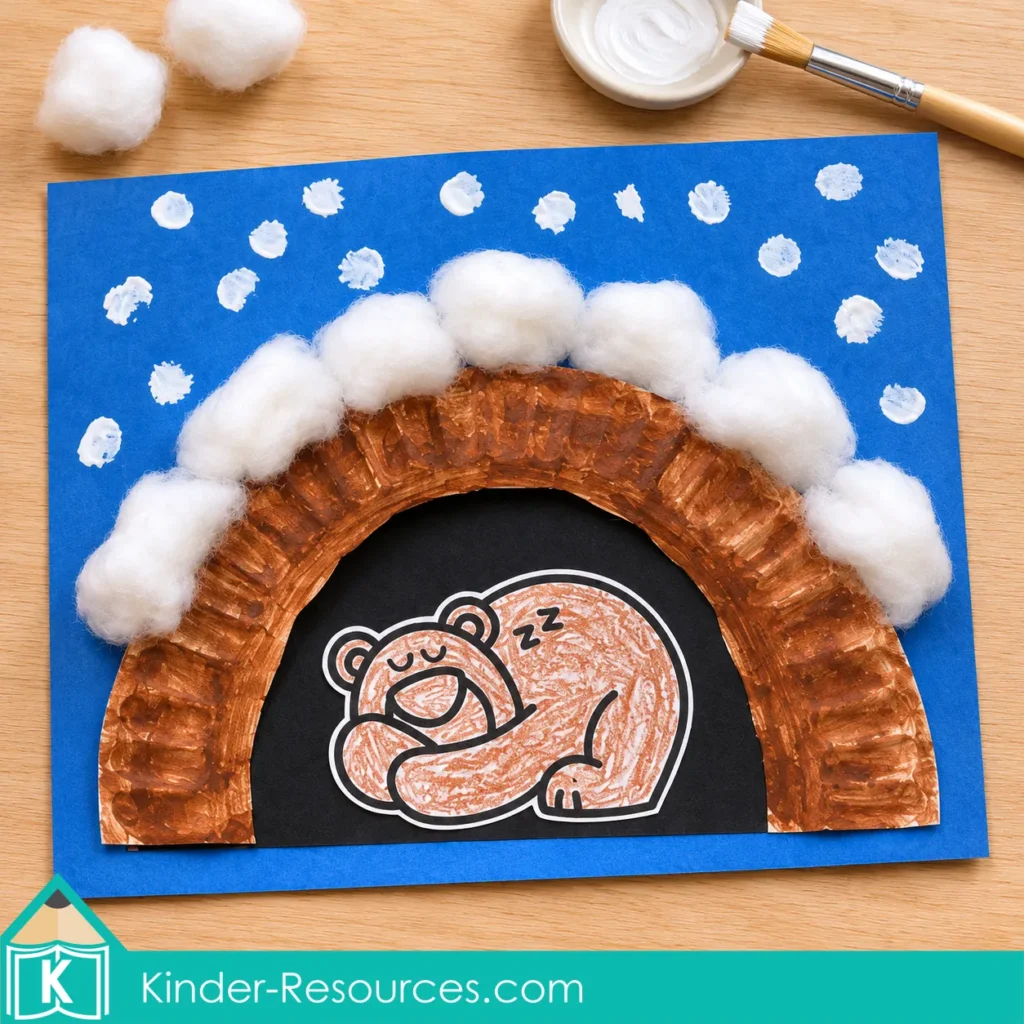
Hibernation Activities: Make a Bear in a Snowy Cave
Use a paper plate arch to make the cave entrance. Children paint or color it, then glue it over black paper on a blue background.
Add the colored sleeping bear inside the cave. Cotton balls along the top become snow, and dots of white paint create falling snowflakes.
As children assemble their pictures, use position words such as inside, above, around, and under. Ask them to describe where they placed the bear and the snow.
Explore Winter Animal Shelters
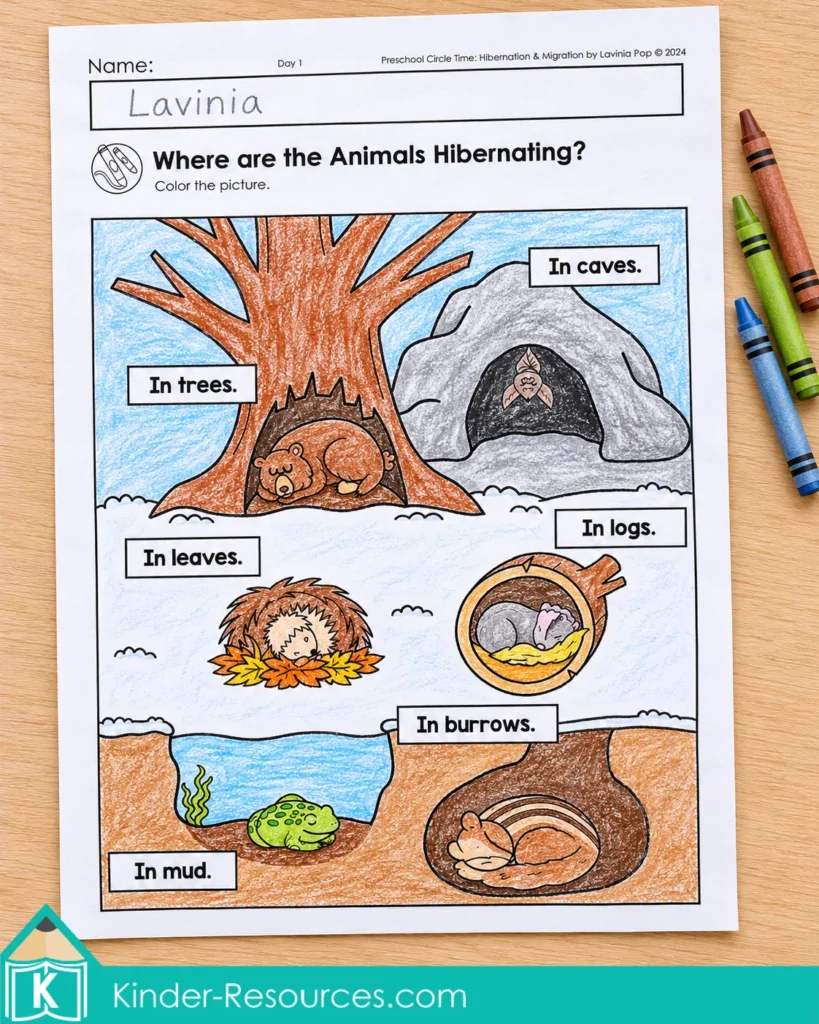
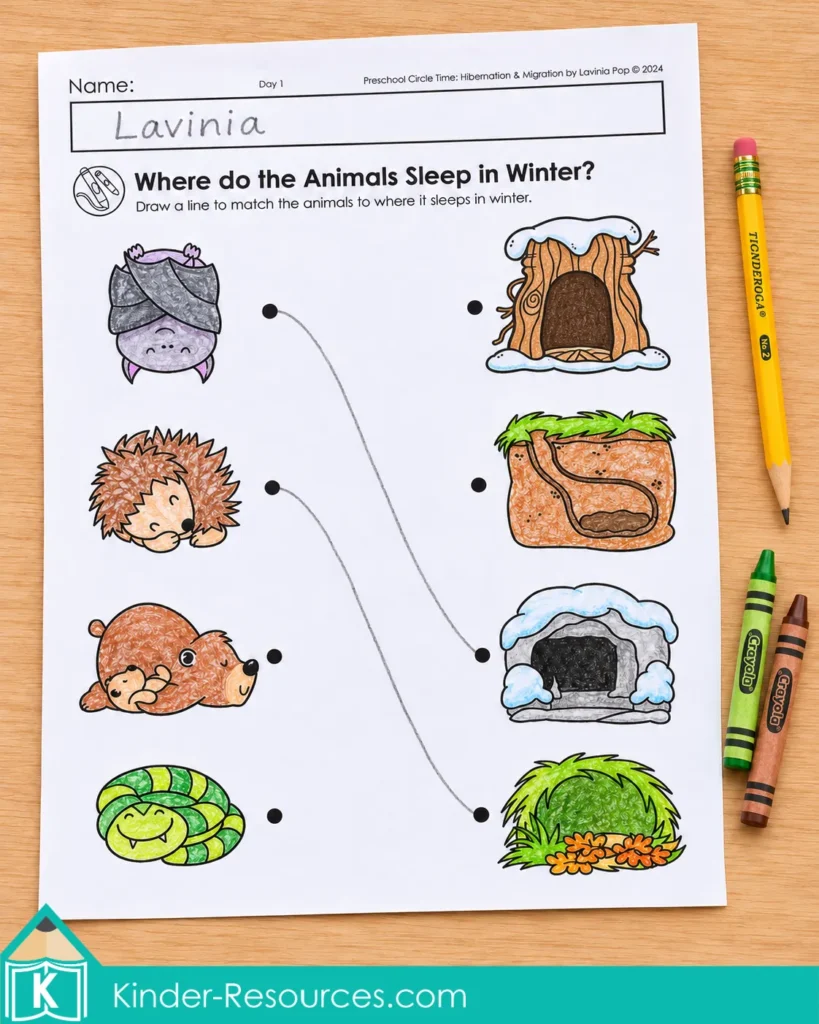
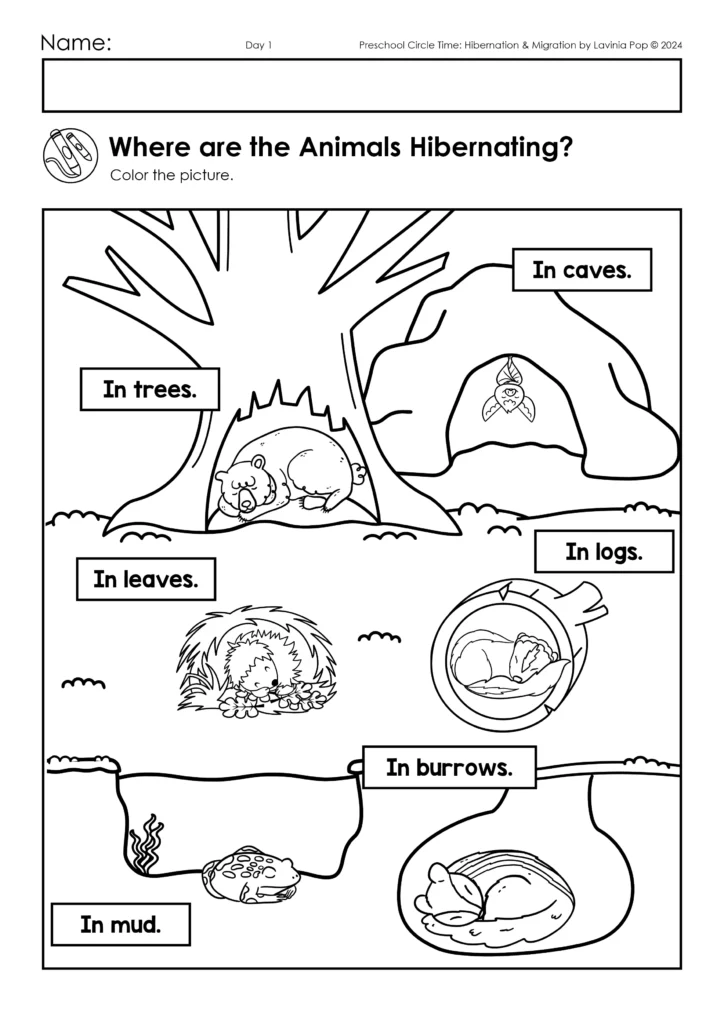
The Where Are the Animals Hibernating? coloring page and Where Do the Animals Sleep in Winter? matching page provide another way to discuss shelters.
Name the animals and look closely at each setting before children begin. Invite them to trace a matching route with a finger before drawing a line.
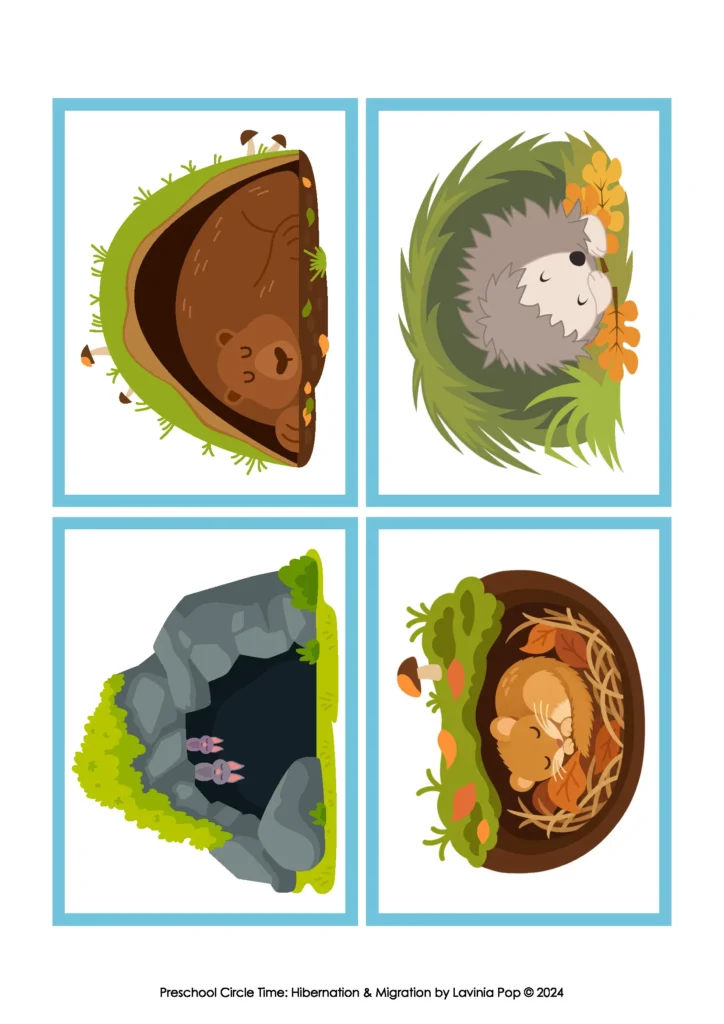
The hollow tree and cave pictures also give children a reason to compare shelters. A bear’s den can take different forms; the picture shows one possible place an animal might use.
Day 2 — Why Do Animals Hibernate?
Read Time to Sleep by Denise Fleming and talk about the signs that winter is approaching. Revisit the idea that hibernation helps animals save energy when food becomes harder to find.
Ask, “What did the animals notice?” and “What did they do next?” Children can use the pictures to explain their answers.
Investigate Animal Bedding Materials
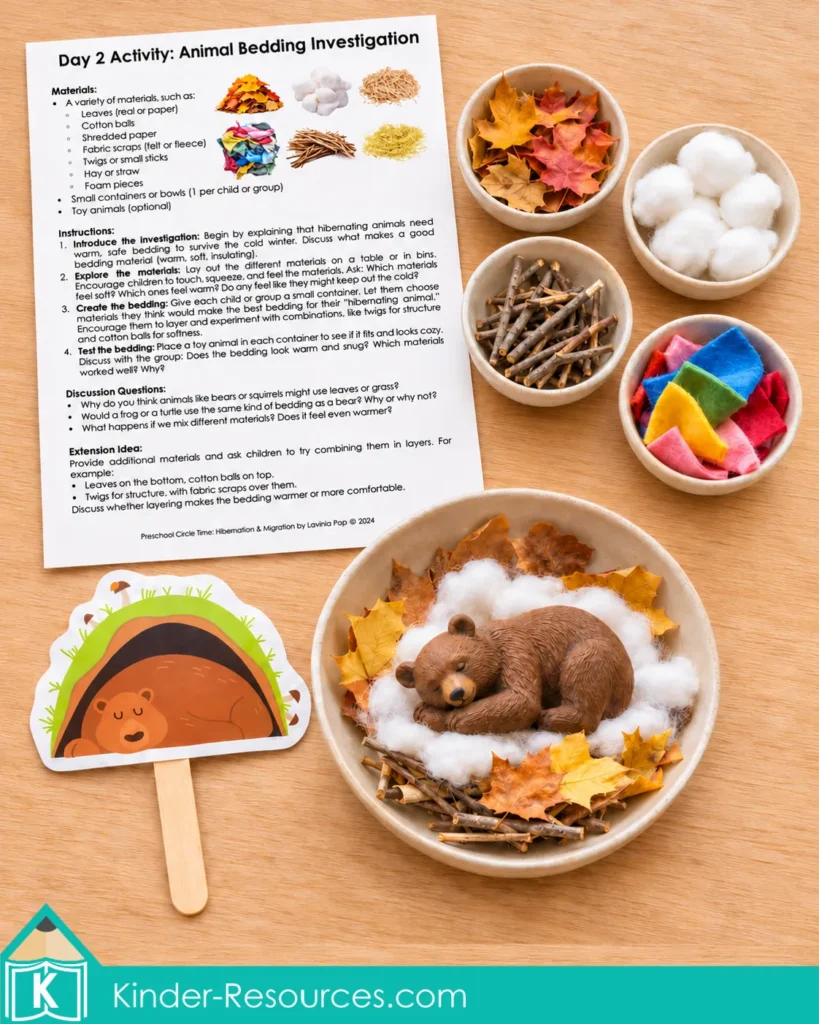
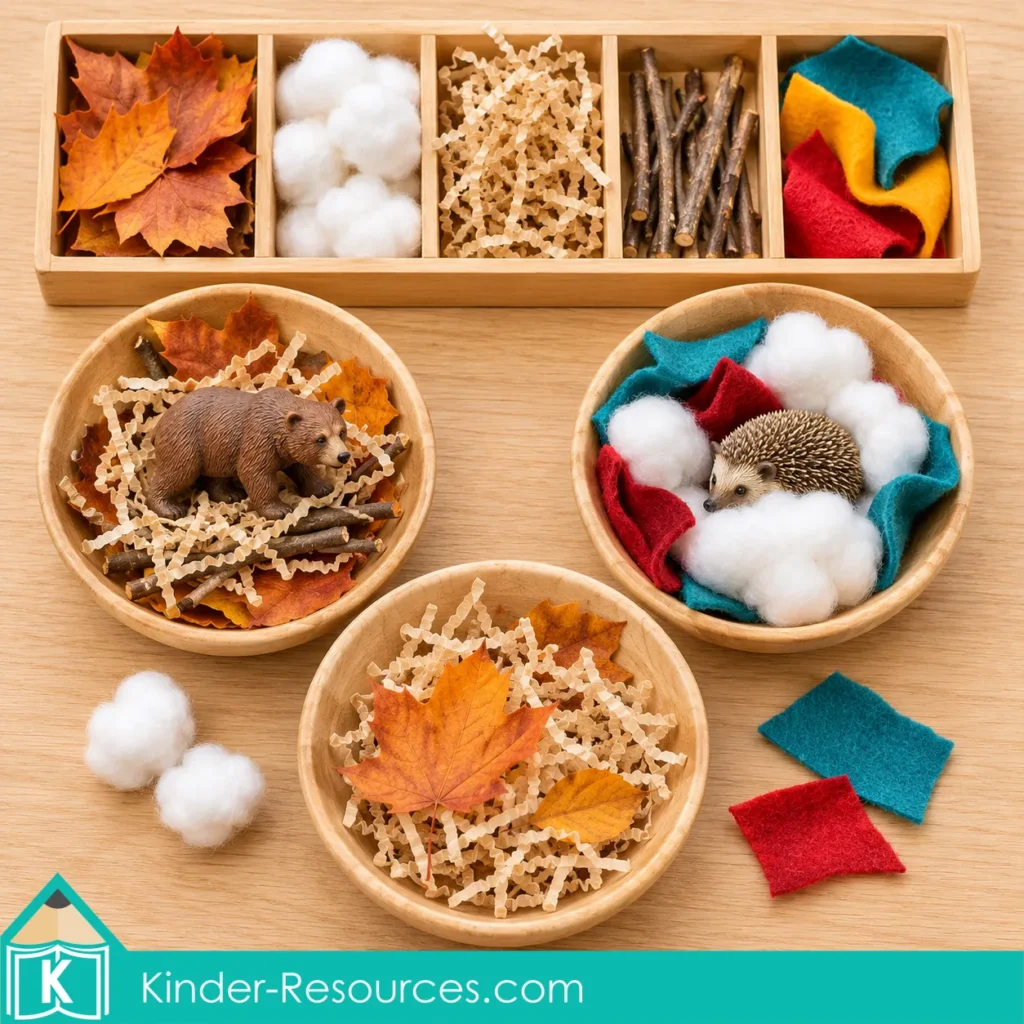
For the Animal Bedding Investigation, set out leaves, shredded paper, fabric scraps, cotton balls, and small sticks. Give children a bowl or container and a toy animal.
Invite them to feel and compare the materials before choosing what to use. They can arrange a base, add a softer layer, and adjust the space until their toy fits.
Useful questions include:
- Which materials bend, squash, or keep their shape?
- What happens when you put one material on top of another?
- How could you make more room for your animal?
- What would you change if you built it again?
Keep the focus on observations, choices, and changes. These are model animal beds made with classroom materials; feeling soft does not tell us which material would keep a real animal warmest.
Invite children to explain one choice while you record their words. Open-ended questions encourage children to observe, describe, and share their thinking.
Talk About a Bear’s Fall Foods
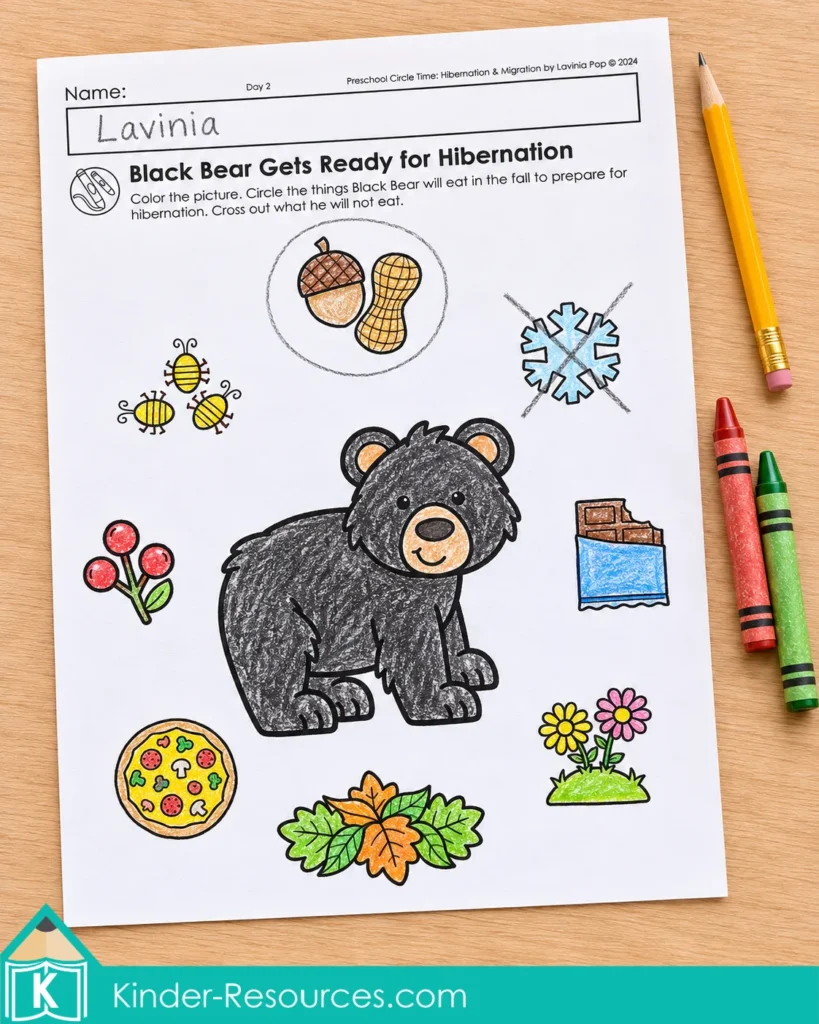
Use Black Bear Gets Ready for Hibernation to connect fall feeding with winter preparation. Name the pictured items together before children circle their choices and cross out the other pictures.
Ask children to explain one choice using the sentence starter, “I think the bear would eat ___ because ___.” Return to an animal information poster when they need help checking an idea.
Make a Hibernation Flipbook
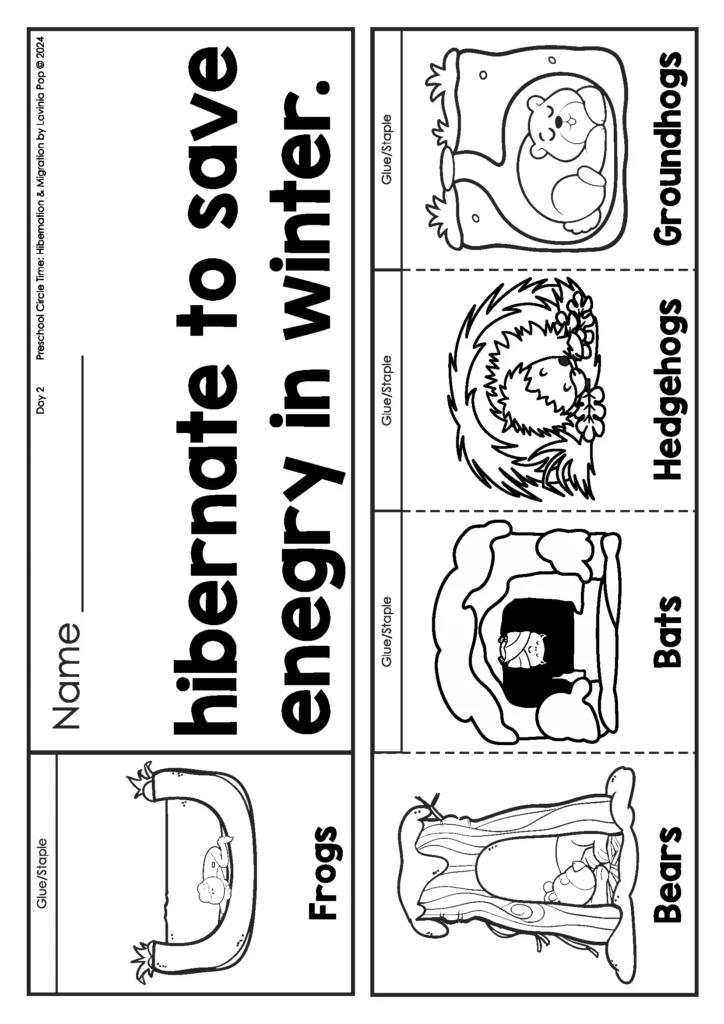
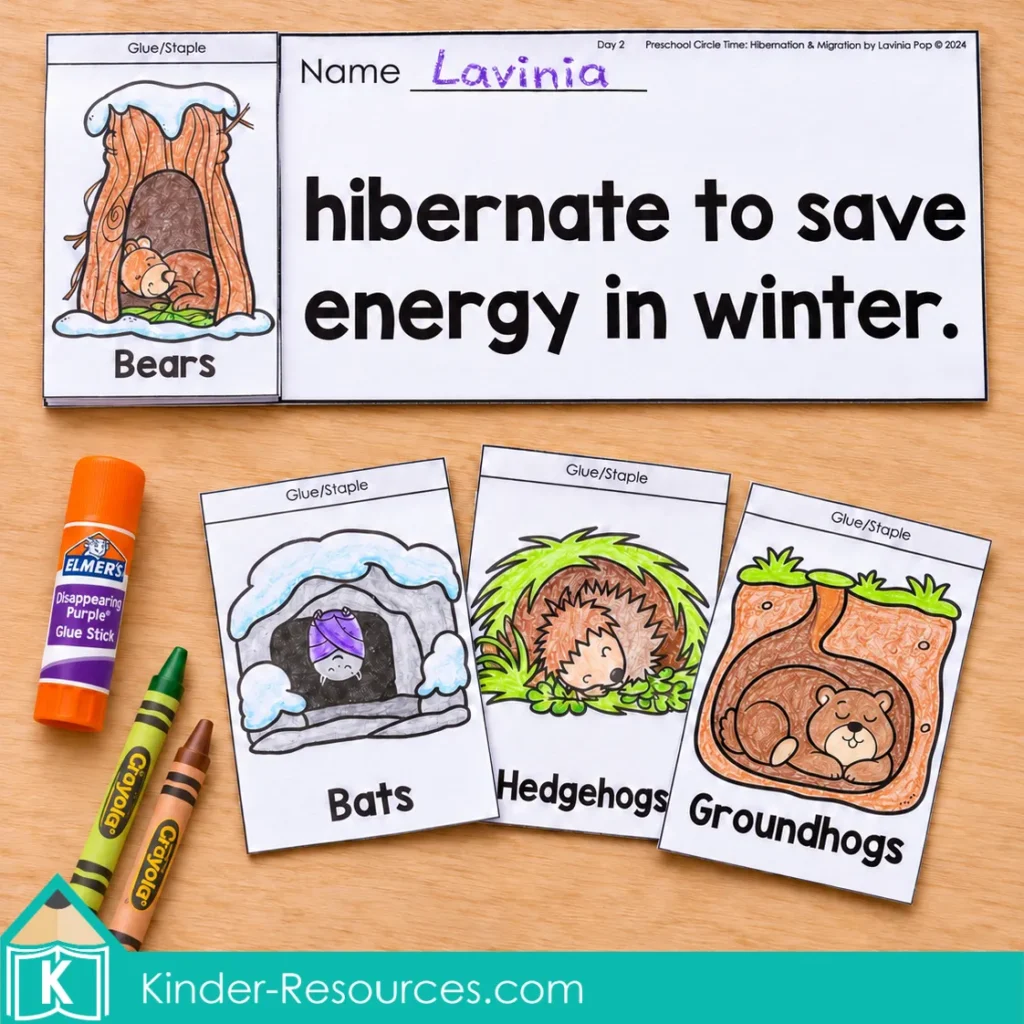
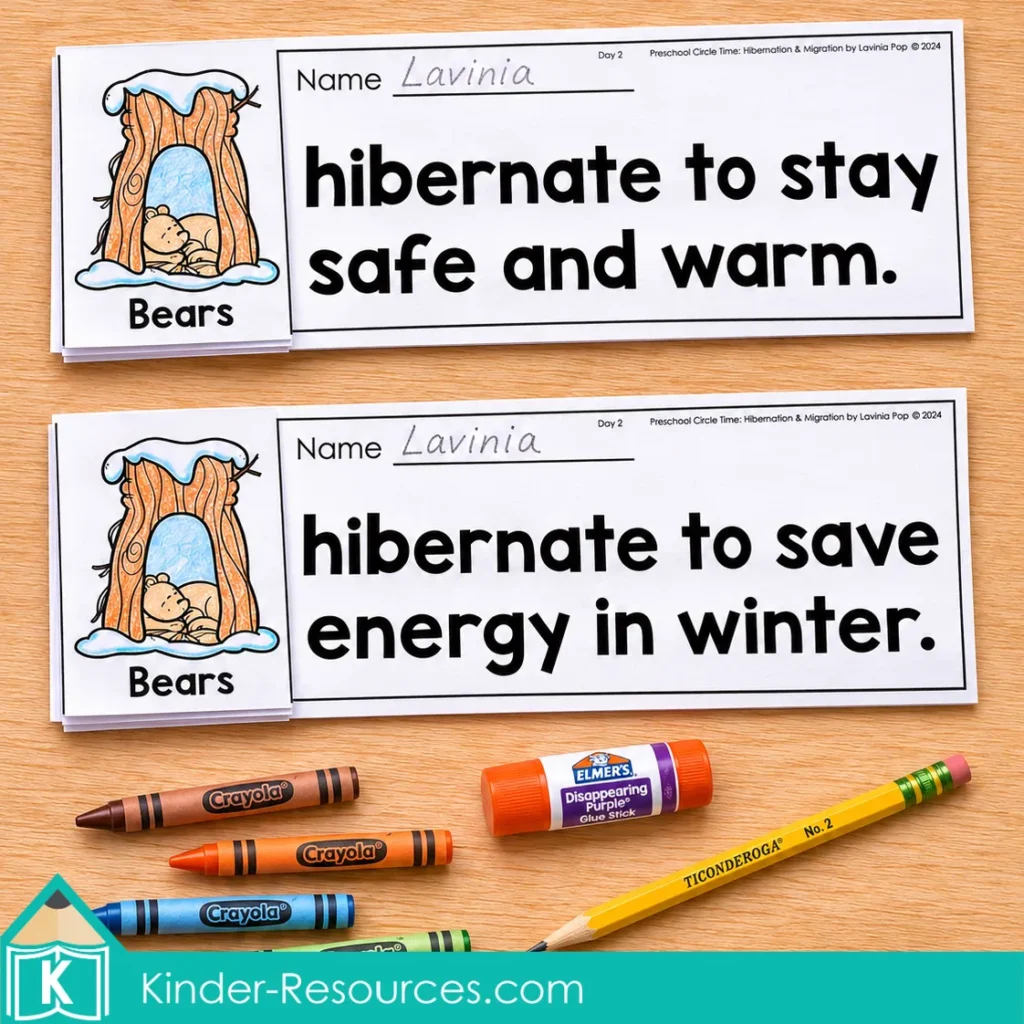
The hibernation flipbook features bears, bats, hedgehogs, and groundhogs. Children color the pictures, help assemble the flaps, and turn them as an adult reads the sentence.
The packet includes both “hibernate to stay safe and warm” and “hibernate to save energy in winter” versions. Choose the wording that fits your discussion, and use the repeated sentence for shared reading.
Children can point to the animal, name it, and join in with the familiar words. They do not need to read the whole sentence independently.
Day 3 — What Is Migration?
Introduce migration with Home at Last: A Song of Migration by April Pulley Sayre. Look for the different animals in the book and discuss how they move.
Migration gives you a useful opportunity to compare flying, swimming, and walking. Invite children to show a movement with their hands or move a toy animal along a pretend route.
Create a Paper Plate Sea Turtle
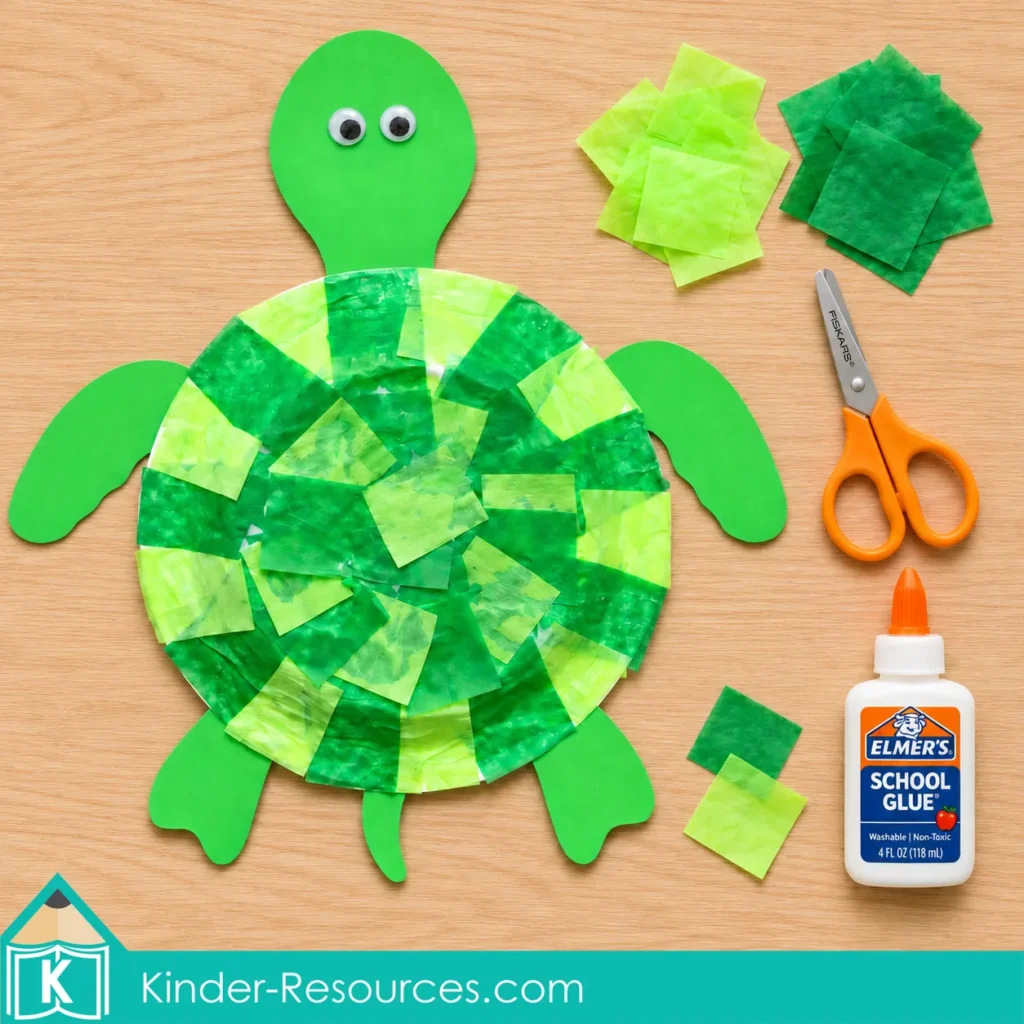
Children cover a paper plate with light and dark green tissue paper squares. Attach the turtle’s head, flippers, and tail, then add eyes to complete the craft.
Talk about the flippers and how the turtle moves through water. Sea turtles travel between feeding areas and nesting beaches, making them a helpful example of migration through the ocean.
For a simple extension, place blue paper between two pretend destinations and invite children to move their turtle along the ocean route.
Follow Paths and Sort Migrating Animals
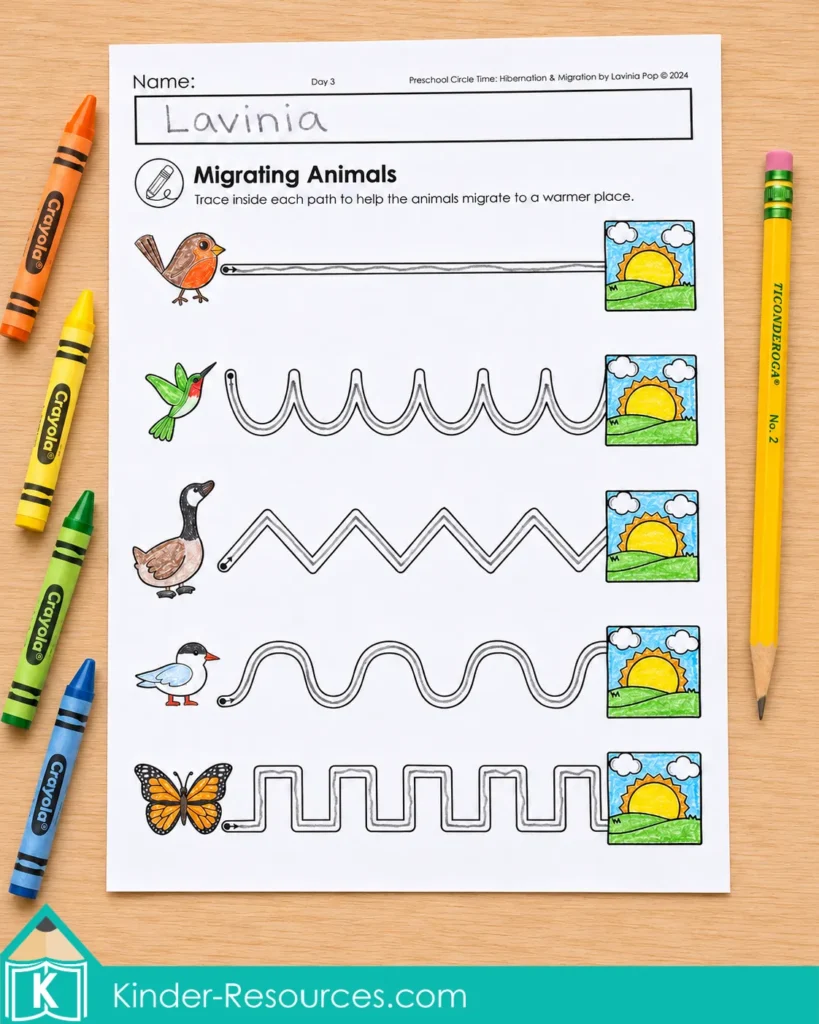
The Migrating Animals tracing page includes several types of paths. Children can follow each one with a finger before using a pencil or crayon.
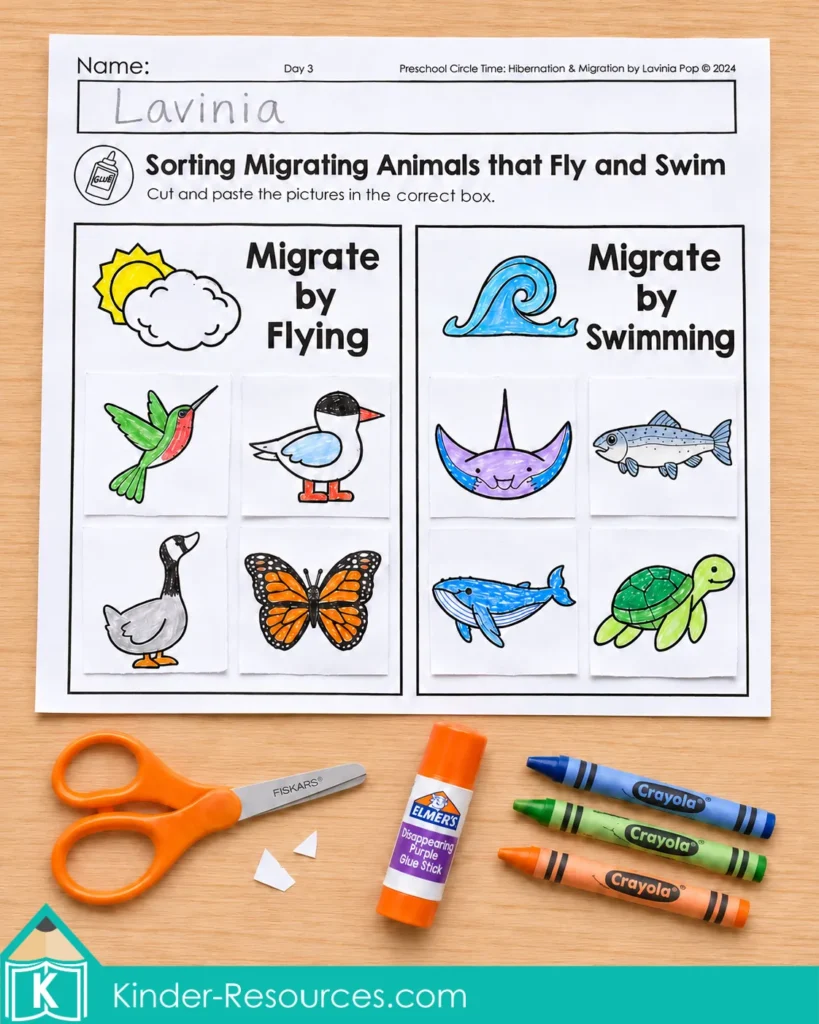
The Sorting Migrating Animals That Fly and Swim page adds classification practice. Name the animals, discuss how they travel during migration, and let children arrange the pieces before gluing them down.
Talk about the journey shown. For example, a goose can swim, but it travels long migration routes by flying.
Day 4 — Why Do Animals Migrate?
Read Is This Panama? A Migration Story by Jan Thornhill. Follow the little bird’s journey and invite children to think about what an animal needs along the way.
You might ask:
- Where could the bird stop to rest?
- What might it need to eat?
- How might its next destination be different?
Return to the idea that animal journeys are connected with finding suitable places and resources.
Migration Activities: Create a Paper Bird
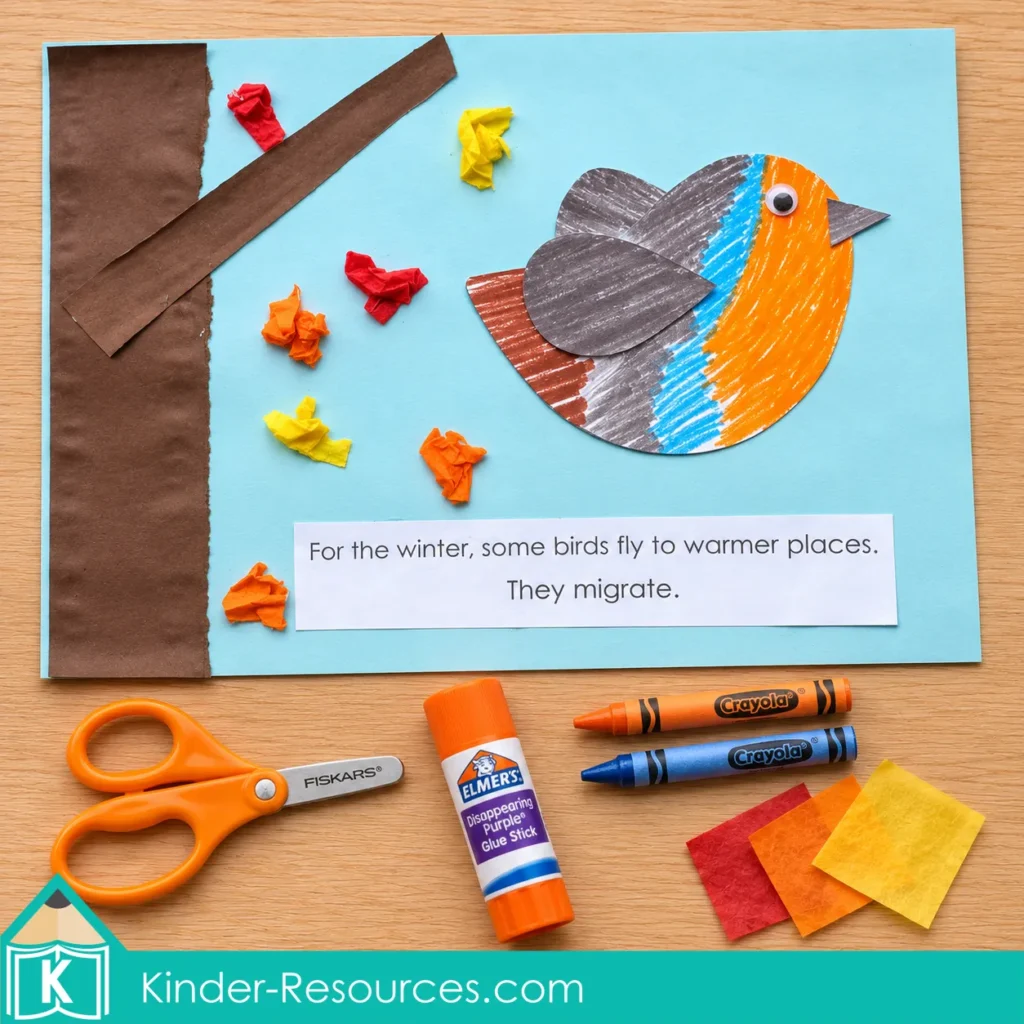
Children color and assemble the bird, then create a tree and falling autumn leaves on a separate background. Torn or scrunched tissue paper gives them another material to explore.
Add the sentence strip explaining that some birds fly to warmer places for winter. Invite children to tell a short story about their bird: where it started, where it is going, and what it might see.
You can write their words on the back of the finished craft or display them alongside it.
Count and Match Butterflies
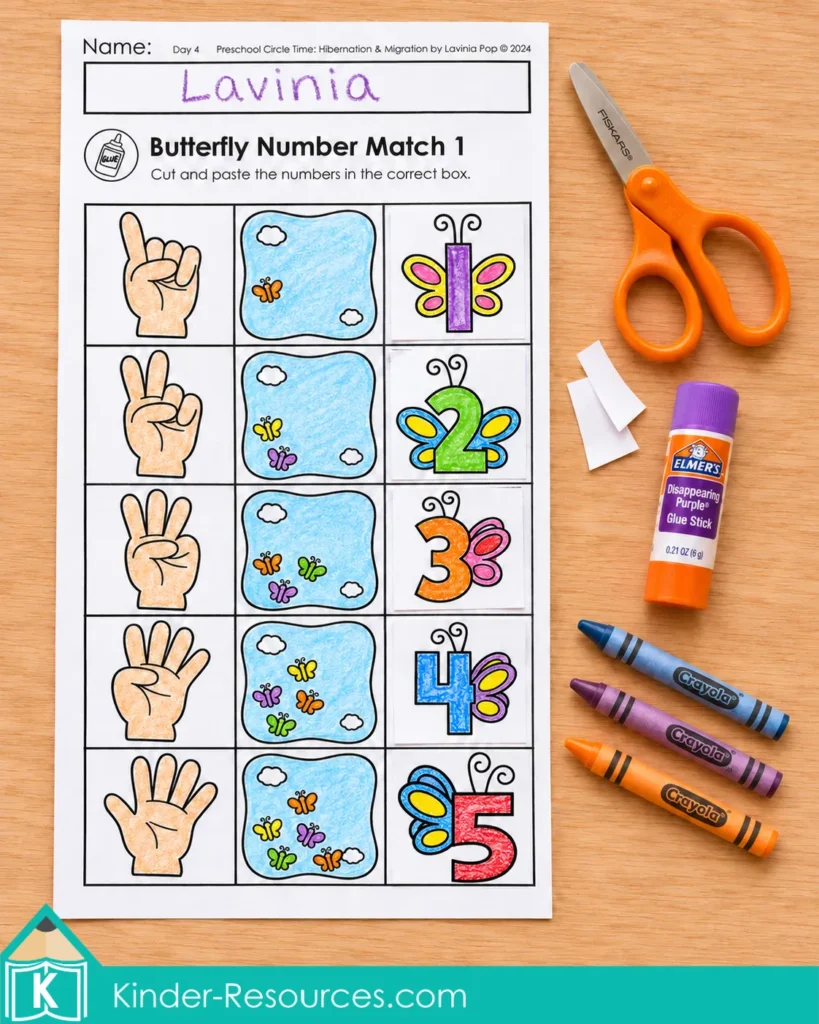
The Butterfly Number Match activities connect numerals with quantities and finger representations. The two pages cover 1–5 and 6–10.
Offer the range that suits each child. Encourage children to touch each butterfly as they count, then find the matching numeral. They can show the same number on their own fingers before checking the printed hand picture.
Assemble a Migration Flipbook
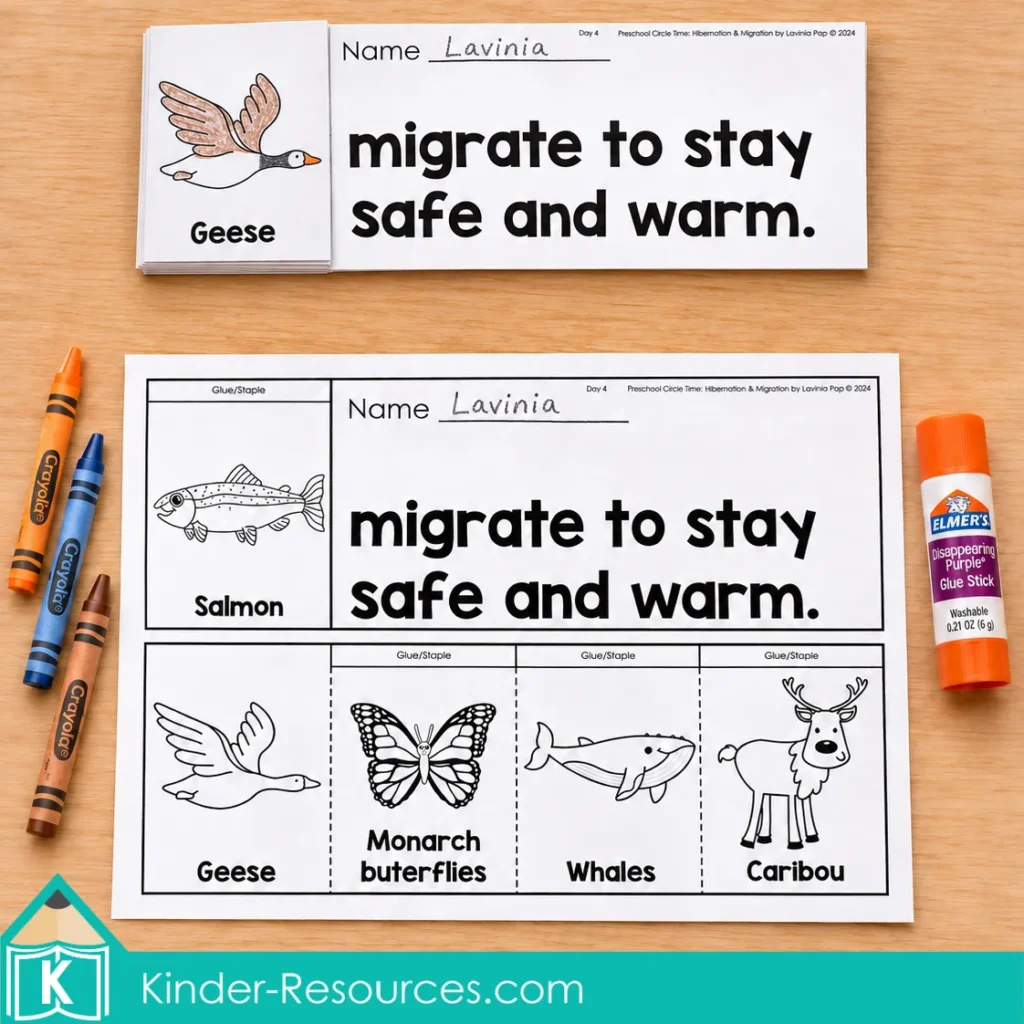
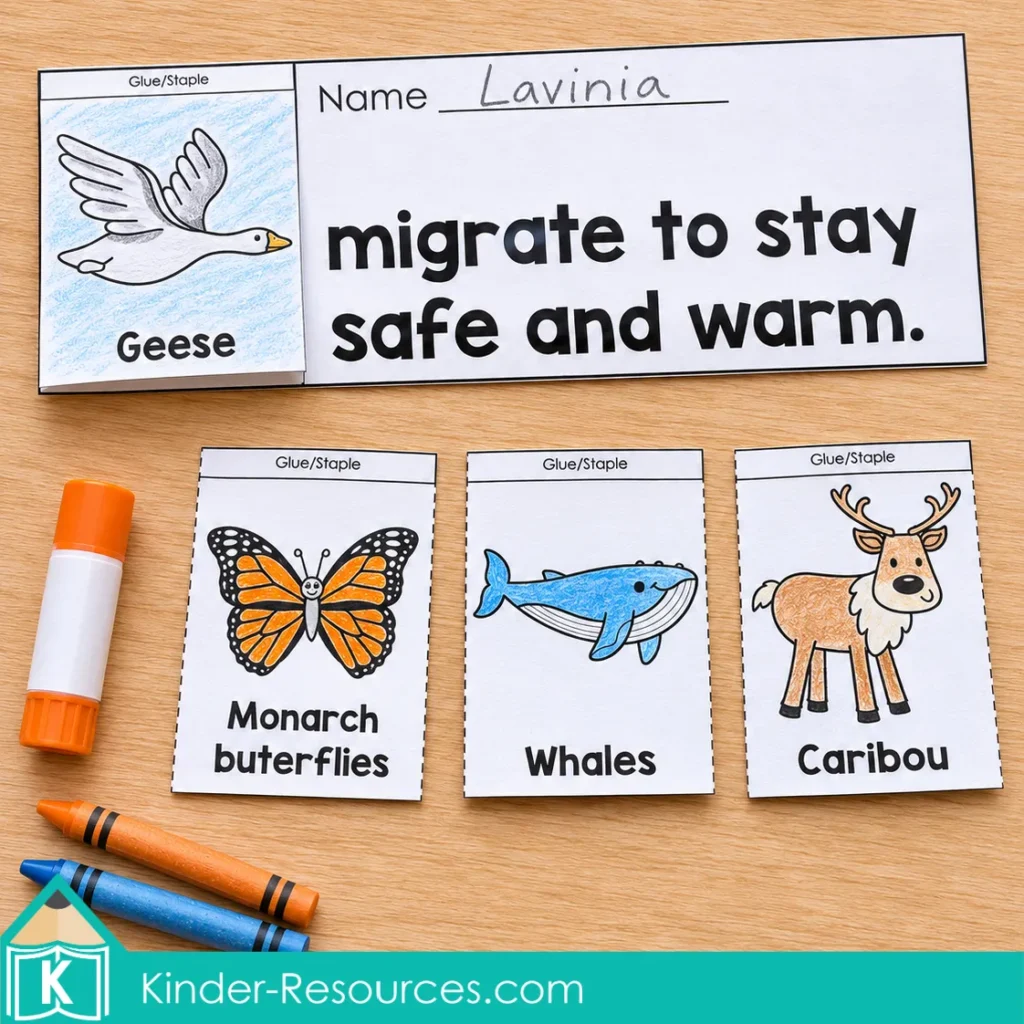
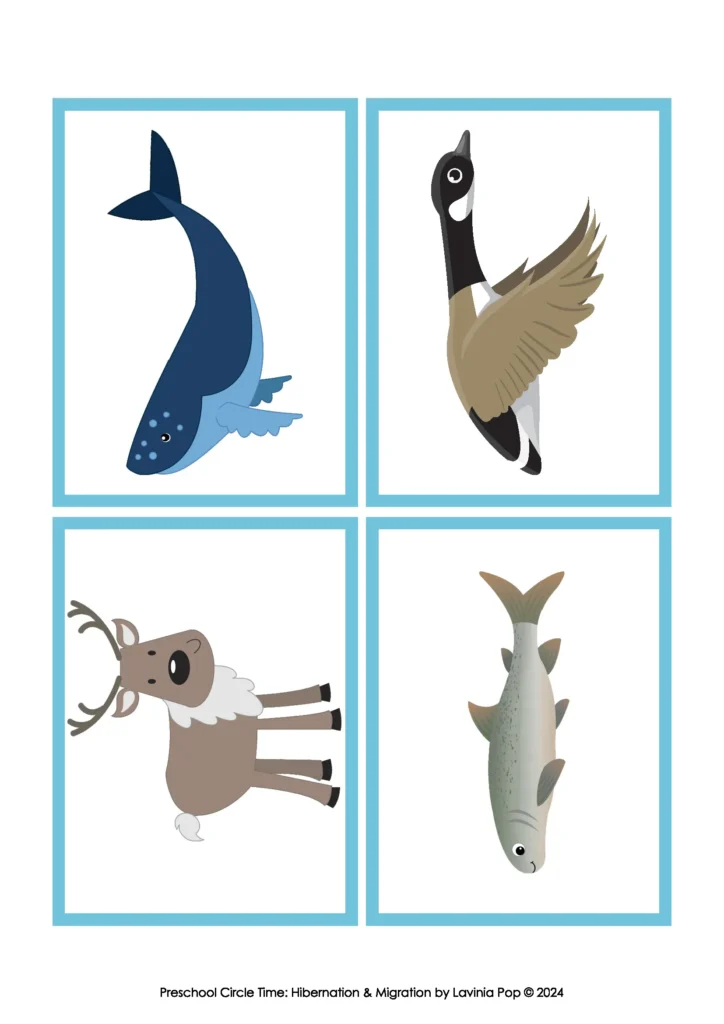
The migration flipbook introduces salmon, geese, monarch butterflies, whales, and caribou. Children color and cut the pieces, then help attach them to the sentence strip.
Turn one flap at a time and name the animal. Ask children to recall how it travels and something they have learned about its journey.
Use the flipbook as a shared reading activity or send it home so children can talk about the animal pictures with their families.
Day 5 — Hibernation and Migration Sorting Activities
Finish the week with Animals in Winter by Henrietta Bancroft and Richard G. Van Gelder. Revisit the two song verses and ask children what they remember about each animal’s winter behavior.
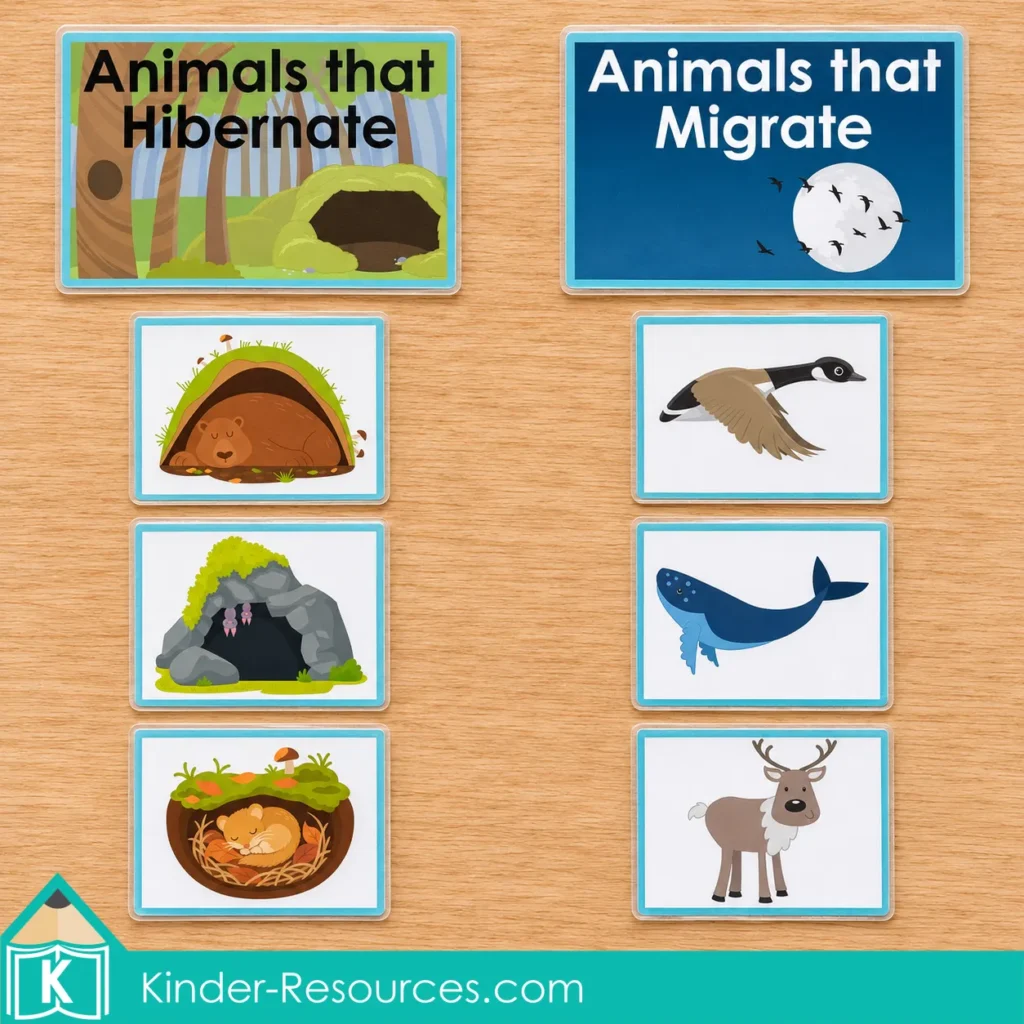
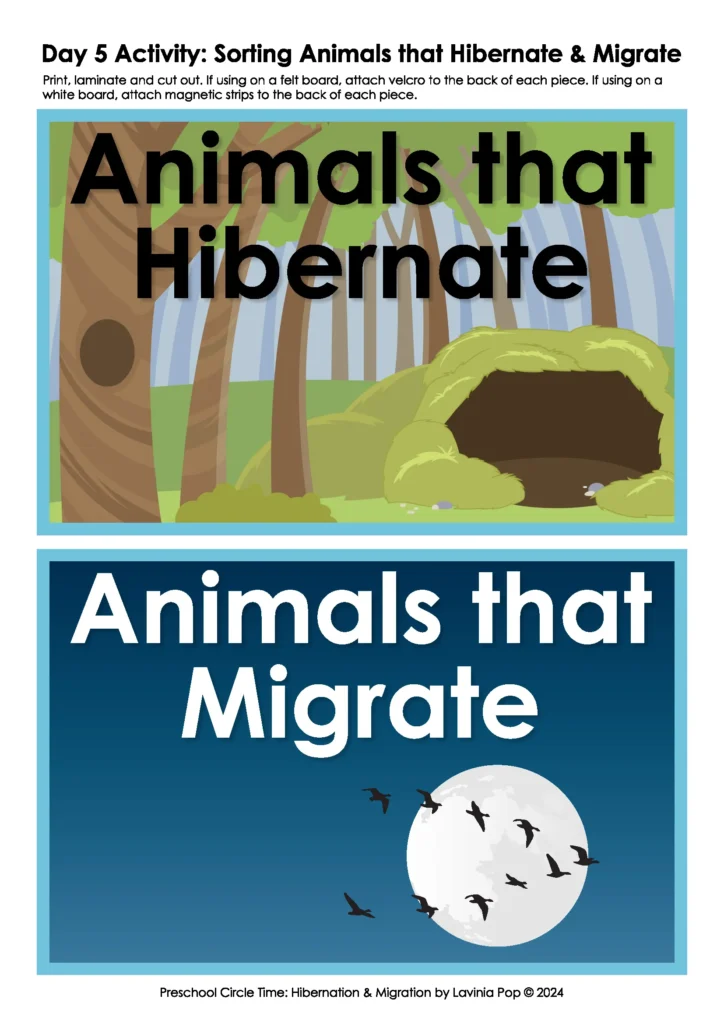
Place the Animals That Hibernate and Animals That Migrate headers where everyone can see them. Model one choice, then invite children to take turns placing a card and explaining their thinking.
Begin with a few familiar examples, such as a bear and a goose. Add more cards when children are ready. If someone is unsure, return to a poster or book and look for information together.
For small groups, offer the Sorting Animals That Hibernate and Migrate worksheet. Children can move the pieces around and discuss their choices before pasting them.
More Hibernation and Migration Activities Through Play
Extend your hibernation and migration activities with simple pretend play, model shelters, and observations of birds near you.
Build a Model Den
Offer blocks, cardboard tubes, fabric pieces, and toy animals. Invite children to build a shelter with an entrance large enough for their animal.
Ask, “Can your animal fit inside?” or “What could help the roof stay up?” Children can rebuild, compare designs, and explain what they changed.
Make a Pretend Migration Route
Place paper destination markers around the room. Children move a bird puppet between them, stopping at places labeled with pictures for food and rest.
Add a simple challenge: one rest stop is unavailable. Invite children to plan another route. This gives them a playful reason to talk about what an animal needs during a journey.
Observe Birds Near You
Watch from a window or take a short outdoor walk. Notice the birds’ size, colors, movements, and locations. Children can draw a bird or dictate an observation for a class notebook.
Return to the same place on another day and compare what you notice. Seeing a bird once does not tell you whether it migrates, so use a local bird guide when questions arise.
Look at a Real Migration Map
Choose one animal and show a simple map or photograph of its journey. Journey North’s Monarchs for Kids resources include visual material you can preview and adapt for a brief discussion. archive.journeynorth.org
Keep the task concrete: point to the starting place, follow a route with a finger, and find the destination.
Adapting Hibernation and Migration Activities for Different Learners
- Offer several ways to respond. Children can speak, point, move a puppet, or choose a picture.
- Reduce the number of pieces. Begin sorting with two or four familiar animals.
- Separate the skills. Precut pieces when you want children to focus on matching, counting, or explaining.
- Leave room for children’s choices. Crafts can have different colors, arrangements, and details.
- Repeat useful words. Use den, shelter, journey, hibernate, and migrate during stories and play.
Tip: Record a child’s explanation before and after an activity. A drawing and a short dictated sentence can show how their ideas are developing. NAEYC recommends giving children ways to record observations, including drawings and descriptions. (NAEYC)
Questions About Teaching Hibernation and Migration
Is hibernation the same as an ordinary nap?
It is a helpful starting comparison, but hibernation involves changes in how an animal’s body works. For preschoolers, emphasize that the body slows down and uses less energy.
Do all birds fly south for winter?
No. Some birds stay in the same area, and migration routes vary. Use the bird song as one example, then connect your discussion with the animals and seasons where you live.
Do we have to complete every worksheet?
No. Choose the pages that support your goals. The stories, songs, materials, and conversations can be the main experience, with selected printables offered later.
Can we use this theme without snow?
Yes. Focus on seasonal changes children can observe, such as different birds visiting, cooler mornings, or changes in plants and available food. The snowy crafts introduce environments that may be different from your own.
Get the Complete Hibernation and Migration Circle Time Packet
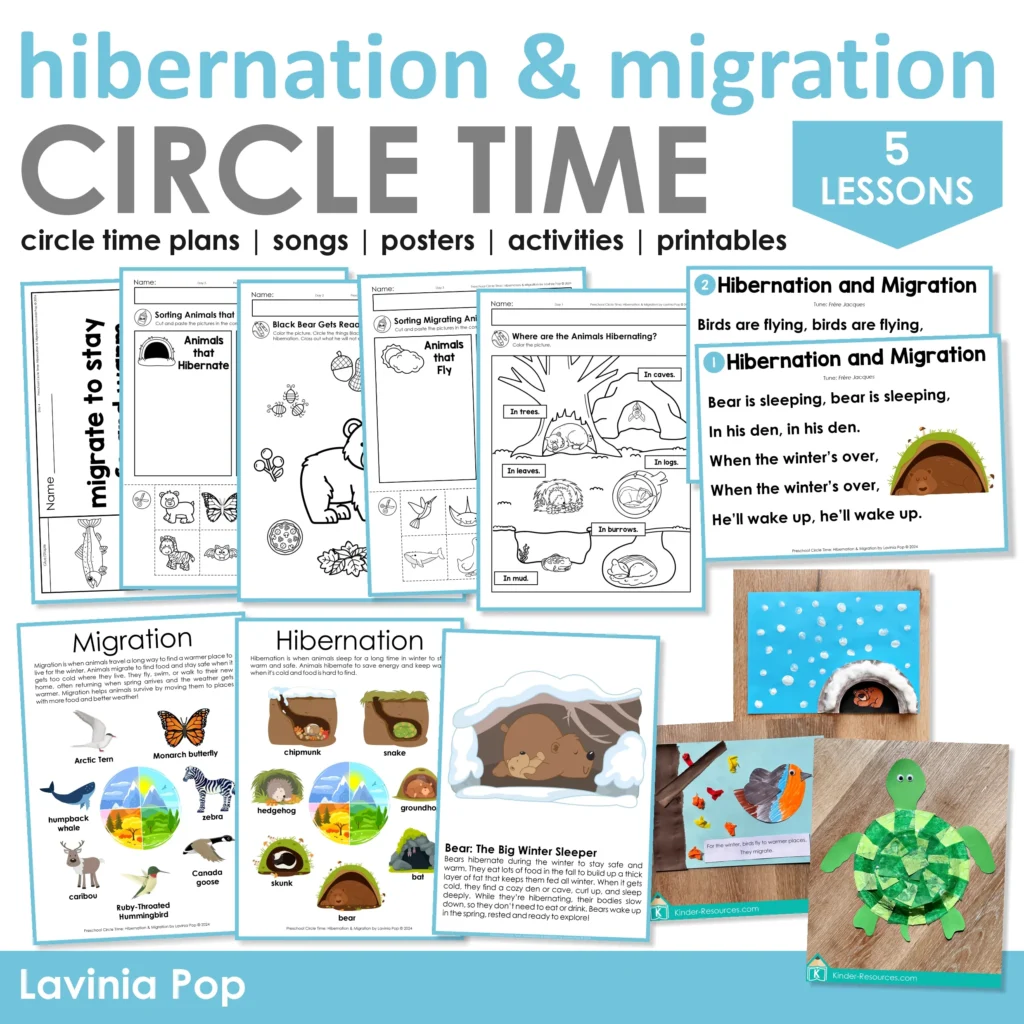
The printable resource brings together:
- A weekly overview and five daily circle time plans
- Suggested read alouds and discussion prompts
- A complete song poster, two verse cards, and bear and goose props
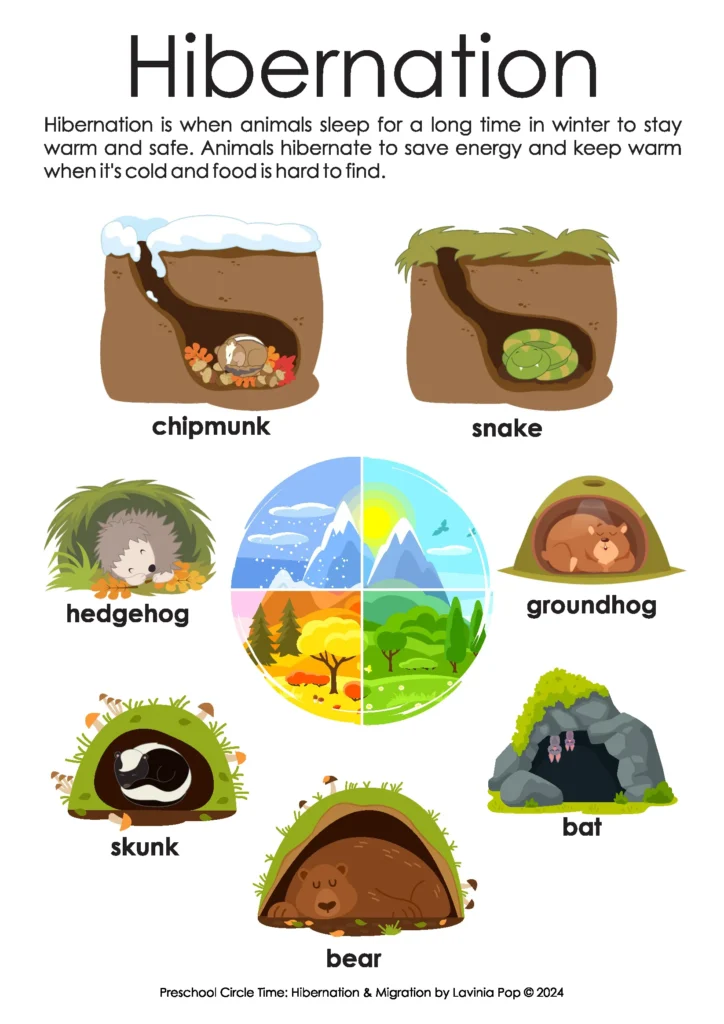
- Hibernation, migration, and individual animal information posters
- Bear cave, sea turtle, and migration bird craft templates
- Animal Bedding Investigation directions
- Hibernation and migration flipbooks
- Matching, tracing, sorting, and butterfly number activities
- Reusable animal sorting headers and picture cards
The resource combines color teaching visuals with black and white versions of the child activity pages for coloring and completing.
Choose a few hibernation and migration activities for preschool centers, or use the five-day plan to connect your stories, songs, science conversations, and creative work.

Happy Teaching! 😊
You Might Also Like