volved in picking them and making apple pie. It also provides a familiar setting for counting, matching letters, building patterns, and practicing with little hands.
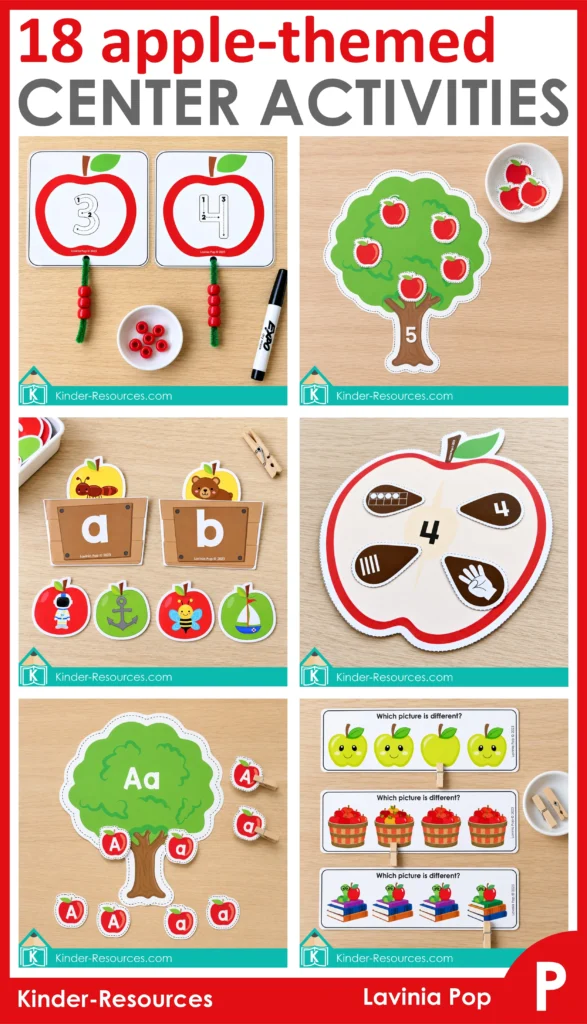
These apple centers for preschool bring those experiences together through printable activities you can use in morning tubs, small groups, learning centers, or at home. The collection includes 18 activities, giving you options for children who are beginning to match and sort as well as those who are ready for letter sounds, number representations, and word building.
You can download the free apple center sample pages to try a few activities with your group. The complete packet is linked at the end of this post.

Getting Your Apple Centers Ready
Choose a few activities that match the skills your children are practicing. A fine motor mat, a letter matching activity, and a counting tray make a manageable starting point. Introduce each center together, showing children how to use the materials and where to return the pieces when they finish.
Print the pages you need, laminate the reusable mats and cards, and cut apart the activity pieces. Keep each set in its own tray, pouch, or container. Buttons, counters, clothespins, play dough, magnetic letters, and dry erase markers give you plenty of ways to use the printables with supplies you already have.
You can adjust the activities for preschool, Pre K, TK, and kindergarten by changing the number of choices, the materials provided, and the amount of support you offer.
Apple Fine Motor Activities and Prewriting
Apple Fine Motor Practice Mats
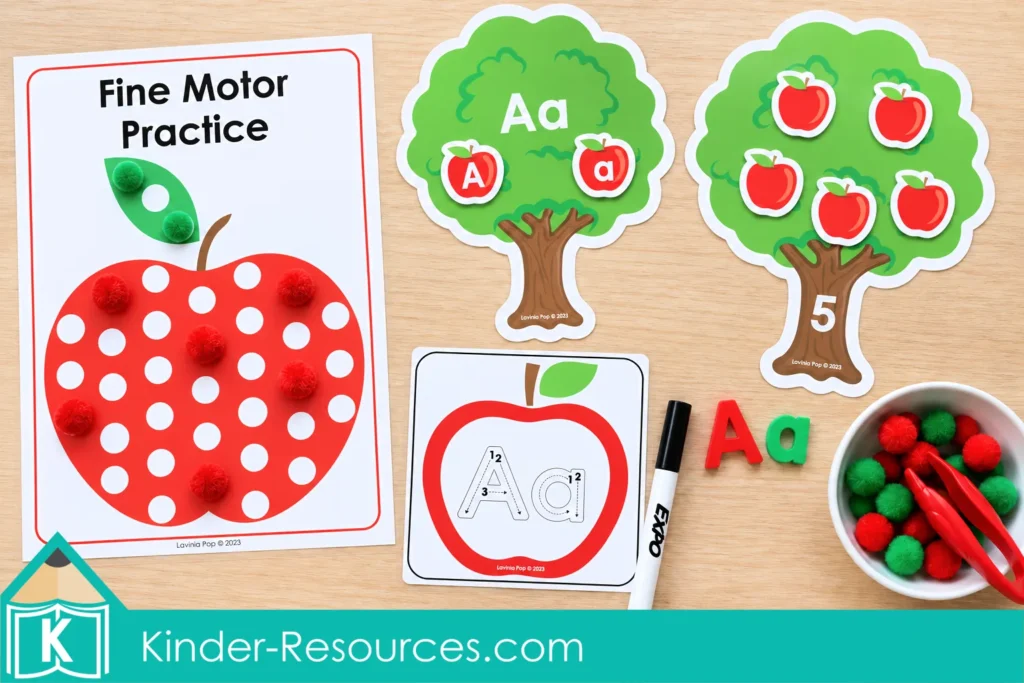
The fine motor mats invite children to choose a small object and place it on a circle. Red counters can fill the apple, green pieces can cover its leaf, and colored buttons can complete the girl’s hair, dress, and basket.
Offer one color at a time or let children match their pieces to the colors in the picture. A small dish beside the mat keeps supplies within reach. Children can place the pieces by hand, or use tweezers to transfer pom poms when they are ready for another challenge.
The five mats give you different pictures to rotate through while keeping the activity familiar.
Apple Prewriting Tracing Cards
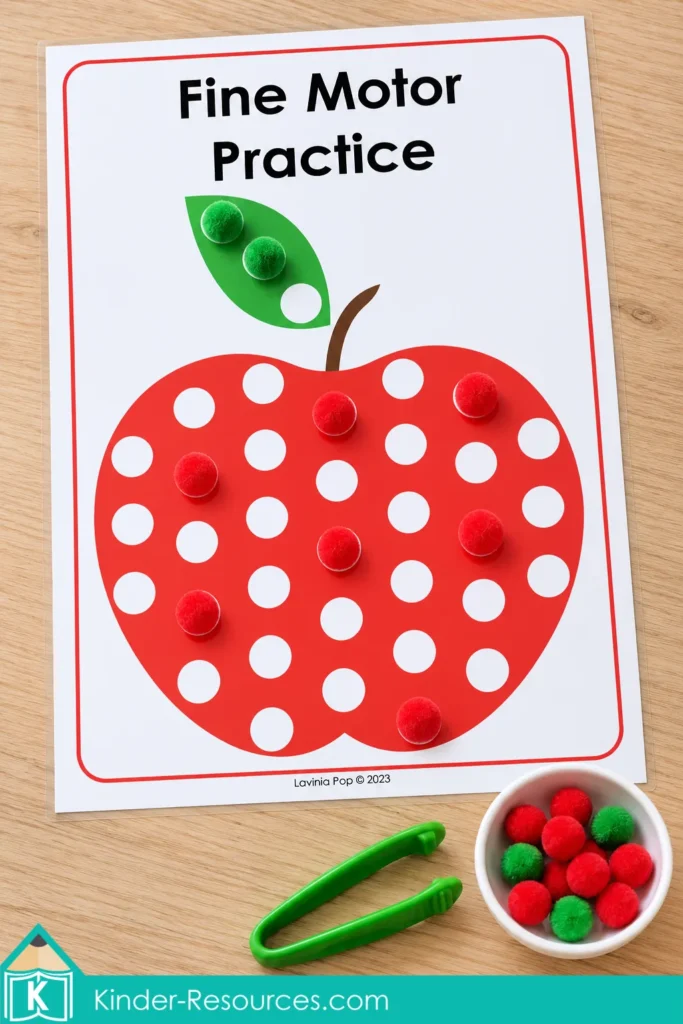
The prewriting cards introduce paths such as curves, loops, and zigzags. Children begin at the apple on the left and follow the path across the card.
Try tracing a path with a finger before introducing a dry erase marker. Yarn or soft play dough ropes provide another way to explore the lines. Offer a few cards at a time, then change the selection as children become comfortable with the movements.
Apple Literacy Centers
Alphabet Tracing Cards
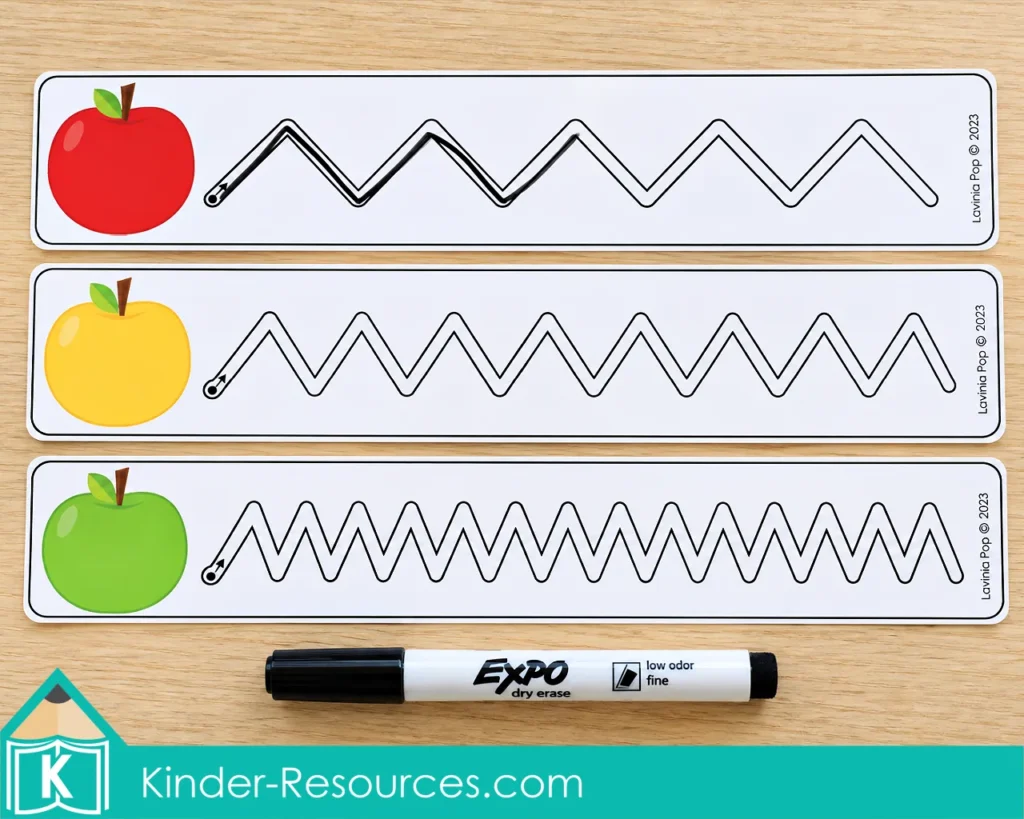
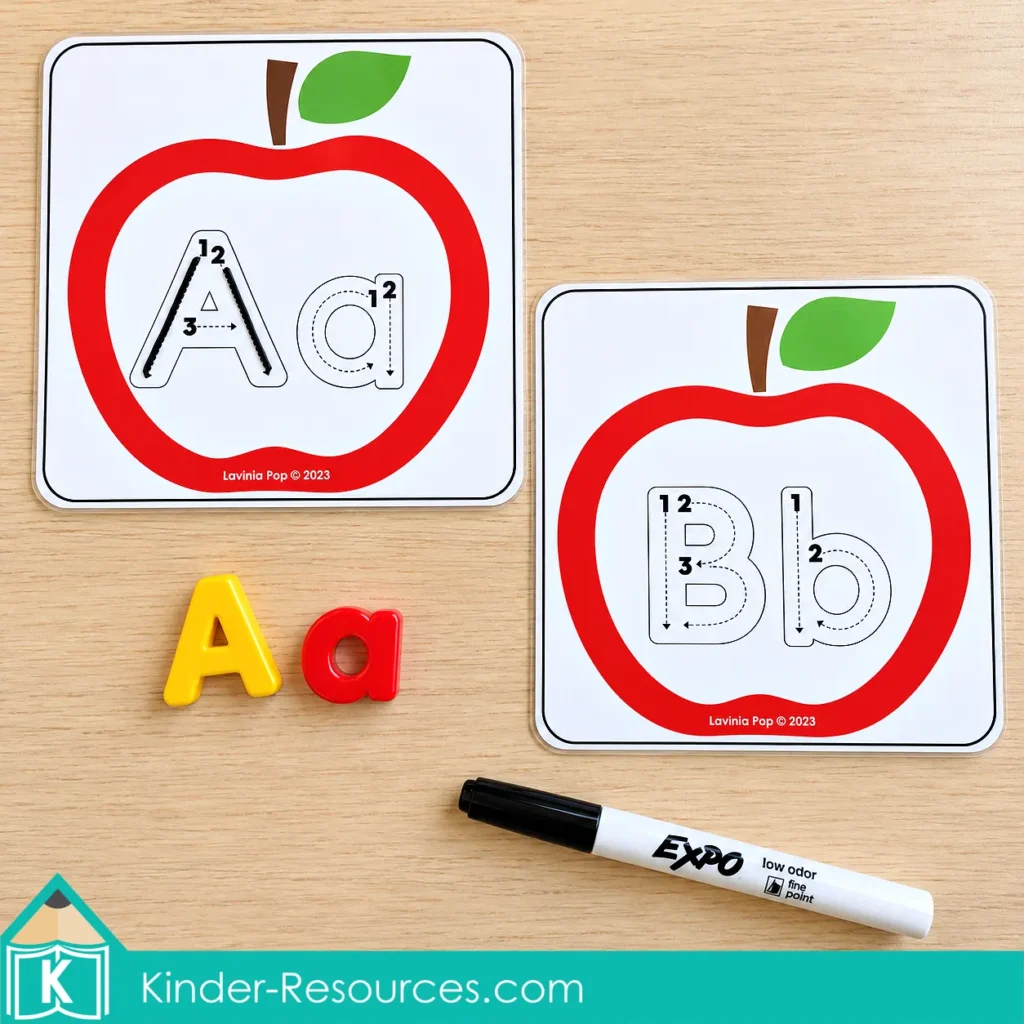
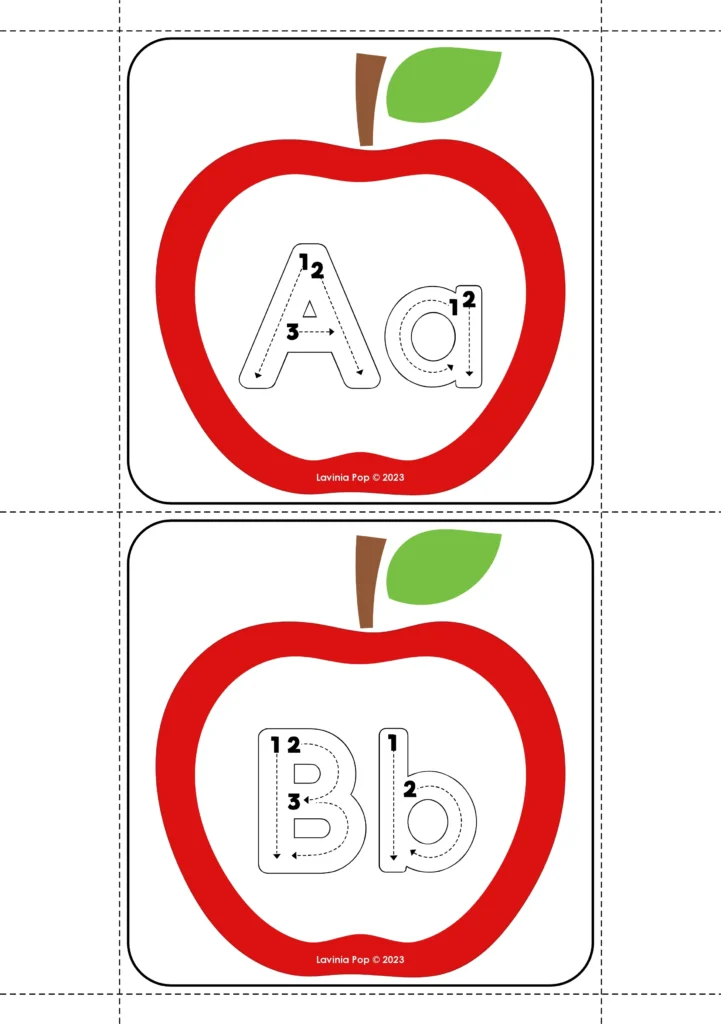
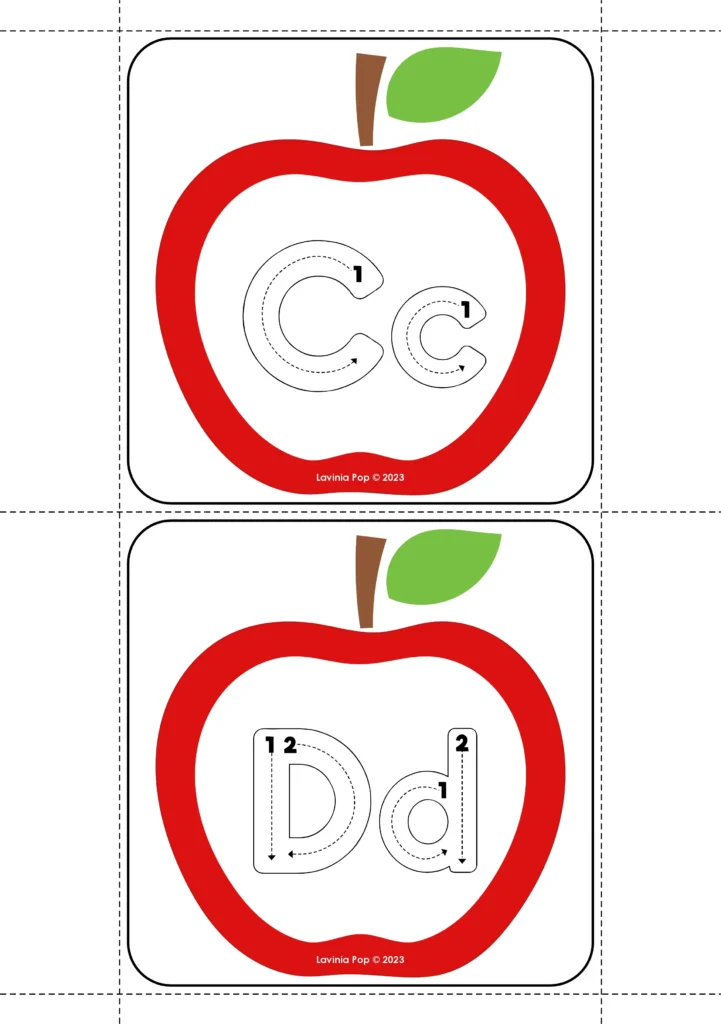
The alphabet tracing cards show uppercase and lowercase letters inside an apple, with printed guides for letter formation.
Choose letters your children are learning and model where to start. Children can follow the guides with a finger, then trace with a dry erase marker. Keep the selection small so they can concentrate on the letters you have introduced.
You can also place a matching magnetic letter beside a card and invite children to compare the two versions.
Uppercase and Lowercase Apple Tree Matching
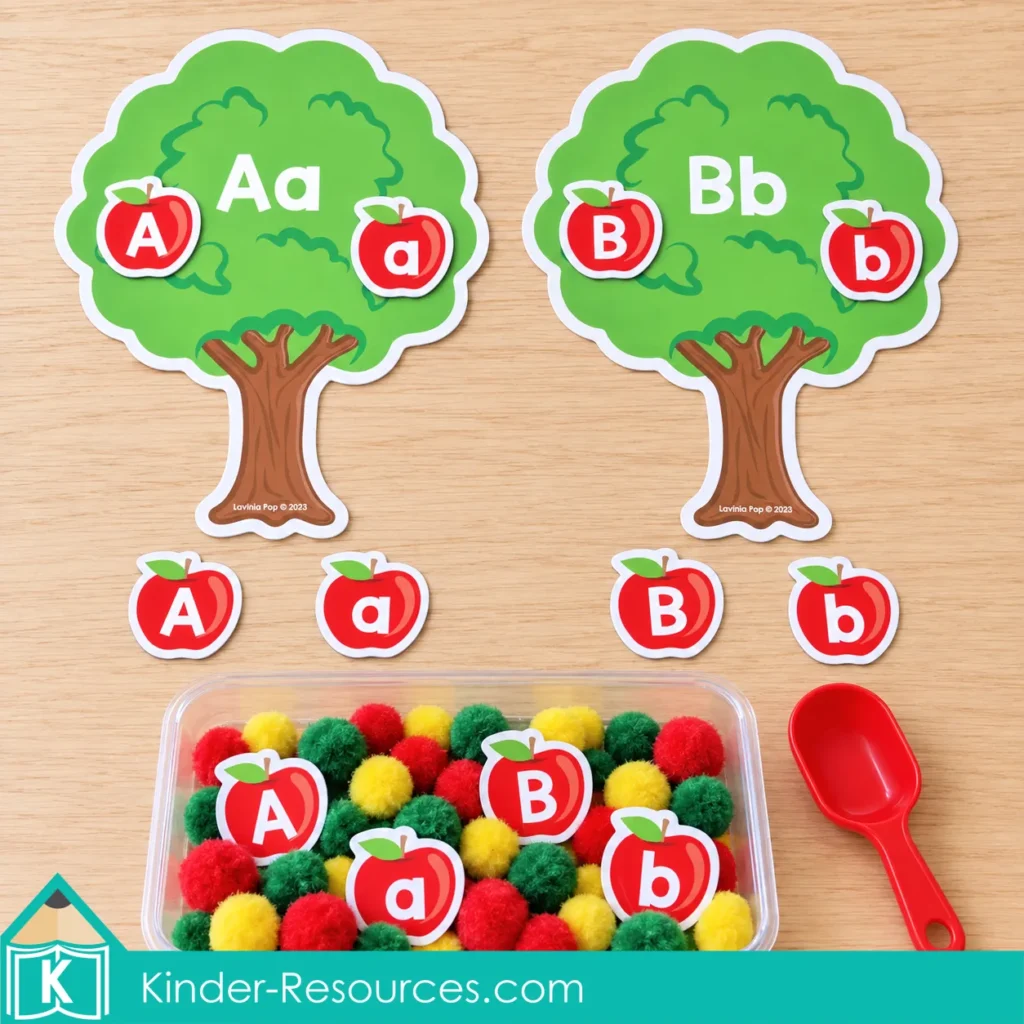
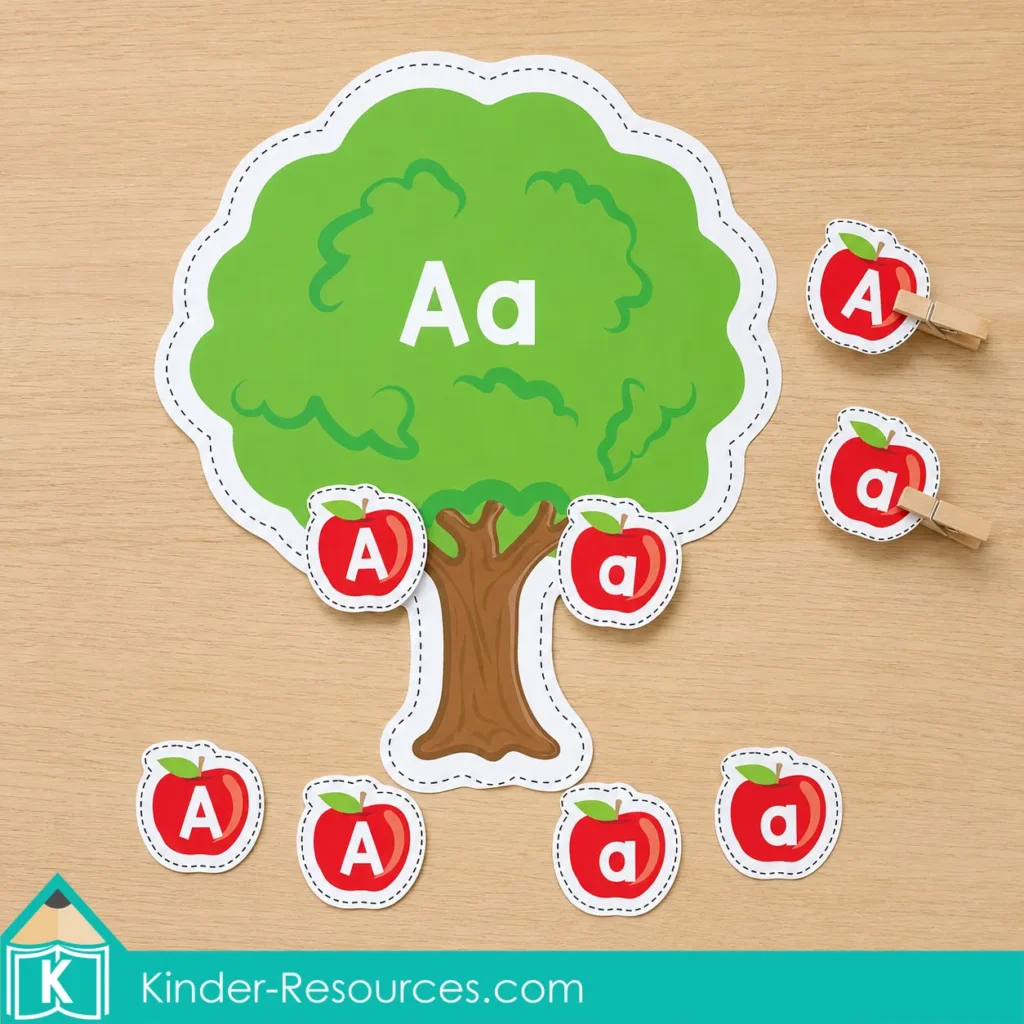
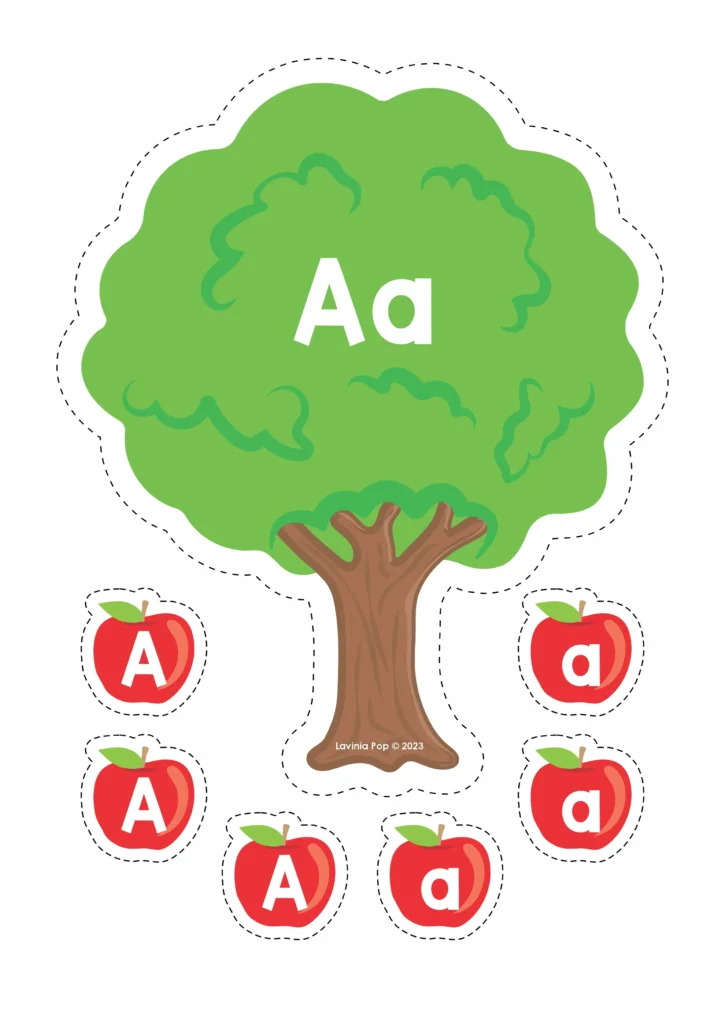
The apple tree matching activity gives children a place to collect uppercase and lowercase versions of each letter.
Begin with two familiar trees and their matching apple pieces. As children gain confidence, introduce more letters and ask them to explain how they decided where an apple belongs.
For a sensory extension, place the letter apples in a shallow bin of shredded paper or pom poms. Children find an apple, identify its letter, and carry it to the matching tree. Keep the trees beside the bin so the matching task remains clear.
Beginning Sounds Apple Crates
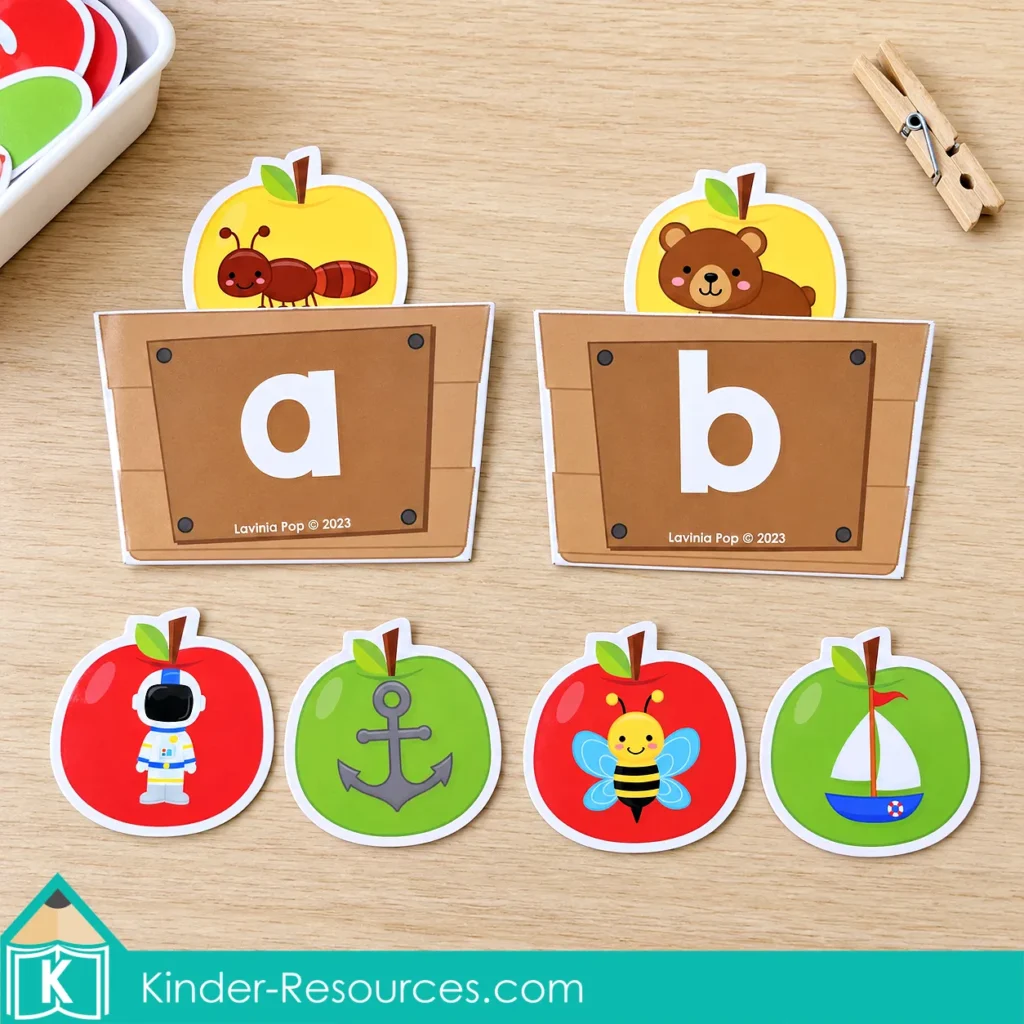
The beginning sounds activity turns picture sorting into a little apple collecting job. Children name the picture on an apple, listen to its first sound, and place it in the corresponding letter crate.
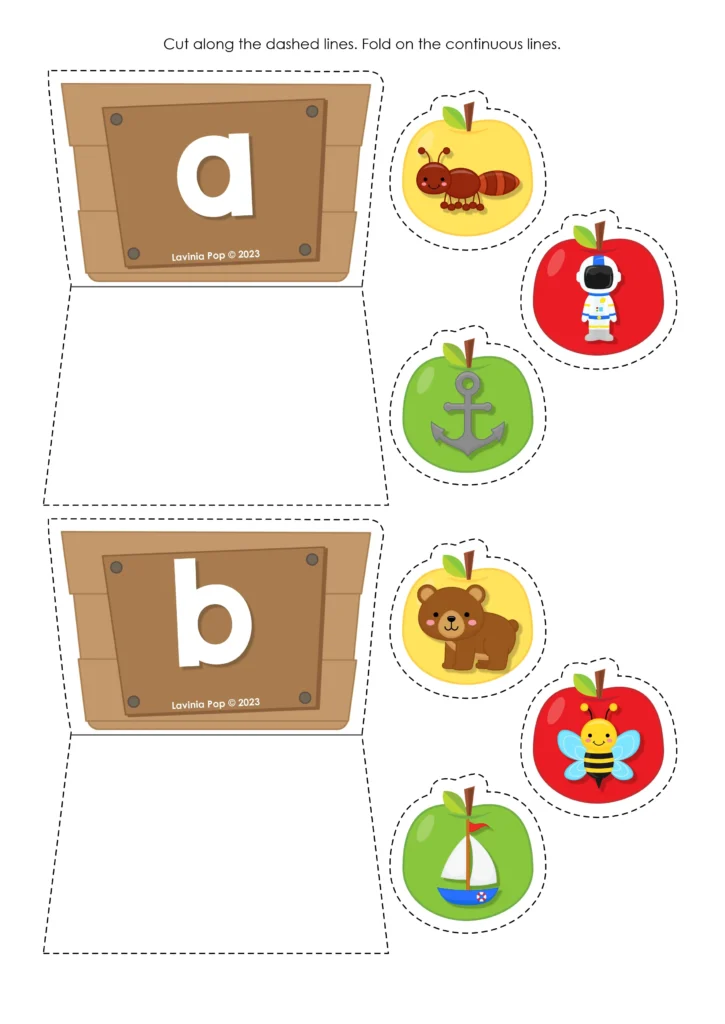
For example, the bee, boat, and bear belong in the b crate. Say the picture names together before children begin sorting so you can introduce unfamiliar vocabulary and model listening for the first sound.
Prepare the paper crates by following the printed cutting and folding guides and securing the sides, leaving the tops open. Start with a couple of crates and their picture apples, then add more letters when children are ready.
Apple Rhyming Match
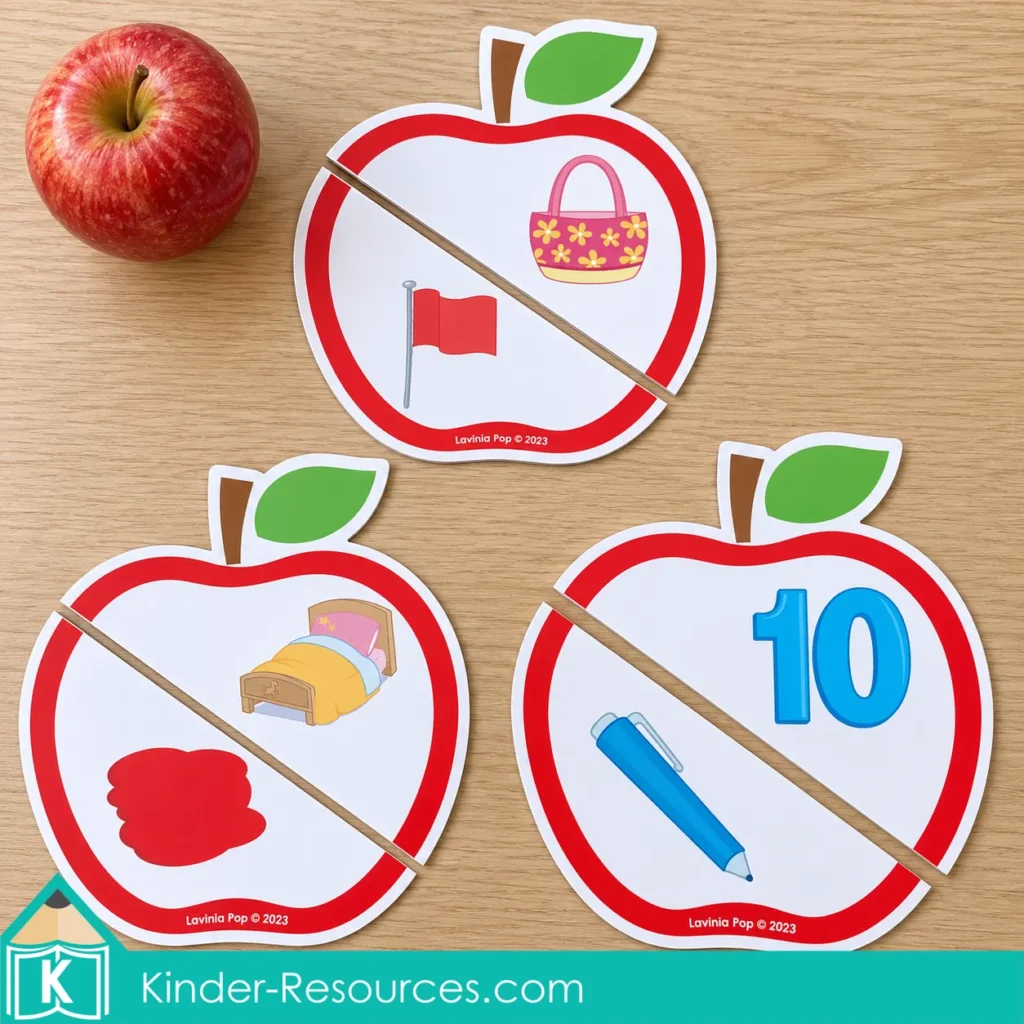
The rhyming pictures provide a listening activity that children can enjoy without reading the words.
Say the picture names aloud and invite children to find a pair with matching endings, such as bag and flag. Spread a few pairs face up to begin with and say the words again as children compare their choices.
Working with a small selection gives children time to listen closely before you introduce more pairs.
Apple Sight Word Building
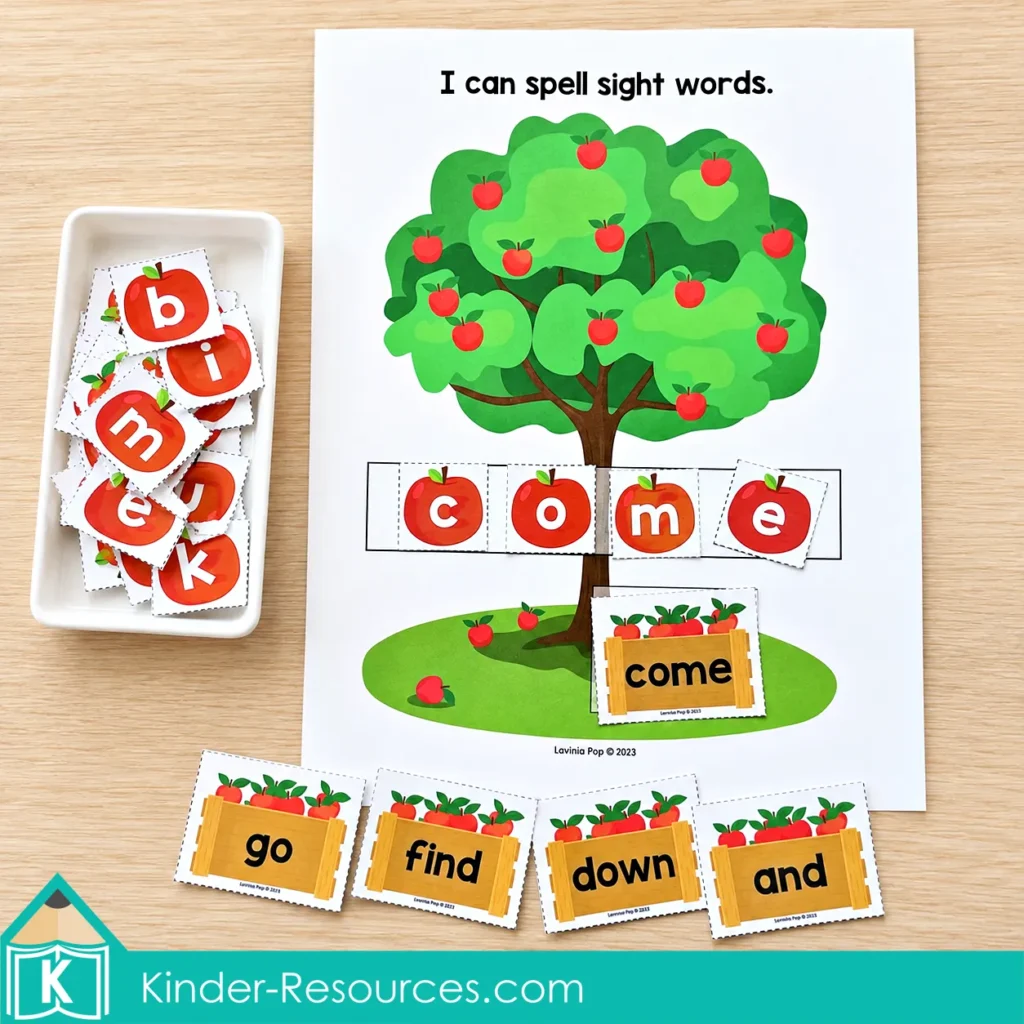
For children who are ready to build familiar words, the sight word tree provides a place to arrange the apple letter tiles.
Choose a word card, read it together, and build the word across the mat. For example, children can arrange c, o, m, and e to match the word come. Point to the letters in order and compare the completed word with the model.
Choose words you have already introduced and use this activity alongside your reading instruction. Discuss the sounds and spellings children know, and read the finished word together. Magnetic letters provide another way to build the same words.
Apple Math Centers
Apple Number Tracing Cards
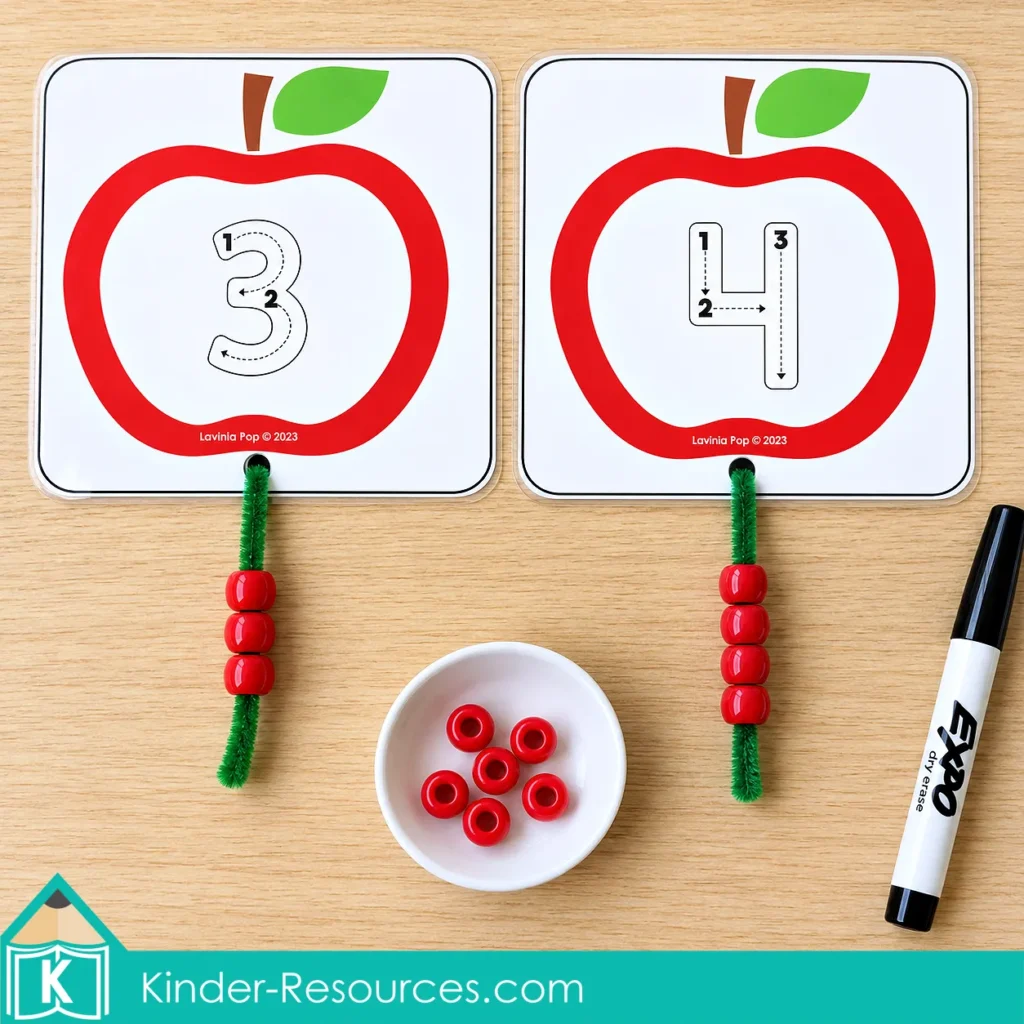
The number tracing cards give children practice forming the numerals from 1 to 10. Model the starting point and direction, then invite children to follow the printed guides.
Place a matching collection of counters beside a card so children can connect the numeral with its quantity.
You can also prepare a counting version by punching a hole beneath the numeral and attaching a pipe cleaner. Children thread on the matching number of beads, counting each bead as they add it.
Apple Tree Counting
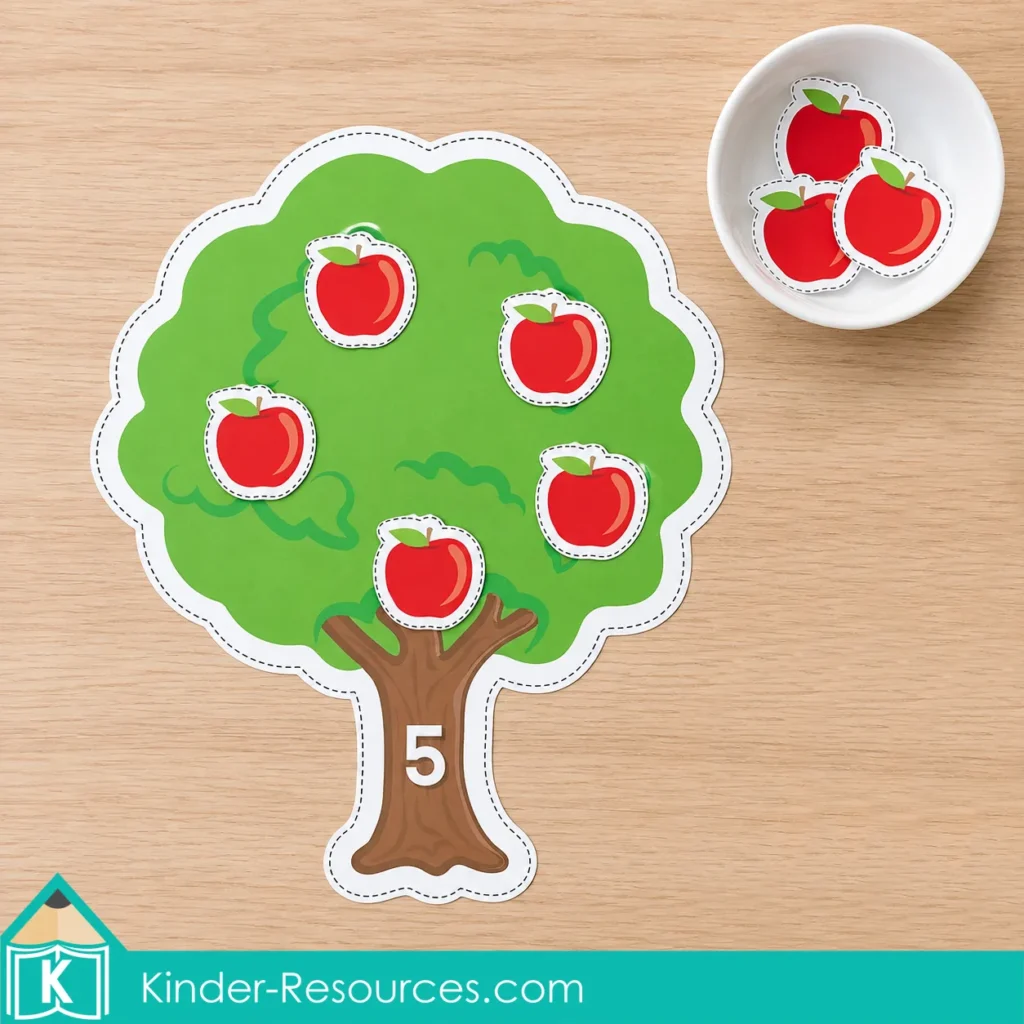
The apple tree counting mats connect a written number with a collection children can make themselves.
Read the number on a tree and add that many printable apples. Encourage children to touch or move each apple as they count, then check how many apples are on the tree altogether.
Begin with the numbers your group is practicing, perhaps 1 to 3 or 1 to 5, before introducing more of the mats up to 10. Red pom poms, apple counters, or small play dough apples can replace the printable pieces when you want to vary the materials.
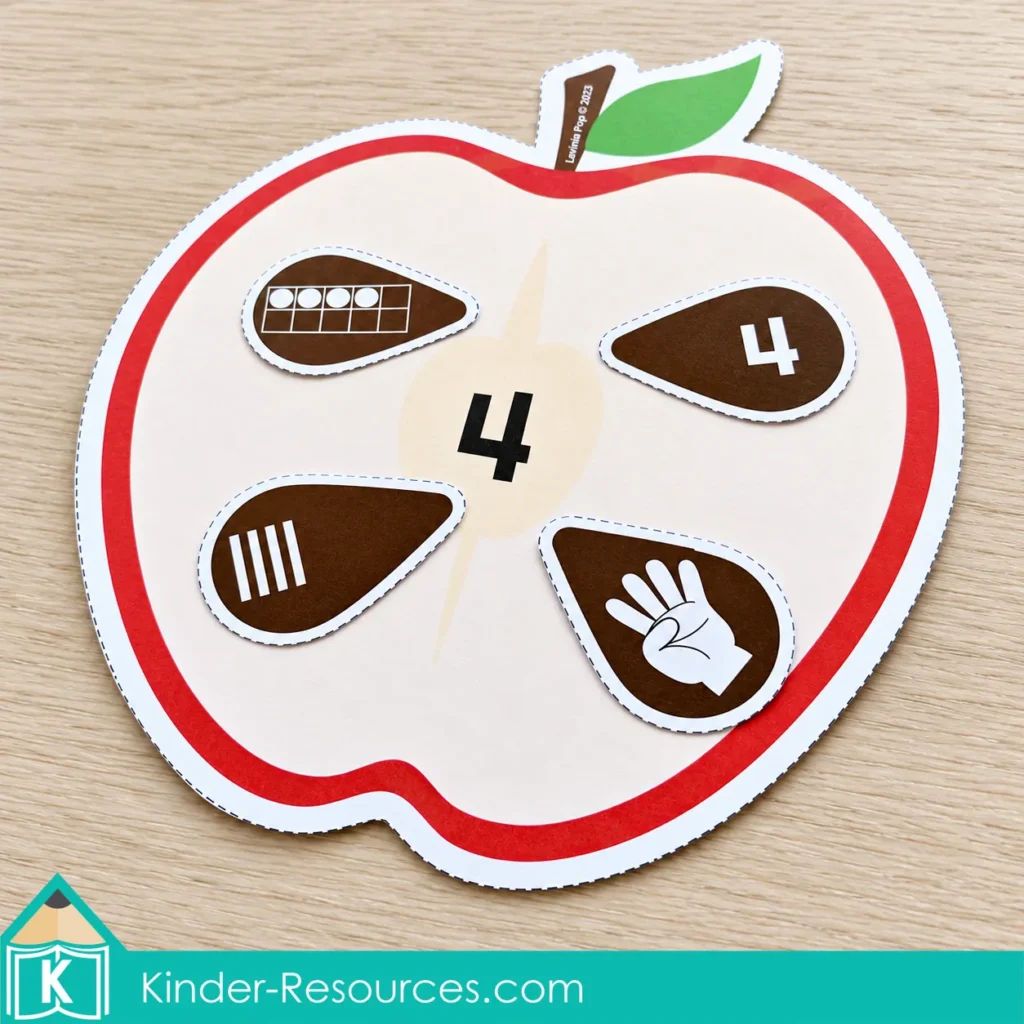
Apple Seed Number Sense Matching
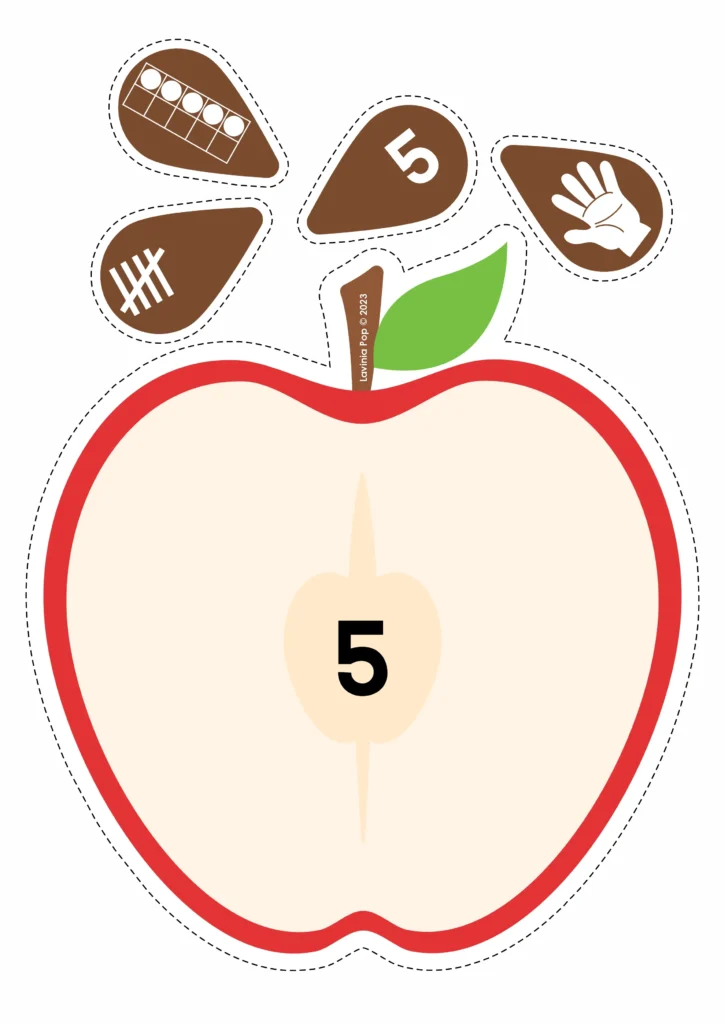
The apple seed activity shows that the same number can be represented in different ways.
Children find the seed pieces that match the number on an apple, including a numeral, a ten frame, tally marks, and a finger representation. On the number 4 mat, each matching seed represents four.
Ask children how they know a seed belongs on a particular apple. They can count the dots, examine the tally marks, or use counters to check a quantity. Start with two apple mats and a small selection of seeds, then add more numbers as the activity becomes familiar.
Ordering Apples from Smallest to Biggest
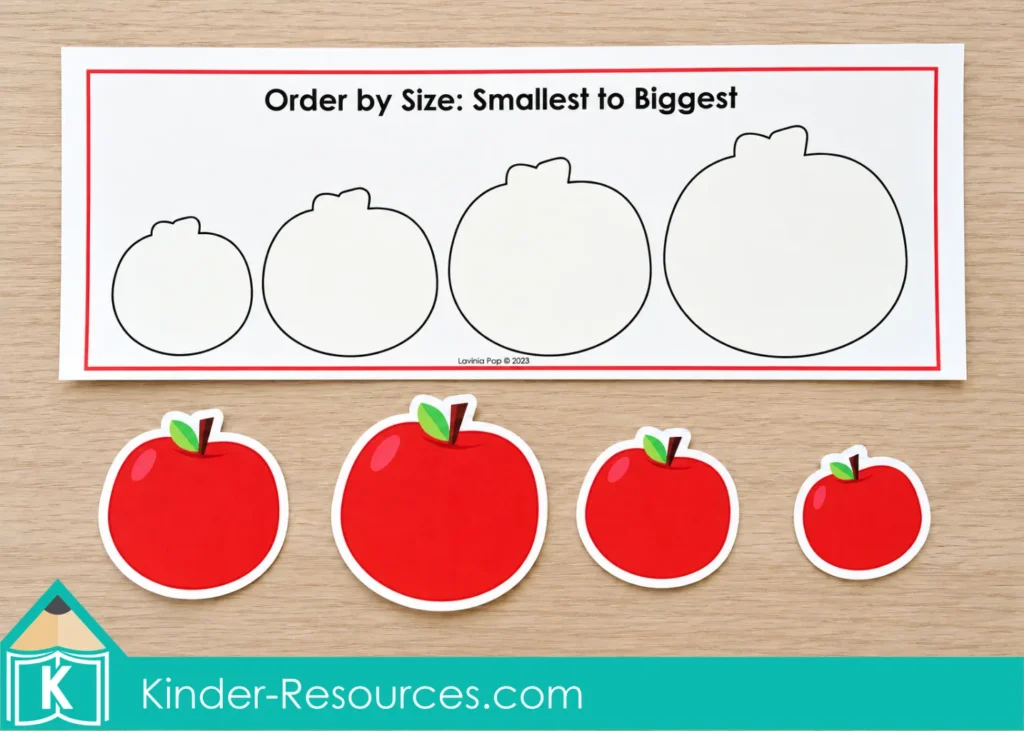
This activity invites children to compare four apples and arrange them from smallest to biggest.
The mat with outlines gives children a guide for checking where each piece fits. Once they are comfortable with that version, offer the mat without outlines so they can make the comparisons themselves.
Talk about the pieces as children move them. Which apple is smaller than this one? Which is the biggest? Placing two apples beside each other gives children something concrete to compare.
Apple Shape Sorting
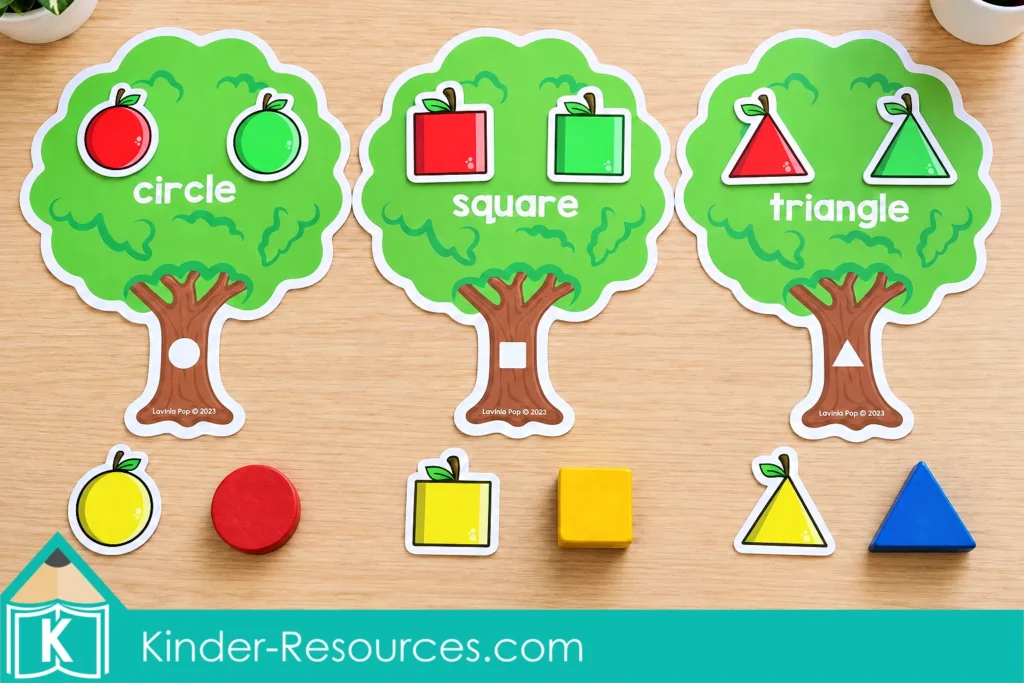
The shape trees encourage children to focus on shape while other features change.
On the triangle tree, red, yellow, and green apple pieces all belong because they are triangles. Children can compare the pieces, talk about their sides and corners, and match them to the corresponding tree.
Begin with a few shapes and introduce more as children learn the activity. To extend the sorting, invite children to find classroom objects with a matching shape, such as a circular counter or a triangular pattern block.
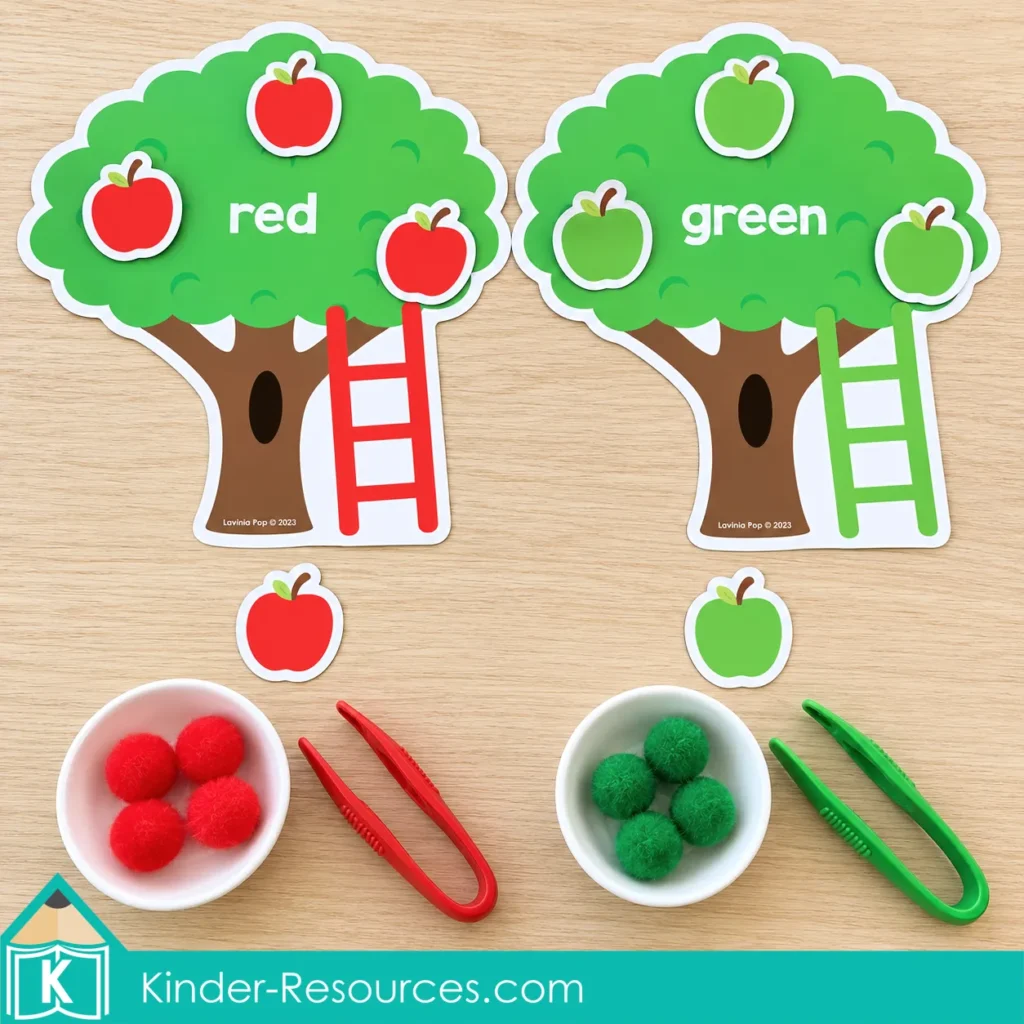
Apple Color Sorting
The color sorting trees give children another way to organize the apple pieces.
Start with a few contrasting colors and place the matching trees where children can see them easily. Children choose an apple, name its color, and find the corresponding tree.
After sorting the printable pieces, offer classroom counters, blocks, or buttons in the same colors. Children can compare the new objects with the apples and add them to the matching groups.
Apple Patterns and Picture Matching
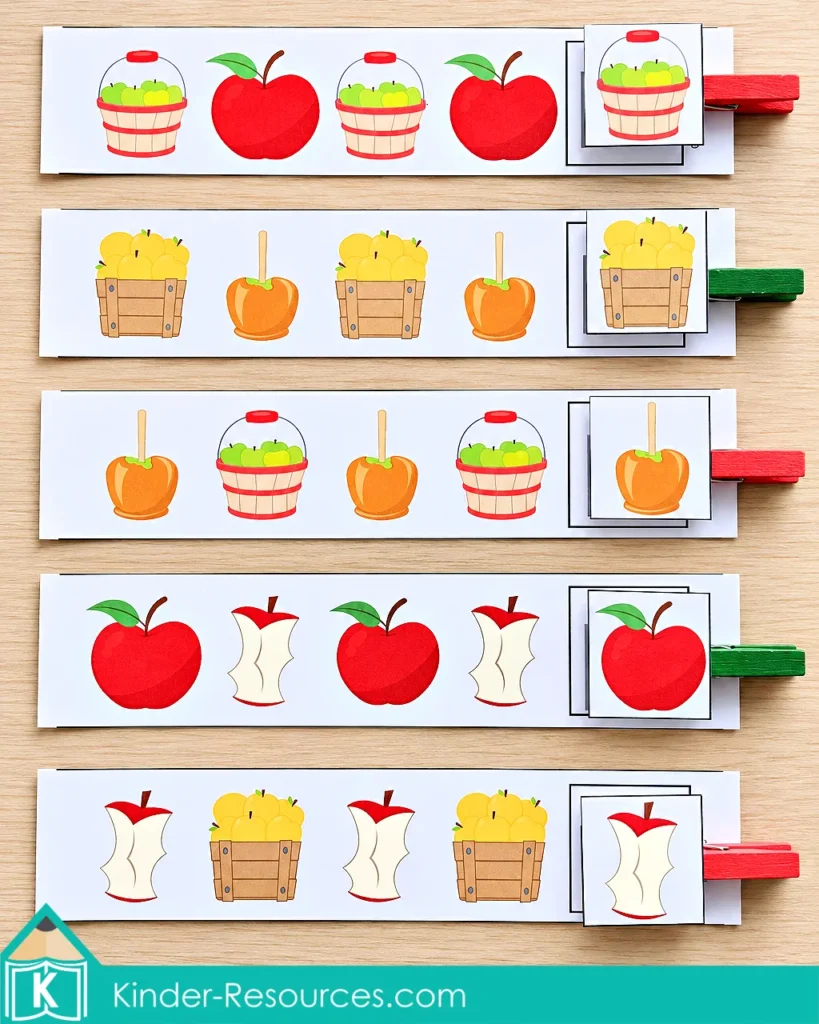
Apple AB Patterns
The AB pattern strips show two pictures taking turns.
Say the pattern aloud together, such as apple, core, apple, core, and pause before the empty space. Children choose the picture that comes next and clip it to the strip.
Once children understand the repeating pair, invite them to make an AB pattern with two colors of counters or blocks. They can point to each object as they say the pattern and check that it continues in the same order.
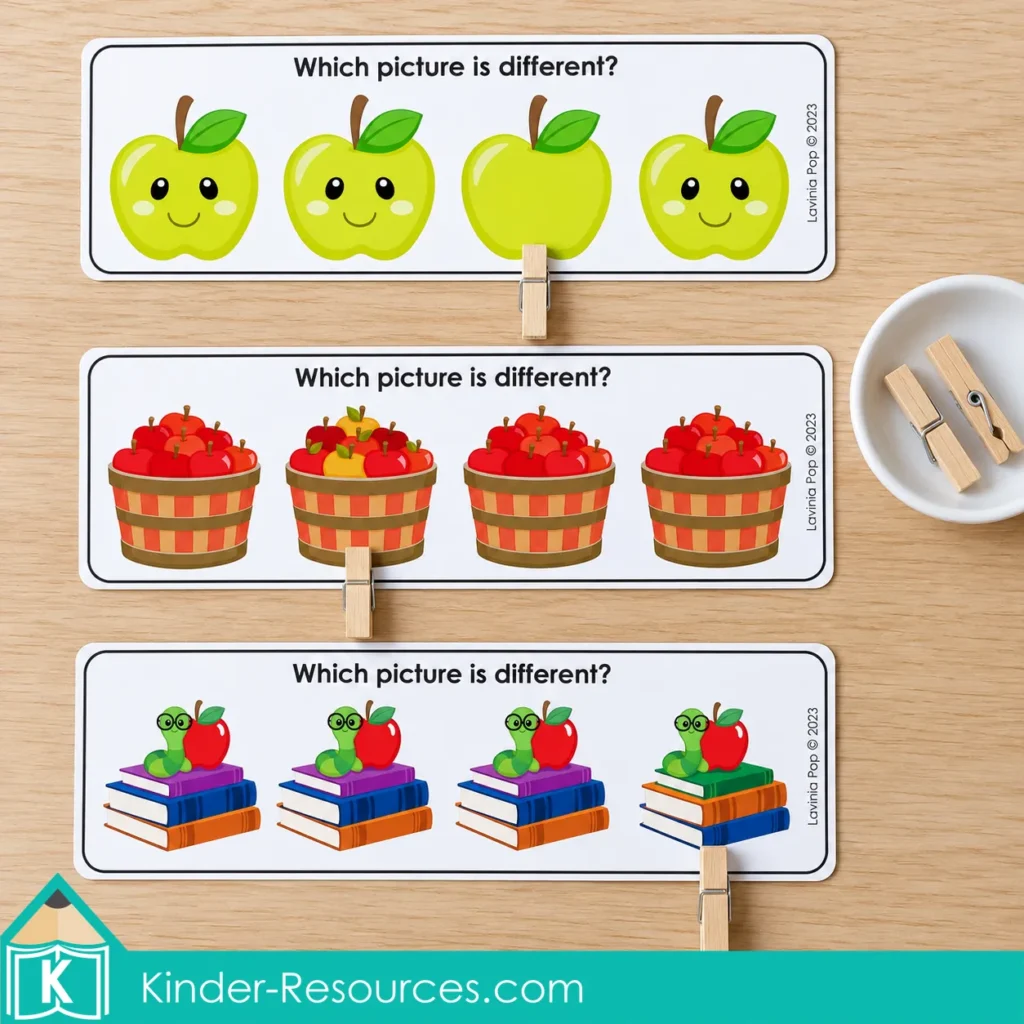
Which Picture Is Different?
These cards encourage children to look closely at similar pictures and find the detail that has changed.
They might notice an apple without a face, a tree without apples, or different colors in a stack of books. Children can point to their choice or mark it with a clothespin.
Ask them to explain what they noticed. Their description gives you a chance to hear how they are comparing the pictures.
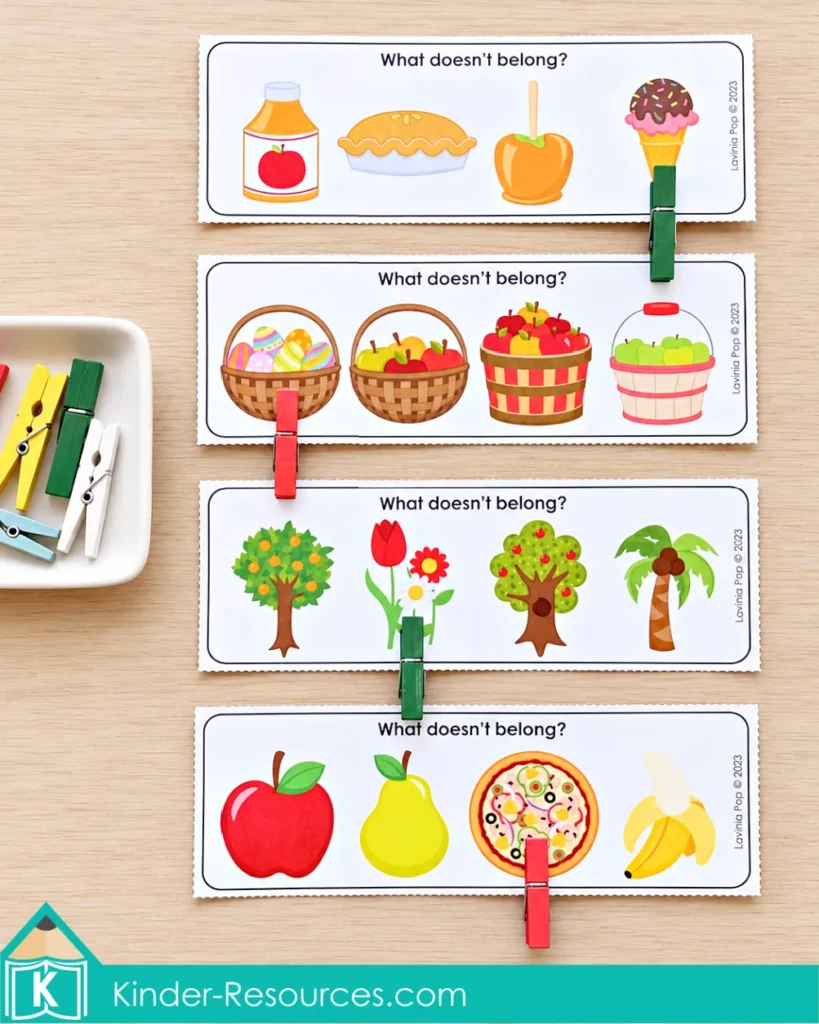
What Doesn’t Belong?
What Doesn’t Belong? asks children to think about how pictures can be grouped.
The pizza does not belong with the fruit, and the basket of Easter eggs does not belong with the apple baskets. Children choose the picture that does not fit the group and mark it with a clothespin.
Encourage children to explain their choice before clipping the answer. You can then ask them to name another item that would belong with the group.
Apple Shadow Matching
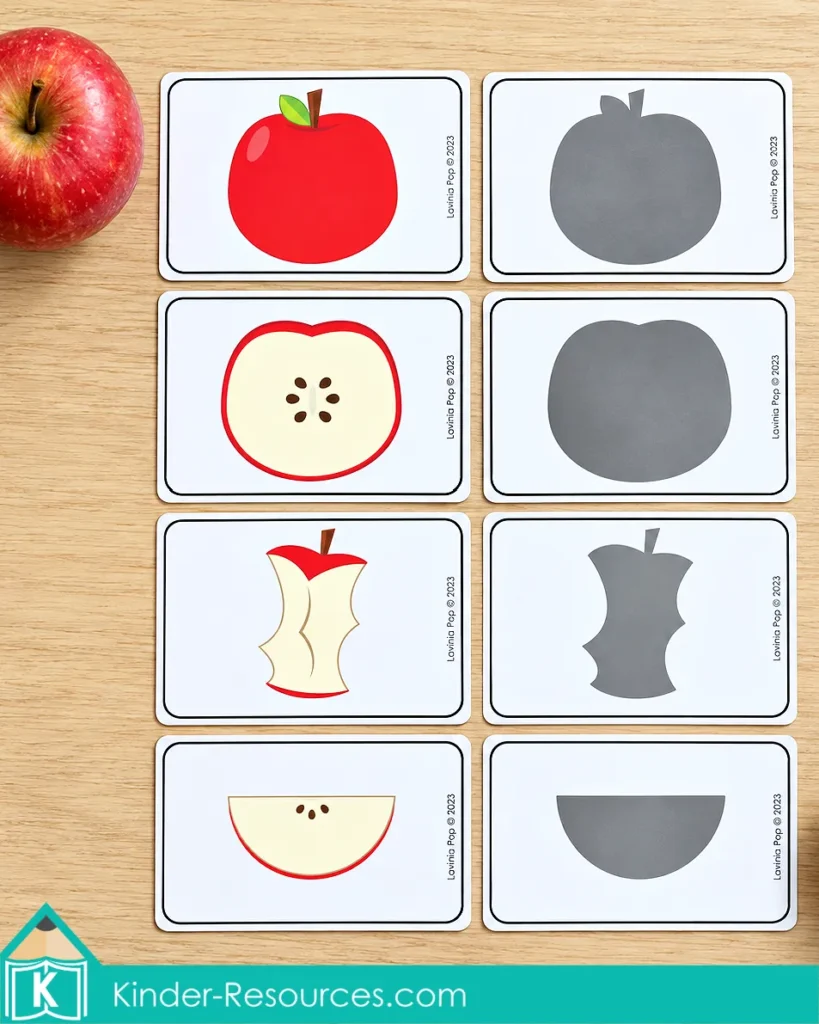
The shadow matching cards invite children to compare a picture with its silhouette.
Begin with a few pairs spread face up. Encourage children to notice the outline and any distinctive details as they look for a match.
Add more pairs when the smaller selection becomes familiar. Children can work independently or take turns finding matches with a partner.
The sequencing activities give children a chance to organize events and tell a story with pictures.
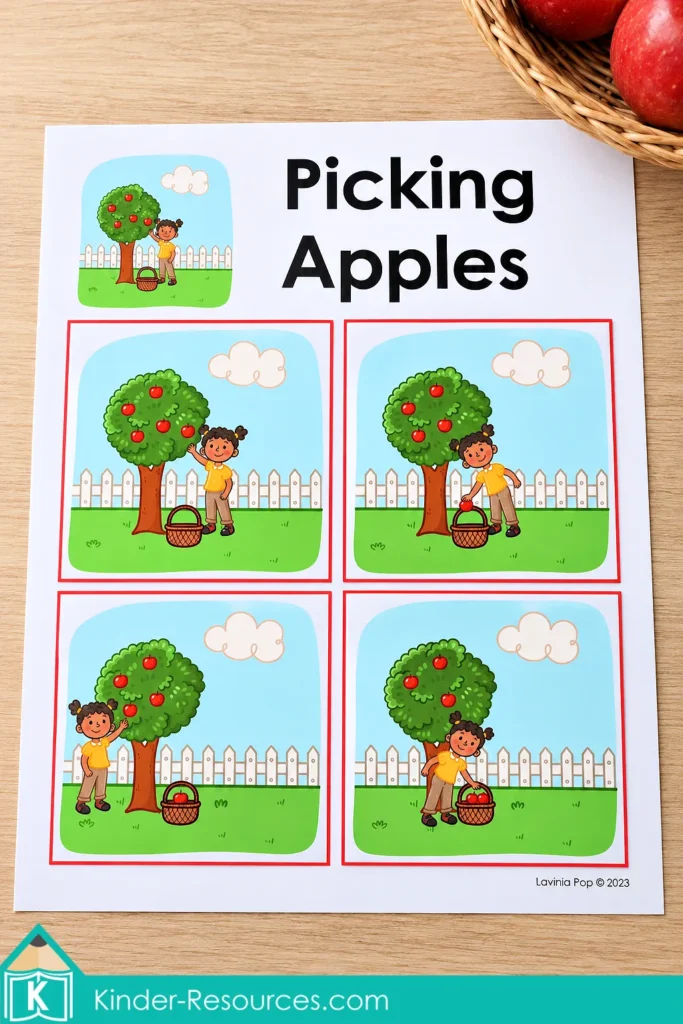
Picking Apples uses four cards, making it a useful starting point for exploring a short sequence. Look through the pictures together and talk about what is happening before arranging them on the numbered mat. You can place the first card for support and ask children to work out what comes next.
Making Apple Pie uses six cards, giving children more events to organize. Talk about gathering ingredients, preparing the apples, mixing, filling the pie, baking, and eating it. Questions such as, “What needs to happen before the pie goes in the oven?” encourage children to use the picture details to explain their thinking.
After putting the cards in order, children can retell the sequence to a partner using words such as first, next, then, and last. Acting out the steps with pretend movements gives them another way to revisit the story.
Making the Apple Centers Work for Your Group
You do not need to introduce all 18 activities at once. For an opening rotation, you might offer a button mat, two letter matching trees, and counting mats for 1 to 3.
Keep familiar activities available while you introduce a new pattern strip or beginning sound sort in a small group. Often, adjusting the number of choices is enough to change the difficulty. Fewer letters, two number mats, or a small set of shadow pairs can make an activity easier to manage.
For children who are ready for more, add choices, remove the size outlines, or ask them to explain how they checked a match. At home, one tray at a time gives you space to model the activity and join in the conversation.
Purchase the Apples Preschool Center Activities
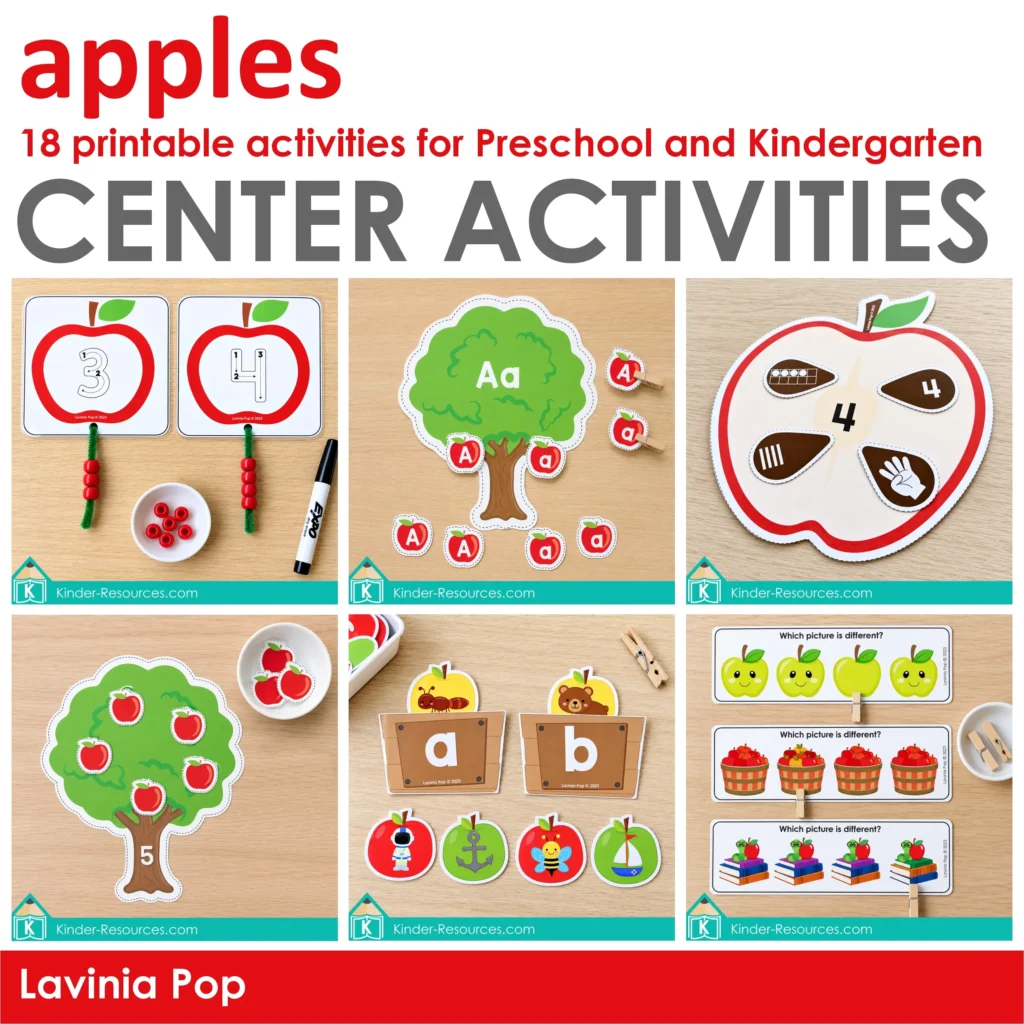
The complete Apple Centers for Preschool packet includes 18 printable activities across 142 pages, with options for fine motor practice, early literacy, counting, sorting, patterns, picture matching, and sequencing.


Happy Teaching! 😊
You might also like…
I love your activities,its amazing
Thank you so much, Hum! I’m so happy you’re enjoying the activities. Your lovely comment means a lot! 😊